Mate

The classic British drink is of course the 'English Breakfast' tea. Quite why it becomes associated with a morning meal once you cross the pond is a mystery. Don't you get it, America? We drink tea all the time. ALL THE TIME.

The Argentinean equivalent to this, frankly, perfect beverage is the 'mate tea'. Unlike English Breakfast, however, its preparation and consumption resembles that of an illegal drug.

Mate is a shared drink, apparently because it is universally acknowledged to be utterly undrinkable until the third or forth addition of hot water to the bitter yerba mate leaves. These leaves are in the form of a ground powder which are put in a small round pot until it is 3/4 full. There is then some complex rearranging of yerba so that the hot water can be poured down one side of the pot. The tea is then drunk through a metal straw that also acts as a strainer.

So, in the end, you have a small round pot, filled with a greenish powdery liquid being passed around a group of people who take it in turns to take a long drag from the metal straw.

See what I mean about drugs?

I was relieved the process had been demonstrated to me by the hotel staff before I saw our taxi driver drinking one the following day.

Because the first serving of the mate will be the most bitter, it is often drunk by the host. As more water is added, the taste weakens. I found the mate's taste bitter, but not unpleasant, though I couldn't honesty say I noticed any significant weakening over time. It had a smokey aftertaste that reminded me of a hot islas whisky, such as Laphroaig.

I'm not sure it'll be replacing the excellent British brew in my life quite yet (not least because I'm sure I'd be arrested if I was spotted drinking such a concoction in Canada) but it was interesting and --despite appearances-- less deadly than horse riding.

Pink feathers

"A short hike from the hotel leads down to the lagoon."

We had moved north from Ushuaia to the Argentinean Steps; a mountainous country punctuated by wide, wind swept plains and icy glacier fed lakes. This was the day before I tested an alternative career as a horse-backed gaucho and we were sitting in a wide windowed lounge, listening to a member of the hotel staff describe the area.

"You can see the flamingos on the water." The lady explaining this to us gestured out of the window towards the small patch of blue.

Flamingos?! I looked out at the wilderness around us. Small runty trees dotted the plains, their branches all stretched out to one side due to the shaping force of the harsh winds that whistled over this land. How could wild flamingos exist in a landscape where the vegetation looked like it was in front of a high speed fauna hairdryer? That didn't sound remotely likely. Flamingos should belong in hot tropical countries. The kind with wooden shacks on the beach selling cocktails in the half coconut with brightly colored drink umbrellas.

I clearly wasn't the first person to treat this pronouncement with complete disbelieve. On the table in front of me sat a pair of binoculars. I snatched them up and leveled the bins at the patch of blue. Sure enough, scattered around the lagoon edge in smudges of incongruous pink, were a flock of flamingos.

It was just ... just ... WRONG.

It had to be seen up close. In fact, I had to catch a flamingo and have my photo taken cuddling it.

The walk to the lagoon took about an hour. That was apparently long enough for each and every one of nature's barbies to move to the far side of the water. We skulked around the lake edge. For creatures that spend most of their time on one foot, it's surprising how adept flamingos are at subtly shifting beyond the reach of a really good photo. In the end, I had to settle for a lot of water and a string of pink blobs. Arty landscape shot.

We had marginally more luck with other wildlife in the area. The mountain side was stuffed with llama-like guanacos. This was hardly surprising since, as I have previously established, South America is FULL of alpacas which they use as their primary form of transport. Sometimes disguised as BMWs. Guanacos were the wild cousins of alpacas. They could probably be trained into skodas.

There were also the buff-necked ibis whose head, with its long curved beak, resembled its white American relative, but with the body of something closer to a vulture. It looked at as though someone had had far too much fun with a sewing kit and a bird encyclopedia.

Then there were the small emu-like rheas and the armadillo with its baby which resembled a mutantly sized earwig too closely to be cute. There were also hares everywhere --spawning from the introduction from Europe in 1888-- including in my dinner that night, served with chocolate sauce.

Yum.

It almost made up for the lack of hugging-a-Chilean-flamingo shot. The afore mentioned, incidentally, are more commonly found in Argentina.

Horses are not go-carts

"What about hats?"

"Your hair is short. You will be fine."

I looked up at the horse in front of me and then across at the rough trail that led up into the hills. Oddly, the wind blowing through my hair was not what I was primarily concerned about.

With the exception of those connected to the budding tourist trade, the main inhabitants of Patagonia are the rangers or 'gauchos'. These horse-backed loners heard sheep and cattle through the mountains and plains normally with the help of just their mount and dogs. In their account of travels with the Beagle, both Darwin and FitzRoy mention the gauchos, with the former traveling with them when he wished to go inland. Clearly, riding was the way to conquer this wide, open space so it seemed churlish not to give it a try.

Due to being a somewhat accident-prone child, I had never taken riding lessons when I was younger so my equine experience to date came from the occasional beginner-level hacks while I was on holiday. I had been assured that this outing would be similarly suitable for a complete novice, apparently so much so that hard hats were deemed completely unnecessary. The saddles were also small and largely concealed by a large thick blanket. This meant the only options for holding on were the reins (which were held in just one hand and you couldn't exactly pull on them) or the horse's mane (I wasn't too keen to pull on that either). I tried to reassure myself that this was the traditional gaucho experience and wasn't that exactly what I had desired?

I wondered how many gauchos-in-training died horrible deaths on their first outing.

We set off walking in a line up the track. My horse was third in the string, behind a small five year old and her mother. As the only non-Spanish speaker in the party of five, I was unable to exchange reassuring comments with my fellow riders. The stable-hand in charge of our group spoke excellent English, but obviously wasn't the slightest bit nervous of DEATH BY BAZURK HORSE. However, as we moved through the first gate I heard the international squeak behind me of someone feeling anxious. I felt better.

The path wound upwards but had a series of steep trenches that must be crossed. On foot, they were an uncomfortable scramble; maybe two careful steps down, a jump and then a two step leap up. This didn't look like a remotely good idea on the much larger horse with four legs to maneuver. We approached the first one.

I swallowed.
Looked around desperately for something to hold onto.
Failed.
Wished I had a hard hat.
Prayed.

Then with a slight jostle we were over.

"When you go down, lean back on the saddle," our guide called out, first in Spanish and then in English.

Wait, why hadn't he mentioned this before we went over the first drop? Was the decent coming up INFINITELY WORSE? Perhaps no one had ever stayed mounted before on this crossing. Maybe it was six foot deep and be more bone shaking than your average roller coaster. The type whose last safety test on its wooden frame had been 1970. Before the infestation of woodworm.

"Um....!" I called out.

"Don't worry! It's exactly the same as before!"

Just before you felt no need to offer us life-saving advice.

It was at this point that I reached an important conclusion that was going to affect me for the rest of the ride:

A horse is not a go-cart.

There was no way I could have gone over that steep trench in anything with wheels and come out unharmed. I would have been thrown to one side, spun head-over-heels, ended up in a lot of pain and someone somewhere would have laughed. My horse, however, was a sentient being who knew full well how to negotiate such a drop. It picked its way carefully down and up without any change in speed. Even though it looked a highly precarious process when watching the animal in front of me, the ride itself felt almost completely smooth. One of us in this trekking unit knew what we were doing. It just wasn't me. I could live with that.

From then onwards I realized all I needed to do was trust the horse.

The only slight problem with this was that my horse hated being number three in our line. Perhaps when it saw the wide open land before us it just wanted to run. Maybe it was in a blood feud with the forefront bicolored pony. It could be that it just felt it was undignified for both of us to have to follow a five year old. I didn't know. I did know that I wasn't quite prepared to take an ad-libed route across this mountain which would culminate --in the best scenario-- with a small child being thrown to the ground.

Well, actually, I probably was, but the likelihood of the brat staying mounted and me falling to my doom was rather higher.

For the majority of the ride, a few tugs on the rein kept us in position. We rode up along the trail, stopped for a brief photo shoot and then began our decent. Seeds of worry started to blossom in my mind as we reached a prolonged steep decline.

Just trust the horse.

Right. I kept my hand as loose on the rein as possible, allowing my horse to amble comfortably down the pitted ground ... until it seized its opportunity and took off at a trot.

This ALWAYS happens to me on beginner hacks. At some point, my horse gets bored of walking and decides a brisk sprint is in order. It was, however, the first time this had happened on a sharply declining hillside.

Did I mention I wasn't wearing a helmet?!

I yelped a protest.

"Pull on the reins!" our guide called to me.

I'd thought of that before making a noise like a fretful three year old, but had dismissed it in favor for the toddler distress call because I thought pulling up on a horse when it was running downhill might go badly. Apparently though, it was still the thing to do. I pulled. My horse reluctantly came to a graceful stop.

"I see you know how to trot your horse," the guide said, jovially.

I tried to smile. It came out somewhere between a snarl and a grimace.

Any thoughts that I might have had regarding my anxiety being an overreaction were put to bed a few days later when we crossed the border to Chile. While hiking in the Torres del Paine national park, we were passed by a group of four riders ... and one horse sans rider.

Clearly, not only had one poor novice gaucho met their demise, but the group had just carried on, probably leaving the rotting corpse to be eaten by pumas.

Patagonia is a harsh harsh place.

You say tomato...

"We'd like to go to the port. Puerto?"

"Puerto?" The taxi driver looked baffled. Clearly this was not a word in his vocabulary. Moreover, it was not a word that any other passenger in the tourist town of Ushuaia had ever used in his cab before.

"Um, yes. Puerto? The port? With the boats?" We tried again, making a hand gesture that hopefully suggested some kind of water vessel.

"..... Ah, Puerto?"

"..... Si."

There were three possible causes for the reoccurring communication bar we were having with our Argentinean taxi drivers. The first was that our pronunciation sucked. While Spanish is a reasonably phonetic language, there are differences in the pronunciation of some letters from English and indeed, differences between European Spanish and Latin America Spanish. This had been our problem the day before, when we had asked to return to our hotel, 'Los Yamanas', whose pronunciation is closer to 'Los Shamanas'.

The second possible cause of error was that we simply couldn't hear the subtler sounds in the locals' speech. Since we had all been brought up as purely English speakers, there would inevitably be tones in foreign languages that would just slide right by us. For instance, while living in Tokyo, I never really managed to differentiate between the Japanese word for 'hospital' (byouin) and 'hair salon' (biyouin) -- potentially unfortunate. It was just about possible that this was the cause of our difficulty in directing our current cabby to the watery destination of our choice.

The third option was that the taxi drivers in Tierra del Fuego were bored of carting around touristing gringos and were just having a laugh.

The following day, we set out to go to the train station.

"The train station, please. Tren?"

"... Tren?"

...... totally option three.

The train at the end of the world

"Welcome to the train at the end of the world!"

Well, that wasn't something you heard everyday. Our guide book had been somewhat disparaging about this train trip. It claimed that it was ridiculously touristy and the only way of reaching Ushuaia's national park at a slower pace would be to walk the distance. On both accounts, it had a point. It was rather like walking into a live-action 'Thomas the Tank Engine' set, with small carriages pulled by a steam train with an additional diesel engine for reinforcement. The countryside though, was beautiful, and since the main aim of the trip was to admire the scenery, the speed hardly mattered.

The train attracted a variety of passengers. While waiting to buy our tickets, I found myself standing behind an elderly lady in pointed patent leather shoes dragging heavily on her cigarette in the cold morning air. As the line moved forward, she dropped her handbag which spilled its contents over the gravel to reveal a lighter, more cigarettes... and an asthma inhaler.

In contrast to this sight, a man boarded the carriage in front of us in serious walking gear. Dressed in luminous yellow from head to toe, his waterproof trousers came up to his arm pits and his heavy duty jacket dropped to his hips. We speculated as to whether he actually hiked, or just spent his time traveling on cute little tourist trains telling smoking grannies with asthma inhalers thrilling tales of his fabricated climbs up all the peaks visible from the window.

Tourist trap or not, it was fun to think you were on the southmost train track in world. I had discovered a large globe in our hotel and, by lying on my back, had appreciated for the first time exactly how far south Patagonia stretches. Its tip is considerably lower than bottom of both Africa and Australia, at a latitude of 56, compared with 35-40. The equivalent northern latitude is around Newcastle and one member of our group tested the temperature of the Beagle Channel and declared Tierra del Fuego identical in every way to his Geordie homeland. The rest of us felt there were some small differences.

The rail road had originally been built for the transportation of prisoners, feeding a prison that had been built when Argentina wanted to establish a firmer presence in their lower borders. If desired, you could buy a full prison uniform from the shop by the ticket office. I considered getting one for my brother.

The hour long train ride ended in the park, where we hiked along the water and spied on Chile. In the center of the channel separating the two countries was an island on which someone had planted an Argentinean flag. Rather pointed, I thought.

Tracing Darwin


On 27th December 1831, the HMS Beagle set sail from the UK on a journey that would ignite a change in the way we view the human race forever. Led by Captain Robert FitzRoy, the Beagle's primary objective was to continue the work of its last expedition in conducting a hydrographic survey of southern South America.

FitzRoy had been known to suffer from bouts of depression (a disease that would eventually lead to his death in 1865) and it was partially to help counter this that he invited a naturalist to join the crew to make observations on the creatures and geology of Patagonia. The young scientist would be FitzRoy's equal in rank and keep him company with lively intellectual debates.

The naturalist chosen was the 22 year old Charles Darwin.

Darwin's observations led to the publication that is the source of all modern evolutionary theory, 'On the Origin of Species', the contents of which drove a wedge between himself and FitzRoy who never accepted the idea.

Also aboard the Beagle were three indigenous people from the southernmost tip of South America, Tierra del Fuego. The Beagle had 'collected' these individuals (possibly rather unintentionally) during its first voyage around the coast and had brought them to the UK to be educated. The plan was now to return the Fuegians to their former home accompanied by missionary Richard Matthews, to start the bulk enlightenment of the Yaghan natives in Christian and British ways.

The only real suspense in this tale is how long this took to fail. The answer to that is nine days.

After that time, all three Fuegians had returned to their former (undoubtedly country appropriate) habits and Richard Matthews begged transport back on the Beagle.

It was reading a fictional account of this journey in 'This Thing of Darkness' by Harry Thomas that had led me to suggest this trip south. I was therefore VERY EXCITED(TM) to touch down in Ushuaia and see the Beagle Channel for the first time.

Ushuaia's claim as the southernmost city in the world makes it a tourist town, with much of its human traffic passing through on cruises to the Falkland Islands (sorry, sorry, in my current location I naturally mean 'Islas Malvinas') and Antarctica. Its port, however, is on the banks of the Beagle Channel, named by FitzRoy as he recorded its location on the first voyage to Tierra del Fuego.

While a catamaran might not have been an exact replica of the HMS Beagle, it was a pretty good alternative. We hopped onboard to cruise down the Beagle Channel and see the local sea life. I stood on the metal bridge linking the two hulls and pretended I was captain.

Then a huge wave swamped me and I was forced to beat a tactical retreat.

I should mention that even though February is the height of summer for Patagonia, the weather isn't super warm, hovering around the mid-teens in centigrade. We were extremely lucky that we had a series of clear, dry days (although the latter was now rather academic for me) even though the forecast had predicted rain.

The wildlife was spectacular and apparently completely unconcerned by the presence of a large boat full of pointing people. We saw islands of cormorants --declared 'fake penguins' by our tour guide due to their black and white colour-- and sea lions as well as real penguins that bounced out of the water while swimming in a similar manner to dolphins.

Our cruise ended at the small farmstead of one of the first successful missionaries, Thomas Bridges, who settled and raised his family there later in the 1800s. Part of the site is a small museum displaying the skeletons of sea mammals. It is run by a marine research team that is based in Ushuaia and it was possible to visit the shed where the bones were being cleaned.

This delightful job appeared to be a task for graduate students.

One of the most amazing sights in the museum was the comparison of the skeletons of a specked porpoise and a leopard seal. While the porpoise's tail consisted of the expected single line of bone, the seal had two separate limbs contained within the tail (bottom right image). It was amazingly human-esque and a beautiful example of a half-way step in evolution, from land animal to sea animal.

While it is true that FitzRoy was not greeted by a seaside town selling stone penguins (in fact, he was greeted by Fuegians who stole his boat), the landscape of the area would have changed little since the Beagle's journey. I woke up in the night to hear the wind howling down the mountains and turning the channel into a continuous crash of white crested peaks.

It was around then that I concluded that a hotel room in a tourist town was probably as authentic as I wanted this historical recapturing to be.

City of the dead


While Santiago's wealth is expressed in its gleaming glass sky scrapers, Buenos Aires displays riches in the form of old stone mansions... and graves.

There is a saying in Argentina that it costs more to die than it does to live. If it is your final wish to be laid to rest in La Recoleta Cemetery then there is no denying that you better have done some serious financial planning.

The 4800 above-ground vaults that form Buenos Aires' most exclusive departed neighborhood produce a marble city of individualistic tombs adorned with domes, statues and pillars. The streets of these unique graves are truly a remarkable --if slightly creepy-- place to walk among.

About half of the vaults display a small alter with flowers, Christian art or even a photo of the deceased behind their glass pane doors and windows. There is then a trap door or steep flight of stairs that leads below ground to the small crypt that contains the coffin. Other monuments, however, have the coffin openly on display, covered with just a white lace burial shroud. Presumably, the bodies are all embalmed and this negates the need for a six foot deep grave.

Not all of the buildings are in a state of good repair. A number have had their glass facades broken and gravel scatters their floors, dirtying the white cloths over alter and coffin. Whether this is from the city equivalent of tomb raiding or merely a product of neglect is not obvious. It was these broken vaults I found the most disconcerting. The idea that your family line might dwindle away, yet your remains still endure, was unsettling. Personally, I plan to fade with the daises. (Everyone take note of that. No million dollar crypts. Thanks.)

What I found most surprising was that not all of the vaults are old. Some are very recent including the resting place of Raul Alfonsin, the Argentinian president who died in 2009. Originally, the desire to preserve the body in such a way came from belief in a bodily resurrection. The marble entrance to the cemetery reads "expectamus dominum", we wait for God. Now, the exclusiveness of this burial grounds acts more as a status symbol for the living than suitable preparations for the dead.

For most movie-going non-Argentinians, the most famous person in La Recoleta Cemetery is Maria Eva Duarte de Peron or, to use her more common nickname, Evita (top right photo). It is perhaps ironic that she is placed here, among the richest in Argentina, since she was deeply unpopular with that demographic due to her support of the lower classes. Indeed, the fact her family have a vault here at all is surprising, since her father left when Evita was one year old to return to his 'legal' --that is the woman he was married to-- family, leaving her mother and four siblings impoverished.

Evita grew up to become an actress before marrying Juan Peron, who was shortly after elected president of Argentina. Through him, she became interested in politics and was a great advocate for the rights of the poor. There was huge support among the less wealthy for her to run for vice president but she declined due to ill health; a condition that saw her dead from cervical cancer only months later at the age of 33.

After death, Evita's body continues to lead an exciting... existence. At first, it was displayed in Argentina but, with her husband's fall from power, was secretly moved to Milan in Italy and buried under the false name, Maria Maggi. This was revealed 16 years later and the body was exhumed to take up residence on the dining table of her husband and his new wife in Spain. Personally, as the new wife, I might have found this a problem, but perhaps it made a talking point at breakfast.

Finally, after her husband's death, Evita was laid in La Recoleta Cemetery. Due to fears that her body would be stolen, her coffin is under two trap doors and below two other coffins. The other occupants of the vault are presumably family members... or decoys ... wikipedia at least appears vague on this point.

It is odd to say that the most fascinating location in a city is its cemetery. However, there is no denying one spectacular advantage of this location, given our experiences the day before:

The departed do not pick your pockets.

Even light-er fingers

The trip to the Argentinian capital had not started well. I had contracted a stomach bug that resulted in me requesting an airplane sick bag before take-off and upon touching down in the city, I was met by an agent from our travel company who imparted more bad news:

"Your father's had his wallet stolen."

Well it perhaps was the typical Buenos Aires experience, but they had only been there a few hours.

It transpired that the newly arrived state had in fact been the cause of the problem. Having taken an overnight flight from Europe, Dad and our family friends reached Argentina at nine in the morning, which was too early to check into their hotel rooms. They decided to leave their bags behind the front desk and go for a short walk. Unfortunately, this meant that they were carrying pretty much all their valuables, including passports, cash and credit cards. Given that, we should perhaps be grateful that Dad ended up loosing only his cards and some cash.

I confess, three days later, he's still not feeling particularly grateful.

A google search revealed that the trick used on them was a common one in Buenos Aires. This wasn't a simple snatch from an unguarded pocket, but rather a diversion scam. A grey gunk was dumped on the party from high up, probably from a balcony. A few passers-by then exclaimed in consternation that bird poo had splattered these poor visitors' clothing and rushed forward with napkins (that they just happened to have) to help them clean up.

When I saw Dad back at the hotel, the backs of his trousers and jacket were splattered with this mess. Evidently, pterodactyl-sized diarrhetic fowl flock to the skies in South America.

Even though they suspected a scam, my Dad and our friends weren't able to escape this 'kind' cleaning process until they were down one wallet.

Their first step was to cancel the credit cards before returning to the hotel. They were then directed to a police station around the corner only to find that they couldn't report the crime at that location. Apparently, in Buenos Aires, crimes must be reported in the district in which they occur. This deeply unhelpful legislation led to a taxi ride back to the literal scene of the crime and a visit to a second police station.

Here, they had more luck. After a wait for an officer who spoke English (during which they watched a match between two English football clubs on the TV), they explained what had unfolded.

"So you did not actually see those men take your wallet?" the officer confirmed. "It could not have been them."

"There isn't really much doubt," one of our friends remarked in dry humor.

The officer had looked amused.

Two days later found us all packed and ready to leave Buenos Aires for our journey south. Our travel agent met us again to take us to the local airport for domestic flights.

"It's so unfortunate!" she said in disbelief. "Our company hasn't had anyone loose a wallet since..."

Two years ago? Five years ago? That one summer in 1986?

"....since November."

November?! It was only the end of January now and how many people honestly booked a trip over Christmas?

The insignificance of this crime-free duration was confirmed one night later when we sat down for dinner at a restaurant in Ushuaia, the southernmost town in South America (or indeed, the world). We were dining at the ridiculously early 'gringo' time of 8pm and the table next to us was therefore likewise composed of foreigners; a group of five Americans. Half-way through the meal, a snatch of their conversation reached us:

".... the most defining moment was getting mugged in Buenos Aires!"

I suppressed the urge to high-five them. Dad poured himself another glass of wine.

Still, it was only one member of our group who lost their cards. This meant the only person really inconvenienced is ... my Mum. She's still in the UK but most of Dad's credit cards were joint between them and they've all been cancelled. I doubt she'll be buying anything from Argentina for quite a while

Dolphins and whales and penguins, oh my!

"You should leave early, since I'm not sure what time the boats leave."

I looked up quizzically from the large slice of home made pizza I was devouring. "Can't we just google it?"

"No," I was told. "This isn't something you can google."

This wasn't something you can google?! How was this possible? Was this a boat trip off the ends of the Earth? I just wanted to see some penguins. Surely you can google penguins.

By the time we'd driven two hours across the rough desert road to the small seaside Chilean village, I had to admit that a fully interactive webpage where you could view a timetable, book and then pay for your trip with your international credit card was perhaps a trace unlikely.

The village was in the middle of nowhere and that was after it redefined my definition of 'nowhere'. For miles around there was nothing but dusty beige hills on which cacti emerged in roughly even spacings like a particularly unpleasant version of chicken pox. The town itself consisted of squat wooden huts and a pile of small fishing boats pulled up against the shoreline.

This then, was the Chile I had been expecting! Why, there was bound to be an alpaca around the next corner. In fact, we'd probably find our car had been replaced by a four-seater alpaca by the time we came back.

Awesome! Wonderful! Gre....

Then I saw the boat we were to be on for the next two hours.

It was been held by a mooring rope as it bounced wildly in the waves by the pier. The size of a large row boat, it seated maybe a dozen people on benches going across its width with a motor on the back. For reasons I didn't understand, the particular vessel we had signed on with was also flying a pirate flag.

I swallowed.

The crewman holding the pier end of the mooring rope decided it was too rough and loosened it, allowing the boat to be buffeting out into the sea before trying once again to pull it back in. Up and down. Up and down.

I started to back away up the pier.

"It's not as rough in the open water," I was assured.

Unfortunately, images of a boat ride equivalent to the WORLD'S WORST ROLLER COASTER had now firmly seized my mind. We would all die. Worse, we wouldn't die, but be made to endure two hours of hurricane-level sea conditions in which the small dingy would be hurled up to a height of at least 90 meters before dropping below the surface of the Earth to smolder in the molten lava only to rise again and loop-the-loop on circular waves that had taken on a nightmarish corkscrew formation.

Look, I wasn't too sure of the exact mechanics but that was totally what was going to happen.

I tried to explain rationally that, since I didn't wish to suffer unrepairable mental trauma, it would be best if I just waited here on the dock and.... tried to lower my heart rate.

My friends --being disinclined to use physical force against a girl they all knew was capable of howling like an abused three year old when she got irrationally scared-- reluctantly nodded their understanding. The Spanish-speaking crewmen, however, knew none of this, were unable to understand my hand gestures for 'unbelievably-scared-of-this-water-roller-coaster-of-death' or 'meeeeeeep!' and gabbled at me in excited Spanish that almost certainly translated to: "Yes, you will die, but get on this pirate vessel anyway", before leading me onto the boat.

Meep.

The boat set off. I clung to my friend and tried to decide if I'd picked the right religion and if it was too late for a change.

Away from the pier, the sea went calm.

Then there was a whale. Followed by dolphins and sea lions and penguins and a nest of baby fluffy birds and a strange island with a rock formation that looked like a super ugly woman and bird dung that is apparently so valuable that countries fight over the right to collect it.

Then we ran out of gas.

After refilling from a spare container, we headed back to land where I ate a large empanada with shrimp.

It had been awesome. I was relieved. My friends, doubly so.

Light fingers

"Where are you from?" The stall keeper addressed us in English as he stepped away from his small display of fruit and vegetables to intercept to us as we walked towards the exit of Santiago's Central Market.

America, my friend replied in Spanish.

"And you too?" The man turned to me.

"No."

It was a terse answer and one which the stall owner responded to by turning back to my friend and bombarding him with questions: What was he doing in Chile? Had he travelled around much? Did he like it? Did he know what all the fruits at his stall all were? Had he pushed to know my own origins, he might have realised that I was liable to possess an innately suspicious nature of any stranger talking to me that meant while he was busy distracting my friend, my own attention had remained firmly fixed on his friend.  

While Santiago is considered a very safe city in terms of violent crime, pick-pocketing is rife. Two of my friends had previously had possessions depart their person via the aid of light fingered passers-by, while another had worked in a store where even the close circuit TV cameras had not been able to halt the shop lifting. The Central Market, with its close packed stalls and narrow lanes, had to be a prime pick-pocketing location.

The market itself had been quite something. Fruits and vegetables poured from boxes stacked in stalls that had included chunks of pumpkin, cactus fruit, corn the width of your bicep, multiple types of avocado and small orange potatoes. Next door to the produce was the meat market; a long covered alleyway where you could buy raw chicken hearts by the scoop. At the far end of this, we had ducked past two workers man-handling a cow carcass to enter the fish market where open containers now displayed octopus, huge flaps from the top of squid and shrimp between a further 80 stands offering seafood dishes to the public.

Photographs were frowned upon in the meat market, possibly over concerns surrounding hygiene standards, although it had all appeared clean and fresh to me. Cats and dogs did wander freely through the produce aisles though, in the hope of a treat or comfortable resting spot.

Chileans, I discovered, love dogs. However, they don't seem keen in caring for them long-term, resulting in a large stray population of canines in every place I visited. Neutering your pet is also apparently an appalling concept, so inevitably the problem is self-perpetuating. At first I found this slightly alarming. If necessary, kicking off a vicious feral cat would not be too hard a task but an attacking dog is quite another matter. The animals though, seem to be friendly and well fed with decent looking coats implying a fairly high standard of living despite their owner-less status.

And thinking of owner-less statuses, back at the market stall my wallet was apparently considering another home. My eyes followed the red-shirted young man who had previously been talking with the stall keeper before the latter had leaped to engage us in conversation. He appeared seemingly uninterested in our chat, but casually stepped away in a path that would take him right behind us and close to the rucksack I had on my back.

As it happened, he was going to be disappointed however this went down. My wallet and phone were in a zipped compartment within the bag, so dipping one hand into the main pouch would cause me to part with nothing other than my sun screen.

I needed my sun screen :|

Turning, I kept the man in view as he sauntered across the aisle to start talking to the opposite stall owner. We didn't make eye contact, but my gaze remained pinned on his person. Eventually, my friend managed to disengage himself from the conversation and we left the market.

"I don't know what that was about," he said to me as we went to find a freshly squeezed juice. "The questions were very random."

Humph. I should have stolen a melon.

Conceptions and misconceptions

"Guess what? I'm going to be on the news!"

I felt this was a surprising statement, seeing as I'd only been left to my own devices for about 10 minutes at the stop for the tour bus I was taking around Santiago. The fact neither of my friends showed any great astonishment was either a reflection on my ability to cause enough trouble to hit the headlines in a very short amount of time or an insiders knowledge of Chilean reporters love of Gringos.

'Gringo', incidentally, is a Spanish term for 'foreigner' and, as an accurate description, is of course not insulting. In exactly the same way that 'gaijin' isn't in Japanese. Yes. >.>

My appearance on channel 11's news that night, however, was not for any nefarious dealings in the Chilean capitol but rather due to a roving reporter looking for visitors' views on the city. While slightly taken aback to have a camera suddenly focussed on me, I happily waxed lyrical about how great I'd found Santiago and how I'd recommend this clean, blooming city to everyone back home.

It was true too. Santiago is blooming, both in its glass tower high rises, the swaths of flowers in their summer glory and the people; a surprising number of which seemed to be pregnant. Chile's money comes primarily from copper which appears to have suffered less in the current economic down turn that other commodities. The previous president, Michelle Bachelet, was also allegedly careful with funds, putting aside a pillow for difficult times that had clearly paid dividends now. If it wasn't for the palm trees (some of which were actually disguised cell phone signal transmitters) and the mountainous backdrop, I could have convinced myself I was in any exceptionally wealthy western capital city.

I attempted to convey my enjoyment to the reporter without sounding flat-out astonished. Possibly I failed. Before coming here, my previous knowledge of South America was ... um ... the presence of a bunch of telescopes, the fact that Santiago could be full of smog, that a friend had spent a summer building ovens in rural Peru and an Oxfam alpaca another friend has adopted on my behalf as a birthday gift. I therefore naturally concluded that ALL of South America consisted of oven-less huts where people rode around on alpacas which appeared as two giant eyes in the fog filled landscape.

The fact that I had six friends all living in Chile for the last few years had not over ridden these assertions. They were observational astronomers; obviously they knew nothing. Also, they probably spent all their time at the telescopes. Which they reached via mountain-climbing alpacas. Yes.

I'd like to point out that NONE OF THEM had expressly told me I was wrong.

Santiago's impressive facade had therefore been rather unexpected. Nor was this attractiveness only skin-deep. Only last year, an 8.8 magnitude earthquake had hit the region, causing my friend's apartment on the 23rd floor to swing by over 1m and the roof-top pool spew its contents over the side of the building (apparently an intentional design, since it's preferable to having the weight of the displaced water elsewhere on the structure). The visible damage to the neighbourhood though, was a few tiny cracks in the plaster work and a single pane of cracked glass in an area packed with transparent buildings. The market downtown had taken more of a battering, but it was being replaced with something stronger and better. This infrastructure was for keeps.

All of this I had been admiring from my tour bus which was one of the ones that zoom around London. No really; it was a expatriated London bus, in the traditional brilliant red. The only difference was the enthusiasm for passengers to sit on the open top deck; a position rather better suited to the Santiago summer. From my view point, I could see the alpacas were sadly lacking from the paved streets, although I did see a mobile information booth attached to a Segway which was rather pleasing. The smog turned out to be more factual than the camelids, but only occurs in winter when the mountains trap the air over the city.

I had disembarked my British ride just outside ESO: the European Southern Observatory campus. Currently, I was just after lunch, but the following day I would be giving a talk. The buildings were decked with photographs of the telescopes they ran. I thought that possibly, like the smog, their presence was a fact I had not made up about South America. Then I saw a large photograph of an instrument not in existence and decided to group them in the same class an alpacas for now.


--
'Gaijin' translates to 'foreigner' in Japanese and, likewise, is not technically insulting, but the way it emphasises your difference leaves the point rather clear when liberally used.

Close encounters

"Ah, excuse me?"

I was sitting in the airport food court in Atlanta, checking my email on my iPad before my connecting flight to Santiago. As I had looked up to gaze across the bustling space, a man had caught my eye and now made his way over. He got out his boarding pass.

"I'm traveling to Arizona, the mountains, you know?"

Uh. Ok. I arranged my face into an expression of polite interest in an attempt to mask my growing discomfort as he came to stand RIGHT UP BESIDE ME. My hands tightened on my iPad.

"Could you tell me what the time is?"

... Because there are no clocks at the airport? But, to be fair, I'd been confused myself before when connecting through a location on a different timezone. I looked down at my iPad screen.

"6:48," I told him, wishing I was standing so I could take a step backwards.

"6.....48." He proceeded to write this on his boarding pass. I wondered if he realized it would be out of date in like ... a minute.

"People here are so rude," he continued. "I couldn't find anyone to tell me."

Yeah, well, buddy, if you went and stood THIS CLOSE TO THEM I'm not surprised they ran. The fact you ended up picking one of the few Brits in the airport to crush the personal space out of is particularly unfortunate. For me.

"I've just flown in from New Zealand."

Why were we still having a conversation?

"But I'm actually Italian. Most people can tell from the shoes!" He tapped me on the arm.

Forcing a smile, I looked down at the polished black footwear. I guessed it must be something notable and fashionable. I took the opportunity to move my bag under my table. Possibly his romantic-nation origins were an explanation for his extrovert behavior. My origins, however, dictated that I was sure such proximity meant he was about to rob me.

He looked down at the time scrawled on his boarding pass again. "And is this central time or ....?"

Why does that matter?

"It's east-coast time," I said uncomfortably. "EST."

He added this to his note. "E...S...T. How different is that from New York time?"

".... It's the same." I wrapped my legs around my bag, surreptitiously checked my pockets were zipped up and gripped my iPad harder.

"The same?!"

Longitude, dude.

"I'm going to the mountains in Arizona." He caught my arm again.

.... You mentioned and more to the point, you're totally creeping me out.

"Have a good trip." I made a show of turning back to my --tightly clutched-- iPad.

A hand was thrust in front of my face. My left hand tightened while I reluctantly reassigned my right to shaking the proffered paw.

"Goodbye!" The man walked a few steps back, repeated himself when I looked away so I could turn and see him salute me.

Then he was gone. I double checked my pockets and bag and resolutely refused to make eye contact for the rest of the trip.

Bumble bugs

"One good thing about this cold weather: if you flooded your backyard rink last night, it's looking pretty good this morning!"

One hand emerged from the pile of bedding to switch off the radio before I tumbled onto the floor. It was cold, but what did I care? I was going to Santiago where the temperature was in the 30s (that's in centigrade for all you snow-bound East Coasters).

I was packed ... well, mainly. My seminar talk was complete... or at least, most of the graphs were done. The apartment was sorted.... actually, it was in complete disarray, but that was the task for the morning, before dropping the cat at the boarding kennel and heading to the airport.

Look for me, it really was quite organized.

In fact, it was so organized that I found myself digging my car out of the snow an hour and a half before I had to leave. I put the key in the ignition to start the air flows and set about scraping the ice off the rear windscreen. Once done, I was grabbing the keys from the ignition when I decided to turn the engine on.

This was a random, yet fortunate, decision since the car made a loud clicking sound, flashed a random collection of dashboard lights and failed to start.

..... Unfortunate.

I tried again. It couldn't be the battery because the lights and air worked fine. That was a pity because I knew jump-starting a dead battery was potentially a fast fix. I turned everything off and then back on again. Hey, if it works for a computer....

Apparently, Volkswagens are not based on Microsoft Windows.

So on the day I was traversing the length of the globe, my car had broken down. I couldn't even give it up as a bad job until I returned and take an airport shuttle because I had to take the cat to the kennels first.

Calm. Calm.

This was why I was a member of CAA (the sister of the USA's AAA and equivalent to the AA in the UK). I dug out my membership card and called the number listed under 'Emergency roadside assistance', which seemed rather extreme for a breakdown on your own driveway. Still, I certainly didn't want their Monday-Friday membership services number. I explained to the operator that while I was not trapped on a lone highway surrounded by ravenous coyotes, I did have a flight to catch and I'd really appreciate someone coming round in the next hour. Then, my head full of images of my yellow bug being towed away down the snowy road to be hijacked and devoured by said rampant coyotes, I started hunting for a back-up plan.

My first idea of such a contingency operation was to phone a friend who didn't have a car, but might be able to magically make one appear. He was British; I had complete faith in my countrymen. Anyway, I was panicked and rambling, so he was possibly one of the few who would still understand me in such a state.

While refusing to convert my car into a pumpkin and back into airport-bound Cinderella carriage, he did suggest a couple of our friends who he knew had cars and gave me their numbers. Meanwhile, CAA called back to say roadside assistance would be with me in 10 minutes.

I confess to being pretty impressed by this.

I went back out to the car and dully turned the key in the ignition again. The car promptly started.

Um.

In disbelieve, I drove up and down my driveway, almost crashing into the CAA van that had just pulled up.

"It's starting now?" The guy from the CAA seemed unphased by this development as he stepped out of his vehicle, the smoke from his cigarette barely curling past his fingers in the cold air.

"Yeah." I gazed at my car in a mixture of relief and confusion. "Is it possible for fuel to freeze?" It was the only idea that occurred to me that would allow to the car to recover on its own.

I knew that fuel freezing must happen, since I'd heard that elsewhere in Canada it was common practice to plug your car into the mains over night to keep it warm. Yet, surely the freezing temperature for petrol was well below water and it wasn't all that cold.

"Oh, yeah." The CAA guy nodded. "The fuel is mixed with a lot of water and that freezes. You should add fuel-line antifreeze to your tank."

I should?! Why did not one mention this before?! Like when I bought the car .... in Florida. Ah.

Left on my own once again, I took my car for a spin around town to check it was serious about moving. There were a few things that didn't add up about the frozen-fuel theory; in particular, my clock had mysteriously reset and my radio had lost it's pre-tuned stations. Still, I stopped at a gas station and bought a bottle of the suggested anti-freeze to add into the tank. It was covered with toxic warnings. I hope my car enjoyed it.

A few hours later saw me parking at one of the airport satellite 'park n' fly' car parks. I pulled into a space that had become a deep snow drift. What could possibly go wrong?

Angels and Evas

"Random street fighter pose!"

The command came from several rows behind me. I turned to raise an eyebrow at my companion, a friend who lived in the upstairs apartment of the house I rented. It was entirely at her suggestion that we had come to see this film. Not that I had needed much in the way of encouragement; it was a showing of a movie from the anime series Evangelion and I was steadily falling in love with that entire Japanese genre.

We were however, possibly the only two girls in the theatre who were here voluntarily. The other two, possibly three, in the room seem to be there under duress.

Filling up the aisles were mullet cut males in stretched XXL tee-shirts with words such as "zombie" written across the back. The guy in front of us even sported a 'Nerv' cap; the principal organisation in the movie we were about to watch.

I briefly contemplated stealing it.

"I totally didn't forsee this," my friend admitted.

"Yeah." I looked around the room again. "I thought anime was mainly a girls thing."

"You did?" An eyebrow was raised in turn at me, followed by a pause to enable me to think that statement through more carefully.

I was basing my assertion primarily on the fact that all the people I role-played with in my anime-based game were girls. They were the ones who introduced me to other series and often mentioned anime clubs they had been in at college. Then I remembered the store in Osaka I had walked into accidentally because it was beside the manga-related retail store, Animate. It was also full of manga (hence the confusion) but a closer inspection revealed the characters to be primarily female, naked and with huge ... personalities. My thoughts then drifted to how I had first perceived typical anime drawings of people, with their ridiculously short skirts, long hair, huge eyes and and heaving shirts.

"Oh. Right," I said feebly. "I like it for the imaginative plots lines and character development." Apparently to the extent that I had forgotten the most obvious appeal.

"Well, so do I." My friend sat back in her seat. "And the fact there are literally hundreds of episodes, followed by live-action movies and musicals."

Really, the West just don't know how to feed an obsession well.

We listened to the raucous chatter around us. Apparently, the guy four rows back and to my left had stolen the gun of another individual on the same row. Somehow, I didn't think this was a firearm that required a licence. Or killed anything besides orcs and the undead.

The movie did not disappoint. Like seemingly most manga-based films, it was not designed to stand alone from the series, but rather act as fuel to an unhealthily dedicated fan base. It was therefore largely incomprehensible, even though I had seen the first half-dozen episodes of the anime. People died, then apparently didn't die. New characters appeared randomly in side plots that never succeeded in joining to the main thread. All personal relationships would be described as destructive by a psychologist.  Everyone was a victim of the secret agendas of shadowy organisations who may or may not know about the secret agendas within their agendas controlled by even more insubstantial bodies. At the end, everyone died. Or maybe not. Who could tell?

I loved it.

Though in case you think I'm exaggerating, Wikipedia tells me that one of the directors' comment regarding the series in general was: "It's strange that 'Evangelion' has become such a hit - all the characters are so sick!"

At the end the credits rolled and people started to move. I proceeded to attempt to extract a modicum of sense from the proceedings from my friend who was more familiar with the whole series. It wasn't particularly successful. As the last few names scrolled by on the screen a great 'Ssshhhh'-ing sound went through the room. There was a final few minutes to the movie designed to mock anyone who had made sense of the events up until that point. It even introduced a new character.

Frankly, I felt the people who all knew that was coming up had seen this movie too many times.


Ice breakers

The pavement sparkled like shattered diamonds in the neon glow of the street lamps. I admired its beauty, which was pretty much the only thing I could do since it was as deadly as hell. In one day, the temperature had gone from -18 C to around freezing, bringing with it a thaw that left a sheet of ice over all the surfaces. As I tremulously picked my way along the path, a car pulled out of its driveways and promptly slid to bump into the curb on the far side of the road. It flashed its lights in confusion before cautiously reversing and creeping off down the street.

I looked back the way I had come. It was late and I was trying to go home. I'd been walking for about half an hour and had managed the same distance I had covered in five minutes that morning. At each intersection, the path was so icy I had to drop into a crab position and crawl off the paved edge onto the tarmac. It would have been quite funny if I didn't think I might be squished like a crab as well. Eventually, I reached a bus stop --a whole one stop down from the University-- and admitted defeat. At this time of night it would be a wait for the next bus, but doubtless the wait at ER for broken bones was longer.

I parked myself by the pole and watched passers-by for tips as to how to walk on ice. Since a significant percentage ended up on their rear ends, it wasn't an overly useful exercise. I would be lying if I said it wasn't an overly entertaining one. There was one patch of cobble stones just past where I stood that was particularly deadly, causing walkers to either fall or barrel into their friends.

A boy approached me along the path.

"Careful," I cautioned, gesturing to the path ahead. "That area is seriously slippy."

He gave his thanks and joined me at the bus stop. It turned out he lived not far from where I did and had also realised the probability of falling to a horrific death while crossing the bridge over the highway was rather high at present. We bemoaned the situation, agreed that at least it was warmer for standing outside and that this was actually the problem.

A girl came by next and I warned her about the slippery pavement. She also thanked me and carefully stepped around that region before heading off down the road. My new companion chattered cheerfully and babbled about his classes which seemed to be in business. I tried to recall what I have learned from North American daytime dramas about 'mid-terms'.

Two other students approached us. One was skipping and sliding across the ice. "I have the sure-footedness of a lynx!" he declared confidently, bouncing towards the icy cobbles.

My eyes met my companion's. Neither of us said anything.

With a slight whoop of surprise, said lynx-boy skidded into his friend who narrowly succeeded in holding him up.

"It really would have served him right if he'd fallen," my companion remarked once they'd staggered out of earshot.

I didn't even try to cover my smile as I agreed. We talked more about classes. It occurred to me that my new friend assumed I was an undergraduate. I wondered how I was going to break it to him that I'd finished grad school six years ago.

"Hey, do you ever go to the Starbucks on Locke?"

I looked surprised. "Yeah, often." Studying him more closely, I realised he was one of the barristers who often worked there at weekends.

"I recognised your accent and your face," he told me, pleased. "What is it you normally order?"

A scene flashed before my eyes of ordering the most complicated drink on the menu due to a story written by a friend about an anime character I role-play. I could see the conversation unfolding:


"Why did you order that?"

"Oh, well, I spend most of my free-time pretending that I'm a Japanese teenage boy. My friend --who incidentally plays another boy who my character is OBSESSED with-- wrote this story where he orders that drink. So of course, I HAD to try it. In the actual TV serious, our characters are middle school tennis players, but in her fiction they are all customers and barristers in Starbucks like you. That's why I go; I sit there and pretend all the staff are in complex love pentagons with one another."


Suddenly, the revelation about my age seemed to matter a lot less.

"You often get tea, right?"

"Oh. Ah, yes!" Quickly I clung to this suggestion. Tea. British. Likely. Safer. Yes.

The bus rolled up and we both got on. During the short journey home, my new undergraduate-barrister-friend asked me what I did and I explained I was a post-doc researcher. His jaw fell open.

Seriously, kiddo, you don't know how lucky you got.

Probity Probes

Today I was anally penetrated by a laser.

Well, I exaggerate.

Slightly.

I have been thinking about laser hair removal for several years. The expense, the rumoured pain, the scary sounding name, the fact it's permanent and I might yet want to audition for a role in 'Planet of the Apes', all delayed this decision.

Shaving my bikini line, however, is a pain in the .... yes exactly. I get ingrowing hairs, red blisters, bumps and soreness whenever I even wave a razor below my navel. The local pool or beach inhabitants have the choice of their companion looking like she lost her cat in her swim suit or she has some terrible highly infectious disease. Take your pick.

All of this sent me to a clinic downtown for a free consultation. The cost --for those interested-- is $200 a session for this area of your body and you need 4-5 sessions for permanency, approximately two months apart.  There's no denying it's a hefty sum to put down, especially for something that is fundamentally a cosmetic procedure. This was the key reason I'd waited several years. On a plus point, you pay per session and each time you go, the hair re-growth is less. So if I had to stop for financial reasons, I'd still get some benefit.

Feeling brave for 2011, I made my first appointment for today after work. The clinic was a small place that doubled as a doctor's surgery (always reassuring). I went into the consultation room and ... well, dropped my pants. Both the American and British kind. My socks were long ones that came up to my knees with silver stars on them. I kept them on. The ridiculousness of this amused me.

The laser is actually not a laser at all but an intense pulse of (full spectrum) light that destroys the roots of the hair below the surface. It's a hand-held device that looks a lot like a supermarket barcode reader. Before we started, I had to read the obligatory safety warnings which frankly scared the hell out of me, rather like they do before I ride simulators at theme parks. It was the usual; I understand that I can expect soreness / the treatment might not be effective / it might be painful / I might spontaneously combust or turn into a giant cabbage etc etc.

Completely spooked, I asked to have the laser tried first on my leg since that seemed a far less scary area. In that region, I barely felt it and hesitantly agreed to continue. After all, I reasoned, if it was too painful I could just run away... screaming, half-naked, down the snow-packed street. No problem.

I was told it would feel like a snap from an elastic band and that wasn't a bad description. It actually sounds quite like that, but I would suggest an analogy with a pin prick or a pinch. While not agonising by any means, it wasn't pleasant. I think part of the issue is that discomfort in that bodily area is sufficiently uncommon it sends off a chorus of alarm bells. Still, the woman doing this was very nice and stopped whenever I said I wanted a break. In total, it took about half an hour, and would have been quicker if I'd just shut up and played 'Plants vs Zombies' on my iPhone and let her get on with it.

If anyone does think of following in my footsteps here, my only advice is to shave/wax well before hand. If the laser hits a hair, it does give you a zap that stings.

ZAP.

Yes.

As I got dressed, I was given advice about aloe and ice.

"Don't use a solid ice pack." I was instructed. "It numbs all sensation so you can't feel anything."

.... Numbs all sensation in an area that's sore? I really had no problem with this at all.

"Then you can't feel when it gets too cold. A previous client of mine did this and got frost bite. She had to go to the hospital."

Eeeeeeeeek! Eek.

"So just use a bag of frozen vegetables."

Noted. In fact, I have to say, it's not at all bad. I walked half-way home (about 1 km) before a convenient looking bus appeared without being particularly bothered. Now I'm just sitting as instructed with a bag of frozen peas between my legs thinking...

I am never eating these.

Doctor, doctor

The zombies were advancing. I planted a pea shooter which smacked the head off the nearest advancing brain eater. Six more were behind it, some with protective cones and buckets over their decaying heads. Swiftly, I slammed down an evil looking chilli plant which exploded to leave blinking columns of ash in its wake. The final wave was on the march and ....

... was rudely interrupted by the sound of bawling in my left ear.

I looked up from my iPhone. Seriously, kid, I get you're sick, but scream any more and I'll destroy your brains myself. Possibly Saturday afternoon was not the best of times to go to the walk-in health clinic[*]. I sighed and flicked out of the 'Plants vs Zombies' game on my phone to check the time. In truth, I wasn't sick --although that might be about to change given the state of people I was sitting beside-- but I wanted a prescription for ...

Look, I should probably mention now that this post might be too-much-information for some of you here. Just sayin'

... for the pill. This was to be the first time I'd seen a doctor in Canada and I'd taken great satisfaction in passing over my socialised medicine card, rather than my visa, when I walked through the door. Glee at that had gotten me through the first half hour, 'Plants vs Zombies' through the second and now .... now I was remembering I didn't like kids. All the more reason to get the pill.

"Elizabeth?"

W00t. We were rolling. I stuffed my phone into my pocket and followed the nurse out of the waiting room. The first step transpired to be a standard pregnancy test; the urine sample pots for this were in the washroom, the pen for labelling them afterwards was on the desk beside which was the counter where the sample should be left and after doing so, I should return to the consultation room. Then the nurse was gone in a whisk of crazy-time-at-the-clinic efficiency. I uncrossed my eyes and went into the single washroom to discover...

I really can't piss on demand.

I'd like to point out that the whole business of aiming into a small container is hard for a woman too. Possibly it was stress at this that caused my bladder to become drier than the Sahara desert. After what seemed like an obscene amount of time both for me and the mother of the crying boy outside who had seemingly decided that his rear-end needed to run as well as his nose, I managed something that I hoped would be sufficient.

Returning to the consultation room, I tried to remember whether I was told to keep the door open or closed. Fortunately, my choice (closed) worked and a doctor appeared. I showed him the brand of pill I used to take and he promptly whisked out a prescription pad. Gratuitously quick but ...

"I actually don't want the pill for contraception," I injected hurriedly, before he dashed out as quickly as he came in. "I want it because I get a ton of pain every month that's been getting worse since I came off the pill last year."

"Understandable." The doctor pulled off the top layer of his pad.

Understandable .... and .... worrying?

"Um. Should I be concerned?"

"Well, it could be due to a variety of things." This statement was followed by a reel of conditions that all sounded faintly life threatening.

".... Uh." What does one even say to that?!

"We could do blood works, an ultra-sound and then refer you to a specialist if that doesn't show the problem." The doctor continued when it appeared more input from him was necessary.

"..... Should we?"

I really didn't feel this was my call. I mean, I also wanted out of here and on the road but I didn't want to die horribly and prematurely either. I felt this was not an unreasonable standpoint.

"I used to have problems when I was in my teens." I volunteered the snippet of medical history, even though no one seemed interested. "But the pill sorted them out. I'd rather go back on the pill and forget all about it, but I don't want to cover up a more serious problem by doing so."

"Well, if the pill cures it, then it's probably nothing serious." The doctor concluded. He passed me the prescription. "If it doesn't, come back." He walked to the door. "And get a PAP done."

The door closed. I saluted it. If I have to come back, I'm totally going mid-week or finding a family doctor with appointments. Leaving the clinic, I set off at a brisk jog back home. It was necessary; I was desperate for the toilet.


--
[*] The reason for the long line; I didn't have an appointment.

New year, old romance

My flight from London had touched down in Detroit at 11:45am EST. It was now past 2pm and I had spent the last two hours of this fresh new year standing in the line before American border control.

For me, the standard question of "Why do you want to visit the United States of America?" had the simple -- if slightly obnoxious -- answer of "I don't." My intention was to take a connecting flight to Buffalo, collect my car and scoot over the border back to Canada. Because of this audacious plan, I had struggled with my customs form which demanded to know the full street address of where you would be staying while in the USA. After a moments consideration, I had scrawled 'Canada' in that box with the idea that this was either an issue they dealt with frequently, or they just wouldn't notice that Canada wasn't part of America. Of course, this did require me making my connecting flight. The 3.5 hour layover was starting to look woefully inadequate.

As I looked down the snake-like line of people waiting with me, I realized I was probably sharing these dilemmas with a sizable fraction of the room. American security demands that incoming international flights go through US customs, even if you are simply connecting through the airport to leave the country directly again.

I idled away the time imagining all the irritating answers I'd like to give to the humorless border control guards if I had less sense and a taste for prison food, and watched while a couple of students were carted away for forgetting their I-20 work permits.

Finally, after another 20 minutes of waiting, I was third from the front of the queue. Another student was taken away, probably to be sent to the modern equivalent of hard labor in Detroit's failing automobile industry. Second in line...

Due to a nation-wide error, we are have a problem with our computers and cannot process passengers at this time.

I raised my head slowly to look up at the intercom that just broadcast this announcement. It appeared the USA border control and I would be starting 2011 as we undoubtedly intended to continue.

May all your Christmases be white....


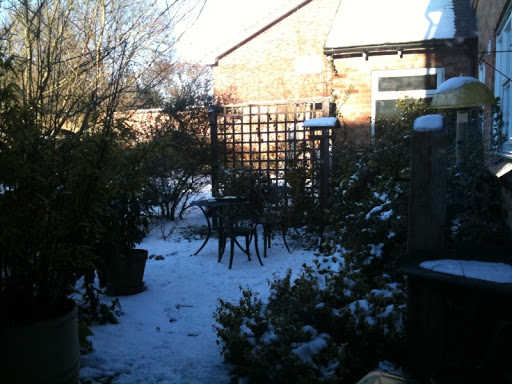
This is exactly how I pictured Christmas in Canada. White crunchy frosting everywhere and a hoard of snowmen to form an Arctic version of a zombie apocalypse. However, the photo is actually of my parents' garden in Leicestershire, since the UK responded to my move north by promptly filling up with snow. It brought a whole new meaning to the old concept that everything you search for is in your own backyard. Literally.

The real question is though, was this a white Christmas?

Let's consider the facts: It was (1) Christmas Day and (2) white. You might think that this was rather damning evidence and that it was a straight-forward done deal.

And you would be wrong.

Apparently, the official criteria for a white Christmas is that a single snowflake must fall in the 24 hours of the 25th December anywhere in the UK. So in fact, everyone could be up to their necks in snow and living in igloos due to brain-eating Frostys having invaded their kitchens and it could still not be an official white Christmas. Conversely, London could be improving their tans, but if that solitary snowflake lands on a bag pipe in Edinburgh, a white Christmas it be!

The Met Office web pages reveal nine 'Official white Christmas monitoring sites', one presumes for the people who have decided to bet their life savings / house / pet dog / first born on it being a white Christmas in a particular year. These locations are Aberdeen Football Club, Aldergrove Airport in Belfast, the Bullring mall in Birmingham, Millennium Stadium in Cardiff, Edinburgh Castle, Glasgow Cathedral, Albert Dock in Liverpool, Buckingham Palace and Granada Studios in Manchester. Presumably, people are hired for this snowflake counting. It could be quite lucrative, if not in over-time pay, then in bribes from people whose partner has bet their eldest son.

So was 2010 a white Christmas in the UK?

Yes.

Second children everywhere are disappointed.

Happy 2011, folks!

'Twas the night before Christmas....

'Twas the night before Christmas and all through the house, not a creature was stirring....

... Except me because I'd just blown one of the circuit breakers. Whoops.

Using my iPad as a flashlight, I wove through the dark living room to the fuse box and examined the situation. On the top row were a half dozen black rectangles that resembled dominoes. I had no idea what to make of those. The lower row showed six switches, one of which was in the 'off' position. Ah-ha! I was a genius! I flicked it to 'on', God said 'let there be light!' and....

.... nobody paid the slightest bit of attention.

I returned to the kitchen and confirmed that no one had listened there either. Dejectedly, I flicked the light switch a couple of times and returned to study the fuse box. It was after midnight, so possibly the best thing to do would be to go to bed and sort it out in the morning when it would be daylight and my parents would be awake. I looked at the switch I had just turned on and paused. Had I flicked the unmarked one on the end or the one beside it labelled 'cooker'? If it was the latter, then the oven had probably reset itself... The oven with the turkey in it.

That ... would be bad. Oh yes.

Deciding I would be in deeper trouble for letting such a catastrophe go unmentioned than for waking someone up, I crept upstairs with my iPad-flashlight. I have to say, the illumination from this make-shift lamp was not great; there should totally be an app for this. Creeping past my brother's room, I tapped on my parent's door.

"Mum? Uh... I blew all the lights.... And maybe the oven."

I'm unsure whether it was a reflection on my childhood that my mother seemed totally unphased by this occurrence. She located a real flashlight and I moved to documenting the events via twitter on my freed iPad as we moved around the house. Returning to the fuse box, Mum took out one of the domino thingos from the row above the familiar breaker switches. It turned out these were breakers too, but ones which you had to manually feed a strip of fuse wire into yourself.

I feel the need to confirm this was Christmas Eve 2010, not 1910.

One screwdriver and a length of 5 amp fuse wire later (5A for fuses, 15A for most electrical appliances and 30A for cookers. It's never too late in the year to improve your education of devices you thought you were born too late to have to deal with) and we were back in business. The other breaker switch that I had flicked turned out to be the unlabeled one and was not connected to anything. Actually, we're not sure, but Mum turned it back to 'off' to see if anyone complained.

"Sorry to wake you," I said sheepishly. "But I wouldn't have had a clue how to reset that fuse."

"It's fine," Mum said cheerily. "You can see why I study fossils now... Anything old is right up my alley!"

I consoled myself by thinking that at least I got to demonstrate how to get new mp3s onto her iPod this week.