The bordinator

"Nationality?" the humourless US border guard demanded, staring at the cover of my British passport.

".... British."

"Purpose for your visit to the United States?"

"I'm visiting a friend in Chicago."

"What is in Chicago?"

".... my friend."

Ever noticed how my conversations at the US border are highly circular? The guard flicked through my passport, pausing as usual at the two expired US visas.

"You were a student here or something?"

"Yeah, a few years ago."

This was true, but in fact both the visas in my current passport were for research jobs after I'd graduated. I contemplated whether this was going to matter but apparently it went unnoticed.

"I have a recent stamp," I pointed out. "On the back page from April."

The guard continued to look at the centre of my passport. "These are old," he declared.

"Yes, my visas have long expired."

Through the tinted glass, I saw him put my passport in a tube to send it across to the main office.

"Hey, excuse me! I have a recent stamp! I don't need to stop."

I was ignored.

"Excuse me!!"

It was 8 am and my flight was at 10. Technically, I had time to stop if I was forced to go in and get a new visitor visa and passport stamp. The problem was that a delay could cause me to run smack into rush-hour traffic in Buffalo. I also wouldn't put it past the border office to take more than an hour to write out the necessary small green slip.

It is rare to meet a border guard with any care for humanity. This guy was no exception and, should I sound too irritable, I was quite confident would pipe my passport away out of perversity, setting it alight as it flew down the tube.

The guard paused. "It's from April," he said curtly, still holding the dispatch tube like a pipe bomb. "It's expired."

"No, I got it in April," I protested quickly. "It's good to July. Would you let me show you?"

Admire my politeness in the face of obnoxious sadistic border guards. There was more superfluous flicking through the passport. Then a long pause.

Cake or death?

The passport was handed back to me. "I found it," he said expressionlessly.

"Thank you." I flashed him a charming smile. He returned it with a look that made me confident he was the precursor model for the Terminator.  I accelerated hurriedly and scooted off over the bridge.

Zoom.
How to impress a female squirrel


Spring has finally arrived in Ontario and the squirrel mating season has begun. But how does a young gray-tailed lady know that the black tree rodent posing for her attention on the front porch is worthy of being her mate? The answer apparently comes down to one rather unfortunate challenge:

Who can terrorize my cat the most?

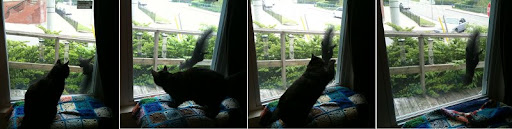
This particular black squirrel has long been a major source of entertainment / annoying itch / enemy who will one day be vanquished (delete as appropriate) for Tallis. It was clear from an early stage that he didn't give a jot about the fact a carnivorous feline was pressed up against the window a mere foot from where he was hanging from my deck rail. Still, until this morning, the squirrel's main objective had been to raid the seeds in my bird feeder and the frenzy my cat blew into was no more than a passingly interesting side-effect.

Today was different. The bird feeder was completely ignored and instead the squirrel danced in front of the window while the newly arrived gray squirrel looked on from on top of the dustbin. Tallis watched, nonplussed, from where she was sitting on my desk. The gray squirrel looked equally unimpressed. Evidently, this was not demonstrating the required quantity of bravado.

Our black friend then leapt onto the wall and ran around the outside of the window frame. Tallis had now moved to her window seat, but couldn't see the squirrel when he was above her. Feeling that his presence needed to be fully marked, the squirrel scuttled down the side of the house and leapt across onto the bug screen attached to the outside of the window pane.

Yoo hoo!

A dance was then performed across the window, complete with a nut clamped in the squirrel's mouth. The addition of the food was quite blatantly to emphasize that while the squirrel had breakfast, my poor cat would be forever without the snack she desired. That didn't stop her trying to chew the squirrel straight through the glass.

In the end, however, the torment was too much. Tallis retreated to sulk in the middle of the room and the squirrel was left still clinging to the window. At length it dropped down and I've not seen it or Miss Gray since. Assuming this bold act of daring was accepted as a feat worthy of a father, this summer could be a tough one for Tallis. We may just have to draw the curtains.

Does whatever a spider cat does

There comes a time in everybody's life when it is desirable to make your cat radioactive.

For many, it is a feeling that a remake of the 'spiderman' movies could be a real hit with one obvious improvement. For others, it stems from a dream to get even with the neighbour's newspaper-chewing dog. For one of my friends, the source was his cat developing an over-active thyroid.

Ramses --known as 'Sir Ramses' by the people who cared for him over Christmas and 'pussy' by his family's newest addition-- had developed hyperthyrodism; a condition caused by tumours (not necessary malignant) on the thyroid gland which leads to an overproduction of hormone. To emphasise his displeasure at this condition, Ramses underlined the inconvenience by having an allergic reaction to every medication designed to treat the problem and ended up in the veterinary hospital. The suggested solution was a dose of radioactive iodine which is absorbed by the thyroid and kills off the excess cells. It only needs to be performed once for a permanent cure. 

There is no mention in the veterinary guidelines of a treated cat morphing into a immensely powerful super villain but, hey, I was optimistic. Especially since said cat was not living in my house. (Though if he appeared at the door, my Tallis could totally take him -- it's what she's been preparing for all these years.)

The 'make your own glow in the dark cat' procedure took place at a hospital 90 minutes drive away. Sick people went in the front, cats were wheeled on a trolley through the back. The nurse who appeared to collect Ramses eyed my car with disapproval.

"When you collect your cat, you shouldn't bring the baby," she informed us, nodding at my smallest passenger who had come along to say goodbye to 'pussy'. "He'll still have quite a high radiation count and that is a very confined space."

Woman, size isn't everything! I covered my car's wing mirrors so it could not hear such comments.

Iodine has a half-life of eight days. Since Ramses ended up staying at the hospital two weeks, he was down to roughly a quarter of his original radiation level by the time we collected him in a baby-free car. Had he been human, there would have been no further guidelines concerning his health. As a cat, however, there was a list of rules that included storing his kitty litter for a further week. Apparently, the radiation levels were still high enough to trigger the alarms at the rubbish dump.

It was after dropping the cat off at the hospital that we all visited the large cats at Killman Zoo. It's good to be prepared.

Bugs in bugs


"This is a front wheel drive?"

"Mmmhmm."

Chunk. Chunk. Chunk. I watched dispiritedly as the front half of my car was lifted into position behind the tow truck. Resignedly, I noted that this trip was not going to end in a hockey game as originally planned.

I had only driven about ten minutes when the problem started; a juddering from the engine that shook the car. My engine warning light came on and started flashing. I didn't actually know that light could flash but, under the circumstances, I felt a conservative translation would be 'STOP OR YOU WILL DIE'. I bounced into a parking lot and optimistically tried shutting everything down and then turning it back on. Hey, I was a Microsoft Windows user too once. The resulting vibration might have been a seat feature if the car felt remotely safe to drive.

I called the CAA.

I rode with the tow truck across town to the VW garage, resentfully eyeing all the other vehicles around us.

"If we see another yellow beetle, could we just stop and switch them over?" I asked sadly as I spotted a grey bug parked by the curb.

"No problem. I know a guy who'll get you a set of keys for it for $150."

.... all in all, it was probably a good thing we didn't spot car like mine. I wasn't sure what my bill from the garage was going to be, but I was fairly certain it wasn't going to fall below $150.

The price of the repair was a particular concern. In all likelihood, I would be selling the car by the autumn and, at 10 years old, it wasn't going to be worth all that much. An added complication was that I had brought it into the country on a temporary import, so it would be preferable to sell it back in the USA rather than pay tax and duty on it in Canada. That meant that it had to be able to reach the border. I didn't like the idea of pushing.

I sat anxiously at the garage while I debated what my cut-off sum was; the amount at which I run from the room, denying all knowledge of having ever owned a car or evening knowing how to drive. I decided it was somewhere close to $1000. Around the price a serious engine malfunction would probably cost. I knotted my shoe laces tighter.

Miraculously, it turned out to be the ignition coil. Not cheap to fix, but not $1000 either. What was more, the garage had one in stock and fixed it within the hour. I had been hesitant about going to the VW dealership; as a general rule they are more expensive that a generic garage. The fact they were open until 8pm, looked at my car immediately and fixed it on the spot made it all worth while. The only bad news they gave me was that my spark plugs and wires also were showing wear and the oxygen sensor (emissions detector thingo) also needed replacing 'in the next few months'.

I'm pretty confident that'll mean after September.

Meow


There are several surprising things about Killman Zoo.

Firstly, it is home to one of the largest collections of big cats in Ontario.

Secondly, despite this first point, it has almost no signposting. My GPS unit point blank didn't believe it existed and tried taking us to a school instead; the only location of note it could detect in the rural fields around Hamilton's tiny airport. Google maps did acknowledge the zoo's existence and took us down a rough gravel track where we eventually saw a small square sign directly opposite its entrance. The website for the zoo describes it as "truly one of Ontario's best-kept secrets". Evidently, they're completely serious about that.

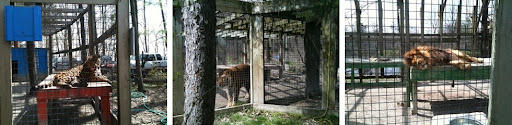
Thirdly, several of the cages contained two cats of different species. A female lion and tiger shared a run and a cougar with a lion. Everyone seemed okay with this....

Finally, it has possibly the most unfortunate name for a place containing large carnivorous animals. Since its founder was a man named Murry Killman, the origin of said name is understandable, but I think in such a circumstance I might have changed my name to Willnotkillman.

The animals are housed in cages that look like they've been cobbled together out of salvaged wood. In fact, the whole area has the feel of a animal rescue centre, except for the fact the pens contained GIANT MAN EATING CATS rather than, you know, raccoons. On the other hand, maybe Hamilton is frequently plagued by wild jaguars and the zoo is just very good at rounding them up. It would explain why the local Canadian football team is known as the Tiger-cats.

In addition to lions, tigers, cougars, jaguars and panthers, the zoo is home to a bear, emus, pigs, turkeys and a whole bunch of bunny rabbits. Evidently, there had been some concern for the fate of said fluffy bunnies, since there were large signs all around the zoo stating 'we do not use live prey'. Since there was one pen that was labelled 'African porcupine' but now seemed to consist only of rabbits, this precaution might have been introduced for the reverse reason than most would presume. 

The cages themselves appeared not to be terribly big which left you with the mixed feelings of pleasure at being so close to the animals mingled with concern for their welfare. However, a closer inspection showed that the cages interlinked to give a more respectable sized run, and each cage had a door into one of the large open areas that were alternately occupied by the zoo's inhabitants. Nevertheless, the website indicates that not everyone is satisfied with this solution since it lists warnings to PETA and Zoo Check that Killman Zoo is private property.  To me, the cats looked healthy and one suspects if they were very unhappy, those cages wouldn't hold them for long. Undoubtedly though, any such containment is a hard moral call.

With me on this trip were a couple of friends and their eight-month old son. While we all admired the cats, the baby's all time favourite site was .... a tree. This was likely due to the meanness of his parents in not letting him stroke the large tiger. With one hand on the tree bark, he looked at me and grinned.'

"Mu-mu-muuuummm."

 I raised an eyebrow. I see the logic kiddo, but your generalisation is too great.

Demon brides


"Is the hat traditional?"

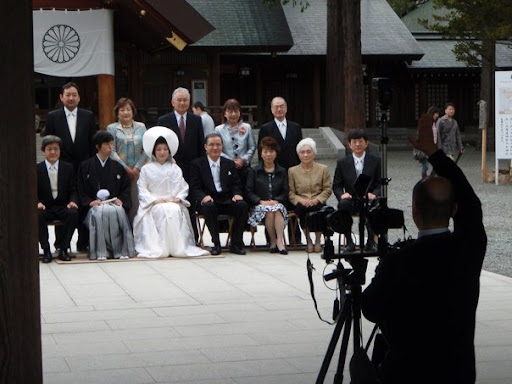
It was amazingly lucky that we had chosen to visit the Hokkaido Jingu Shinto Shrine just as a wedding was taking place. Seated just inside the shrine itself, the bride and groom were being photographed with their close family. I hesitated before taking a picture, not wanting to invade the scene, but since other visitors had no such scruples I tacked on behind them.

One of the major shrines in Sapporo, the Hokkaido Jingu was established on September 1, 1869 by decree of the Meiji Emperor. It is set in a large park which, while not at its most attractive while winter was only reluctantly releasing its grip before spring, was lovely to walk through away from the main city streets. There were several small shrines around the grounds but the wedding was held at the main site.

Like with most western weddings, the bride was dressed in white, but she wore a large semi-circular hat that dropped down over her ears and almost entirely obscured her dark hair. I assumed it was an alternative to a veil, but in fact I was wrong.

"It's to cover her horns." I was told matter of factly.

".... horns?" Was this another part of the traditional wedding dress for Shinto services? If so, I was sorry that the hat had to hide such .... unique .... adornments.

"When they were going out," my friend gestured at the married couple. "Everything was nice between them. But now the woman is a wife, she will become like a demon and will grow horns."

Well, there you have it. There is a refreshingly honest look at marriage in Japan that even the ceremony traditions embrace. 

Red pill or the blue pill

It was the moment of choice.

I couldn't leave the cubicle without flushing the toilet, yet if I pressed the wrong button I might be surrounded by half the store's emergency staff. Even aside from the embarrassment, I obviously wasn't very well so the risk of being carted off to hospital before I was able to offer any explanation seemed dangerously high.

It occurred to me just then that I still couldn't differentiate the sound for the Japanese for hospital (byouin) from that for hair salon (byoin). Unlikely to be relevant, but it added to the annoyance of the moment.

Looking wildly around for some form of guidance (English directions, alternative flush button, Japanese-English dictionary...) I suddenly spotted a large red button mounted on the wall behind the toilet. This was marked in both English and Japanese with 'Emergency'. So if that was the emergency call button, than neither of the other push buttons could be for that purpose. In which case, surely it didn't matter which I hit ....

I pushed one.

A flushing sound filled the cubicle. It would have been even more wonderful if it had been accompanied by water actually going down the toilet bowl. I looked back down at the row of buttons mounted by the toilet itself. Most toilets in Japan are accompanied by a button for creating a fake flushing sound; they were introduced because the too-modest Japanese woman would flush the toilet needlessly to cover up any bodily sounds, causing a significant waste of water. However, they are usually depicted by a music note and situated along the side of the seat. Indeed, this toilet was no exception. The button was there which is why it hadn't occurred to me that the larger button mounted on the wall would also have this result. Clearly, the department store had felt that one button was simply not enough and what was required was some kind of surround sound experience where both noise options could be engaged. Perhaps customers like to feel that they themselves were being flushed through the plumbing in some strange variation of the 3D movie experience.

Shaking my head slightly, I hit the second button. The toilet cleaned itself. I could go.

Return of the toiletator

WHY is it that everytime I have a stomach upset in Japan, the only restrooms I can find have the traditional Japanese hole-in-the-floor style toilets?

The potential for this had seemed amusing as I attempted not to bowl over every department store shopper while making for the restrooms. When actually confronted with three empty cubicles containing floor troughs, the entertainment value dropped by roughly a third for each convenience. The forth and final door in the restroom had a small sign on it marked 'western'. It was occupied.

I swallowed. Did I go with the squat pot and deal with the fact I might be crouched down and unable to move for quite a while? Or did I wait for the western-style toilet to become free with all the discomfort that delay entailed?

I really did need to sit. Casually, I lent against the tiled wall, trying to conceal the fact I was surreptitiously doubling over. At the basins beside me, two Japanese women were washing their hands. I felt a stab of regret I wasn't moving to use the traditional ammenities. No doubt I was confirming every stereotype regarding inflexible foreigners right there. However, there are times to worry about impressions. And there are times to worry about not soiling your clothes. Broadly speaking, they are mutually exclusive.

The door to the occupied cubical swung open. I tried not to nose dive through it. Taking only the moment needed to confirm that no western toilet had this many buttons, I collapsed with relief onto the seat.

Beside me on the wall was a button marked 'push'. Undoubtedly, this was the flush... Unless that was the second button directly above it, also marked 'push'. This upper button had a further description of what said impression would instigate, but it was all in Japanese. The only action I could think of was that one of these choices was an emergency help button, a fact made more likely by the necessity of a disabled customer to use this cubicle. So, if I pressed the correct button, the toilet cleaned itself and I was free to go. Press the wrong button, and the store alarm would sound bringing twenty paramedics into my cubicle.

Was it going to be the red pill .... or the blue pill?

Later, I was to acknowledge there were times when Japan was a bit too exciting.

Here's looking at you, kid

"You can really eat the whole thing?" It was a question worth asking. One day, I am sure people will lie to me.

A dinner out in Japan is a sociable affair. Rather than each individual selecting his or her own dish, you gather as a group around a table to share sushi, hot pots, savoury pancakes or some other form of fare. Not only is this fun, it also guards against over-indulgence from a desire to finish your entire plate. Of course, this does require everyone to agree on the type of food and it helps not to be a fussy eater. The fact I was not a fussy eater was about to be put to a whole new level of testing.

Uo-isshin (whose name is possibly poorly recalled due to google being in denial) is a seafood restaurant with a specialty in crab. Hairy crab. It was originally described to me as 'furry' but since said fur sticks in your fingers like a fine-combed porcupine, I fail to find that description accurate. Still, since I helped devour its interior and than drank sake from its dessicated carcass, I guess I had my revenge.

The crab was served alongside a large plate of sashimi which included large king prawns with all body parts attached. Rather to my relief, since these were raw, the heads and tails were removed before eating. This complacency was short-lived since a short while later a plate of just prawn heads was produced, cooked and ready to be eaten; eyes, front legs and all. A basic rule I learned was that pretty much anything is edible if you fry it.

"The Japanese do not like waste," I was told by the students who were clearly having far too much fun at my expense. Admittedly, my memories of having to sort garbage in Tokyo into half a dozen different piles made me sympathise with this philosophy. I bit into the head. Crunchy.

The shrimp heads were followed by a grilled flounder. This looked totally delicious and I watched as one of the students carefully lifted the bones away from the white flesh.

"Don't throw out the bone!" The call came from down the table. "I want to eat it!"

I studied the fish skeleton. It consisted of almost nothing beside the delicate array of hair-like bones, held together only by the grilled membrane of skin. People were reaching forward, snapping pieces off and popping them into their mouths. I'm pretty sure this contradicted everything I had been taught about eating fish as a child: remove the bones or else THEY WILL CHOKE YOU AND YOU WILL DIE. Apparently, the secret was just to chew them first.

It was maybe a good thing that this meal was served with sake.

From the flounder we moved onto entire individual fish that were eaten like candy sticks. Roughly the size of a sardine, these fish were pencil-long silver lengths that you chewed your way down. I watched to make sure people really did eat the heads and tails, then bit. They were extremely good once you got over looking your dinner in the eye.

A huge salmon complete with extra roe concluded the meal along with a surprise; two pieces of cold flounder sushi for the gaijin to try (that's me, folks!). They tasted of lemon with a firmer, thicker texture than tuna. There was also a pickle-like vegetable that looks like pineapple triangles and humongous squid served in their shells. We drank sake from the shells too. It seems that it looked big enough to be a threat, it was worth toasting your victory by drinking from its remains. 

As we walked back to the station, I was told that other westerners had not liked to try so much of the seafood.

"You are very brave." I was told.

Why, yes. Yes I am.

Nasty Children

"That is a place for nasty children."

"Nasty children?!" I looked in surprise at the innocuous low-rise building. Could there really be a detention centre for young offenders on the corner of Hokkaido University campus?

"Yes. They are very small."

Well, it wasn't that I didn't agree with the sentiment. Small children were indeed often downright obnoxious. Still, it seemed a surprising comment to come from someone who I knew had a son.

"Do you say 'kindergarten'?" One of the students had noticed my confusion. "No, that's German."

"It is German but we sometimes use that for a school for young...." I made the connection. "Nursery children."

"Ahh, nursery children."

I think I should have left that uncorrected at 'nasty'. Far more accurate.

The hand that rocks the cradle

It had to be asked.

We had covered teaching duties, computer resources, research grants, the hiring of students and language requirements. It was quite likely this final point would never be an issue, but for completeness it really ought to be queried when discussing a permanent position.

"How do maternity benefits work in Japan?"

"Matern....?"

The person I was discussing the job details with was a senior male professor. His English was good, but not fluent and this was probably a topic that didn't come up too often in places where he would use the language. Like at conferences on galaxy formation.

"If I were to have a baby....?" I made a hand gesture of show a swollen stomach. Either I would be understood, or it would be assumed I was concerned about sudden and chronic obesity from over indulgence in sushi. The latter was possibly a risk, so finding the solution to that too would be no bad thing.

"Ahh, so you...?"

"No! Not now!" I hastened to clarify my current state of being. "But possibly in the future. Maybe." I stretched my arms out to indicate vast amounts of time passing. I received a gratifying nod of understanding.

"My wife was a graduate student when she had our son. She had six weeks off."

Six weeks?! Did she drop the baby, rock the baby and declare it ready for school? The Japanese education system is notoriously hard core, so this was almost plausible.

"But that was twenty years ago. Now, the Japanese Government wants more women employed, so it may have changed."

Hmm. Note to self: look into getting birth control in Japan. I smiled, "Well, this will probably never be an issue."

However, this produced quick reassurance that such a move would be a positive thing:

"Please, do find husband and have babies."

Well... let's not contract that in quite yet.


--
[As a side-note, this professor very kindly went to find what the current maternity leave protocol was and told me this afternoon that is was 8 weeks (I think...) full pay and up to one year on reduced pay.]

Ace serve

There are some situations that are just going to be awkward. Finding yourself opposite a dozen wide-eyes students who are all clearly anxious about having to speak English to this prospective British faculty member is bound to be one of them. I nodded, smiled encouragingly and wished I could help out by discussing my research in Japanese but ... well, I couldn't.

"What does your favourite character in Harry Potter teach?"

The question wasn't put to me but to a master's student who gulped audibly. The idea was a great one; start a conversation about an incredibly popular British-based franchise to kick off the conversation. The problem was that the professor who poised the question hadn't read the books himself and didn't realise that the answer was unlikely to be in a list of common English vocabulary:

'Apple... chair... book... school... transfiguration...' No, I couldn't see it.

Fortunately, this was an idea I could use but with a small twist.

"I like Japanese anime," I volunteered.

"Ah! Which ones?" came back an enthusiastic question.

"Prince of tennis?" I paused. "Tenisu no Oujisama?"

"Tenisu no Oujisama! Mada mada dane!" The response rang down the table from every student.

Problem solved.
Ore-sama no bigi ni yoi na.

--
("Mada mada dane" is the catch phrase of the anime series' progenitor, Echizen Ryoma. It obnoxiously means "You still have a long way to go". "Ore-sama no bigi ni yoi na" is said by one of the rival team members, translating to "Be awed at the sight of my prowess".)

Please don't flush your sanitary thing down the toilet

My first night back in Tokyo, I slept in a coffin.

Capsule hotels are Japan's answer to cheap accommodation for business men who just want somewhere to sleep. Stacked together in the same room, the enclosed beds have just enough space for you to stretch out lengthways and --in the luxurious versions-- enough height for you to sit up. The pictures I had seen resembled coffins in a morgue but with doors that could be opened from the inside and an internal TV in case the afterlife got boring. Due to the close proximity of the guests, capsule hotels are usually male-only, so I had to hunt around to try out this quintessential modern Japanese experience.

With the help of a couple of friends, I found the Ace Inn; a capsule hotel in Shinjuku, one of the major districts in downtown Tokyo. This place had both mixed and separate floors for men and women with shared bathroom facilities in the basement. Frankly, after being promised a claustrophobic night, buried alive with zombie-fied neighbours, it was disappointingly nice. The capsules resembled enclosed wooden bunk-beds with curtains over an opening in the side. Everyone had a locker for their belongings, but it was a narrow affair which was fine for my valuables, but wouldn't have taken a suitcase. The downstairs showers required a 100 Yen (~$1) coin to operate, apparently to limit the time and ensure everyone has a fighting chance to get clean in the morning. Clearly, some people must have been extremely smelly since I showered and finished before my 100 Yen had run out.

Despite it being 'Hanami' in Tokyo, the traditional weekend to view the cherry blossoms, the capsule hotel was nearly empty. There was a sign pinned up inside the elevator in English thanking visitors for coming to Tokyo during this difficult time and asking them to pass on the message that Tokyo was safe to visit. There is evident concern that the drop in tourism may succeed where the tsunami has not, and drive smaller businesses into bankruptcy.

That particular notice was written in almost perfect English, but elsewhere in the hotel the signs were more entertaining. My personal favourite was the note in the women's toilet stalls saying "Please don't flush your sanitary thing down the toilet". Although, I must say the prospect promised by "If you want to have fun, go to Roppongi or Shibuya!! You can have a hot night there." made me wonder if I should reconsider going to see the cherry blossoms.

There was an earthquake during my brief stay. A 4.3 magnitude shortly after I arrived at the hotel that vibrated the building. Earthquakes are never rare in Japan and the infrastructure has little problem coping with the vast majority of them. There is no doubt though, that the ringing of Japan's main island is a reminder of the all too recent tragedy. As night fell, the usually dazzling lights of one of the world's largest cities appeared at half-mast, both due to the saving of power in the wake of Fukushima's reactor problems and out of sympathy for the huge numbers of Japanese who had lost their homes further north.

In practical terms, the power shortage caused few inconveniences. The express train service running from the airport wasn't operating during the afternoons, but there was a direct bus that took the same amount of time, so it was a non-issue. Even the lack of lights at night was only dark by Tokyo standards; the city still shone with activity. I therefore echo my hotel's sentiments: if you are planning a trip to Tokyo, go. Take a camera. It's going to be great.

A difficult situation

In addition to evil old biddies who think my idea of a fun evening is to have my car breakdown on the sidewalk, there is another lady who frequently passes by my house. She is short with thin greying hair that is cropped to chin level. Her clothes are usually baggy and slightly ill-assorted and she speaks in a pre-occupied manner. She looks to be in her forties and despite seeing her regularly in the same place, I have often wondered if she has somewhere to live.

Regardless of her situation, she is always friendly and treated my stuck car debacal with a great deal more sympathy than the afore mentioned evil biddy. Once she told me she owned a yellow car too. I strongly suspected this was an equally friendly bare-faced lie.

This evening on the way back from work, I saw her not on my road, but near the highway. Crossing the road to head home, I greeted her and asked how she did. I recieved the usual vague answer of "fine, fine", followed by:

"I suppose I can walk back home with you."

I replied that of course she could, took my headphones from my ears and fell into step with her. I noted she was shivering, despite a large sweater and I asked if she was cold, adding that at least the weather had become warmer the last few days. She agreed and started talking to herself in a low tone with words I couldn't make out. We had not gone many steps when her pace slowed and she stopped.

"I think I'm going to walk the other way now."

I should emphasise that this road was near absolutely nothing. Walk twenty minutes and you would reach the cluster of houses and shops belonging to Westdale village, the other side of which the University was situated. Twenty minutes in the opposite direction would see you in downtown Hamilton. An incredibly slow pace alternating directions would see you nowhere, unless you had a particularly favourite patch of highway concrete.

"Are you all right?" I stopped and looked down at her. For the first time, I felt as if I loomed above her stooping figure. "Are you sure?"

She insisted that all was well and started shuffling off along the sidewalk again. Reluctantly, I headed for home.

Technically, I had done my duty, yet there was no doubt that it was within my power to offer more. The problem, of course, is that more personal interventions --for example an offer of money or an invitation to my home-- come with an associated risk. If I gave her cash, it might set a precedent for a continual donation of funds which would deplete my own resources and, if she really was homeless, would not ultimately help the problem. If I let her into my apartment, I left myself open to robbery or worse. Undoubtedly, there are social services who could be contacted, but I'm not at all sure what I could tell them if I called. I should make it clear that never once has this lady asked me for anything, yet self-preservation makes me keep my distance.

It's not that I feel my behaviour is wrong or even unnecessary. It's just damn unfortunate.

Snowpocalypse in spring-time


Hello March. I didn't see you there under ALL THAT SNOW.

It wasn't really the sheer quantity of white stuff that had me gawking out of my window on Wednesday morning. I mean, I live in Canada. I know that has consequences. Perhaps I was daft, but I thought that 20CM OF SNOW would be preceded by, you know, cold weather.

It wasn't even that we'd just had a brief warmer day. It hadn't snowed for weeks and on the weekend, I had finally dragged the bag of de-icing grit for the sidewalks back down to my basement. I had picked up my snow boots from their spot by the door and stowed them in my closet and laid aside my full length coat in favour of a fleece. I had even switched my violently coloured knee-length socks to violently coloured ankle socks. Seriously, spring was coming!

I noted my actions on Facebook and received the prompt reply that I'd jinxed everything and now it was going to snow on Wednesday....

.... I'm still hoping a weather forecast was involved somewhere in that.

Having completed a serious 20 minutes worth of slack-jawed gawking on Wednesday morning, I shovelled my drive and staggered into work. Notably, only the few most major roads had been cleared; something that was true even when I returned home in the evening. In Ontario, much of the snow clearing comes from residents with plough-attachments on their pick-up trucks. They get paid by the province for the work they do, but apparently I wasn't the only one who had packed up for the season.

Upon arriving in my office, I found my Facebook wall had become a site of blame:

"Cause and effect -> didn't you put your salt/grit back in the basement? Doomed..."

Sad but true. Evidently, the clearing of my drive had also been a repulsive act to Mother Nature and she worked steadily all day to cover up any evidence of my labour. It was extremely successful.

I returned home and wrote my message to the world in my car's rear windscreen.

Typical homecoming

Upon walking up my driveway towards the door of my apartment:

Neighbour's dog: Ruff! Ruff ruff ruff! Ruff ruff!

Me: Ruff ruff ruff ruff. Ruff!

Upon pushing open the door and entering the kitchen:

Cat: Meow! Meow meow meow meeeeooooow!

Me: Meow meow! Meow!

I'd feel better about all this if I felt anything I said during the preceding day had made more sense.


The ultimate warm-up

I stepped on the ice and flailed as my right skate shot out from underneath me. Hurriedly, I swung my weight to the left, becoming an ice ballerina as I sailed on one foot towards the barrier. Was the rink slick with water from the new surface deposited by the departing Zamboni? Normally, freshly cut ice has the reverse problem, with the residue thin layer of water causing the puck to stick to the rink before it freezes properly.

Gingerly, I put my skate back on the ice only to have it slide hopelessly sideways. What crazy ice problem was this? Two of my team-mates passed me, apparently unaffected. Was the issue with my skate? Had my blade come loose without me noticing? That would be bad; I couldn't skate with a blade so displaced it sent me flying every time it touched the rink. I'd have to not play.

I scanned my friends performing warm-up exercises. We were low on numbers tonight, I had to skate! I'd just have to ... have to .... skate on one foot. At least I'd have the element of surprise. Maybe if I pushed off from the bench really hard at the start of each of my shifts, I could sail across the rink, intercept the puck and ...

... be carted off for six weeks traction before the end of the first period.

This was clearly a COMPLETE DISASTER! However you looked at it there was going to be carnage and missed goals and broken bones and bandages and probably an iron lung. 

I reached the barrier and leaned against it, allowing me to get a proper look at my feet. My eyes narrowed at the lump of sticky tape attached to my right blade. Okay, perhaps no one had to loose the use of their lungs. This seemed like a solvable situation.

The next few minutes progressed in a remarkably similar manner to this video clip. I pushed the lump of tape with my free boot but it just slid along the blade. Next I tried pinning it down with my left blade while I lifted my right skate up. That caused my skates to be stuck together. Then I tried trying to rub it off on the barrier after which I attempted ... Look, it doesn't matter. Let's just say in a battle of me versus tape there was a clear winner and leave it at that.

Ultimately, I was rescued by a team-mate who was able to bend down and tug the offending stickiness free of my skate. The exposed blade finally cut into the ice and I shot forward just as the whistle blew for the game to begin. Fortunately, I had just stretched out every single muscle. It was the ultimate warm-up. I must write to the NHL.

Don't knock it

"That ... can't be right..."

I was watching the student cashier count out a pile of coins from the till for my change. The thing was, I'd given him $2 and my drink was $1.90. It might be first thing on a Thursday morning, but even I could work out that I shouldn't be receiving a fistful of silver coins back.

The cashier paused and looked at the till screen. It read:

Purchase: $1.90
Change: $0.85

"No ..." he agreed and then shrugged. "Just ... you know ... go with it." He passed me over the coins with a sunny smile.

"Um. Okay. Thanks." I took the coins and the drink and wandered off.

Probably a sociology student.

Sled hockey

"On the off-chance this ever becomes an issue ... which way are we shooting?"

Even for me, it was strange question to ask during a hockey game. This, though, was no ordinary match. This was sled hockey. Designed for disabled players, sled hockey is played --as the name suggests-- on sleds. These devices resemble metal stretchers supported on short twin blades with a plastic bucket seat on one end.

A member of my regular hockey team coaches in a sled hockey league and, finding her team had an hour of extra ice time at the end of their season, she suggested we come and try it out in an exhibition match. There is clearly no other answer to such a suggestion than 'hell yes!' and it was utterly awesome. The 'exhibition' naturally turned out to be us, rather than the game, but this was suspected well in advance of the reality.

The first obstacle I had to cross occurred in the changing room when I attempted to put my hockey gear on without my skates. The issue was not the emotional guilt from leaving my skates in my bag (although that was rather sad) but simply that my kit goes on in a certain order. Like Ikea furniture, forgetting one of the steps usually results in the end product falling to pieces. In this case, my shin pads felt dangerously slippy.

As it turned out, this wasn't a problem since my ankles got taped to the sled. What was more of an issue was getting my GIGANTIC BACKSIDE into the tiny plastic seat. If the proceeding game wasn't enough to wreak my ego, this would have sealed the deal. It transpired later that sled hockey players don't wear the same padded shorts as skaters in the traditional game (IT'S TRUE I TELL YOU!). They either wear lighter shorts similar to those used in roller hockey or just leggings. As a result, I had to be levered into my sled by the referee.

Then I was off!

.... if I could work out how to move. Instead of a single long stick for manoeuvring the puck, sled hockey players have two short sticks roughly a third of the length of a traditional hockey stick. The shooting blade on each is the same size and shape as a full-sized stick but the reverse end is equipped with metal teeth that are dug into the ice to propel you forwards. It was quite like rowing a boat on frozen water. When you wanted to hit the puck, you inverted the stick to put the blade against the ice and shot towards the goal. At least, that was the idea.

The sled blades were adjustable and could be set at different distances apart. Ours were separated by about half a foot rather like the training wheels on a bicycle. A few of the real team members had theirs mounted so close together they looked like a single blade. This forfeited stability in favour for manoeuvrability. Since I had a habit of tipping over, being unable to do handbreak turns on one stick was not overly upsetting. Normally when I fell to one side, I was able to righten myself with one hefty push. However, while guarding the goal (probably from nothing, I have no idea where the puck was at the time), I tipped over so fully that I partially came un-wedged from my seat. This meant that when I tilted back up, my centre-of-mass was off to one side and I just fell down in the opposite direction. Team members surrounded me like a bovine heard around a wounded animal. However, since we were all tied into our sleds, no one was able to provide the leverage and stability to correct the problem. In the end the referee (laughing hard) appeared to stuff me back into position. Time to go!

Never had the ice rink looked so big. None of us were used to working our arm muscles so much and we couldn't yet move at any great speed. Someone sped past me, guiding the puck with one stick and manoeuvring with the other. He approached the goal, lifted the entire sled up about an inch, and shot the puck underneath it to land in the net.

I waved my sticks a bit in stunned admiration.

When the whistle blew, I cut myself free of the tape round my ankles and tumbled unceremoniously onto the ice. Strangely, one of the sorest parts of me was not my arms but my unused legs. This is apparently not uncommon, since you do not normally sit with your legs absolutely still for an extended period of time.

I picked up the sled and carried it to the store room noting, with some surprise, that many of the regular players did the same. Upon inquiring, I discovered that to play in the sled hockey league, you have to have some form of disability, which need not be physical. This led to one very important question:

If you could walk, why on earth is sled hockey considered easier than the traditional sport?

Chocolate, traffic and visas

My car was full of chocolate aero bars. I'd stuffed three in the glove compartment, two in the cup holders and now I was trying to find homes for another five. Clearly, some rearranging was required.

I was parked at the duty free store by the US-Canada land border near Niagara. While this leg of the journey should have taken only an hour, I had left home at 9:30 am and it was now 2 pm. The heavy snow the night before had taken not only me by surprise, but caused a tractor trailer to jack-knife on the highway, blocking all three lanes and resulting in near-stationary traffic for hours. This had led to repeated texts to my friend providing ever longer estimated arrival times.

I supposed I should count myself lucky. As I had sat there flicking through the radio stations and failing to find any traffic news, a car carrier truck had drawn up beside me loaded with three mashed-up vehicles. I suppressed the temptation that had been growing within me to start ramming the car in front.

Despite the fact I was anticipating spending at least another hour at the border office getting a tourist visa, I had pulled into the duty free to use the bathroom. Feeling that someone should benefit from this chaos, I had bought another US residing (a.k.a. the country without aeros) friend more of her favourite chocolate while in the store. Well, it was better than the other (rather tempting but probably regrettable) option of accepting the free samples of ice wine.

For reasons designed to vex me, the US air and land ports have different policies regarding entry visas. The airports have moved over to the electronic ESTA applications and consider these so shiny and superior that they confiscate the old green paper visas on sight. The land border, by contrast, has rejected this crazy modern technology and wants you to have the green slip in your passport. The upshot of this is that I am either sulking in the land border office waiting to be called to the counter or watching sadly as the airport guy destroys my paper visa like a mother weaning a child off a pacifier.

Before pulling onto the bridge, I called my friend and told her I should be in Buffalo in about two hours, depending on the queues and busyness of the border office. I hoped for once that I wouldn't have send the follow up text telling her to double that estimate. Then I stuffed the chocolate into my bag and slid onto the road.

"Reason for coming to the USA?" The border control guard took my passport and flicked through its pages.

"I'm meeting a friend."

"How to you know them?"

I'd long ago learned to outright lie to this question. The friend I normally met when driving over the border I knew from an internet fan group for Japanese anime. If that didn't sound like something for which I should be detained and questioned for 6 weeks, I don't know what does.

"College," I said, my face bland. I watched the guard examine my collection of visas and took a long shot. "I've entered the US recently," I explained. "Less than a month ago through Atlanta airport. There's a stamp in the back."

A visitor visa to the USA lasts three months before you have to renew it. Every other time I had passed through though, the lack of the green paper slip has meant that I have to get a new pass done. Still, I'd never explicitly tried pointing out that this should be unnecessary.

The guard examined the stamp. "Okay, carry on."

....Seriously? I was so surprised, I nearly forgot to put my car back in gear. It was a good job I'd stopped to use the bathroom at the duty free. I drove slowly through the gates, reaching for my phone to text:

"25 minutes."