Just don't drink the water and don't breath the air


Before going to India, I visited a travel clinic in Canada which provided me with three things: an armful of vaccinations to prevent hepatitis A & B, typhoid and tetanus, a course of tablets to prevent malaria and finally, an antibiotic for ... when ... I got food poisoning.

In a time where fear of resilient super-bugs meant at least one vital organ had to be missing to shake antibiotics out of doctors, it was rather disconcerting to be handed a prescription for a illness I didn't yet have. Perturbed, I queried both the clinic's nurse and the pharmacist to be told the same answer:

"Boil or peel food before eating."

"Then I'll be fine?"

"No, you'll just last longer. After that, you take these."

I wondered how long I was expected to survive. Could I reach the guest house from the airport? Or should I be wearing an adult nappy upon landing? Would I be viewing the Taj Mahal through a periscopic lens extending from my sick bucket? Was India secretly a biological warfare camp designed for the breeding of super-humans and therefore uninhabitable by the weak, normal masses?

When I anxiously arrived in India, I told the group of friends who had come to meet me about my culinary instructions.

"They told me I was doomed!"

The response was a shaking of heads, "We don't think that's true."

Encouraging, but if they were all secretly super-humans perhaps they just didn't understand danger.

The strategy I ultimately decided on was a simple one: take some basic precautions but then don't worry about it. My guide book suggested sticking to vegetarian dishes for the first few days, since meat dishes are often very rich which can in itself produce an upset stomach. Fortunately, eating vegetarian in India is far from being a hardship, with roughly a third of the population doing likewise on a permanent basis. Indeed, the first record of a vegetarian diet comes from ancient India around the 6th Century BCE with its popularity stemming from a religious-based advocate of non-violence towards animals. As a result, vegetarian dishes in India are numerous and delicious. Never had I visited a country with more choice for non-meat courses and the only hardship was reminding myself that I did want to try the meat before I left.

For the first three days, my friend and I ate in fairly formal looking restaurants. They were not wildly expensive --although certainly pricier than the many street vendors around the city-- but being in a proper sit-down establishment seemed a sensible tactic for minimising bugs I might not be able to handle.

In India, people eat with their hands. In Northern India, where wheat rather than rice is grown, naan breads accompany the main dish. Strips of bread are pulled off the naan and used to scoop up the meat, beans or sauce before the combined bundle is popped into your mouth. Traditionally, only the right hand is used for this process, with your left hand sitting idly by your plate. Even though I was assured that using both hands or a fork would not be offensive, I tried hard to follow the example of the people around me. Since this didn't involve a new skill such as wielding chopsticks, I thought this would be easy.

I was wrong.

The first problem was that I am left handed, but I'm not convinced this made a huge difference. Managing the entire routine above with only one hand is an impressive feat, independent of your limb of preference. The second problem was a willingness to get dirty. To successfully eat a meal in this style, you have to be prepared to really get your hand into the food. This is a very alien concept to someone used to using cutlery or chopsticks, both of which keep your bare hand at a significant distance from your plate. In theory, I was a keen participant, but I could see that I ended up using only the tips of my fingers and ultimately spilt more food over the table, my face and sometimes my lap. It was very hard to resist the urge not to wipe or lick fingers during the meal, but to regard that hand as a write-off until the meal's end where a finger bowl would appear.

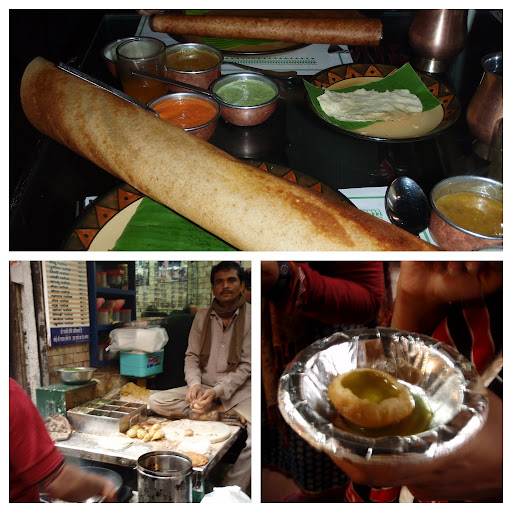
The food itself was amazing and actually very similar to the higher-end Indian restaurants in the UK. While I knew the UK had pretty much adopted Indian cuisine as their own, you never know how much a dish has been altered to suit a different population. Possibly my favourite meal was a huge rolled up bread stuffed with potato called a 'masala dosa', a dish from my friend's home in Southern India. It was quite the miracle I did not also have to be rolled out of the restaurant after consuming it.

The level of spice in the foods varied a great deal. We stuck to the lower end, partly through conscious choice but also just through the dishes I happen to select. My conclusion was that no one should be worried about visiting India if they are wary of hot foods; there is enough variety to suit everyone's palette.

On the forth day in Delhi, we visited old town and ate at a street restaurant. This was a moment of truth, since while the stuffed naans were of renowned greatness, they were being made right there on the street which screamed gut troubles with every bread-turn. Just to make it clear I was laughing in the face of danger, I had a tangy dessert from a street vendor.

... and I was fine. Actually, given my irritable bowel syndrome, this meant I was considerably better than usual.

There was only one possible conclusion to this: I was quite clearly also an INVINCIBLE SUPER-HUMAN! See that goat? I could eat it right off the street, hooves and all! Crunchy.

All and all, it was probably a good thing we were on a rickshaw by this stage, heading back out of the town.

Disaster did eventually strike two days later, in the early morning of the day I was to fly to the UK. It was not a big problem; I woke up with my stomach aching and had to tumble out of bed to the toilet. After I recovered, I noted I was low on toilet paper and thinking this had the potential to end badly in the face of a second attack, I went to ask at reception for a new roll.

It was about 6 am when I nudged the security guard awake. He did not speak any English and assumed I wanted to check out of the guest house. While I understood the initial confusion, I did rather feel that --upon taking a step back-- he should have realised that the bare-footed, pyjama wearing girl before him, brandishing an empty roll of toilet paper, did not really look ready to get into a taxi.

But no, this seemed entirely plausible to him.

He took the empty toilet roll from me and put it to one side. He lifted the check-out book. I ignored the book and re-claimed the empty toilet roll.

Rinse, repeat.

After about 15 very confused minutes during which I declined from making any more gestures that might have aided understanding, a second guard appeared. He sized up the situation before I spoke and said:

"Oh, you need more toilet tissue!"

Bingo.

After that, all went smoothly and by the time we touched down in London, I was right as rain and ready to make myself really and truly sick through the sheer number of chocolates in the house over Christmas. Bliss.


--
On an unrelated but frankly, awesome note: Thank you to Mynx for giving me a blog award from her own awesome site!
--
[In the photo above: top: the giant masala dosa, bottom left: street restaurant in old town Delhi, bottom right, the tangy dessert that is eaten in one gulp!]
Dressing in India


Unlike in Japan, where kimonos and summer yukatas are normally confined to formal events or festivals, traditional Indian clothing is clearly still a common choice of attire in Delhi. My brief analysis in the subway cars we travelled on suggested roughly one third of people were dressed in traditional garments, both young and old, with the rest in western-style dress.

There are two main forms of Indian dress: the saree and the shalwar kameez. The former is worn by women and is a single strip of cloth draped over the body in a magical way that prevents it from sliding off in a heap. Saree colours are often bright and have really beautiful designs. I thought about buying one but --in a moment of damning honesty-- knew I'd never remember how to wear it.

People have been wearing sarees for thousands of years, with its origin tracing back to at least 2500 BC. It is featured in many Hindu epics, for example one in which the god Krishna protects the queen, Draupadi against humiliation by the foreign king, Dusshasan who attempts to publicly undress her by unwinding her saree. Krishna responded to Draupadi's frantic prayer by making the saree infinitely long until Dusshasan passes out from over work. (I should add that Draupadi had previously laughed at Dusshasan for believing a marble floor was actually water and lifting up his robes to step on it, but Krishna apparently considered that fair play).

The second form of Indian dress, the shalwar kameez, is traditionally a Muslim design but it now worn by people of all religious affiliations. The exception to this is in some Hindu temples, which may insist women wear skirts or sarees. Consisting of loose trousers with a thigh length or longer tunic, shalwar kameez can be worn by both men and women.

Contrary to the saree, this is a much easier design to wear and, rather surprisingly, I already possessed one, since the UK city of Leicester where my parents live has a large Indian population with the food and clothing to accompany the demographic. Sadly, I had left my shalwa kameez in the UK, although I almost robbed a French girl staying at the same guest house of hers which was in a stunning teal. Possibly though, it was for the best since when I mentioned this planned mugging to my friend she replied:

"Foreigners wear shalwa kameez with the most ridiculous things.... but they get away with it because they're foreign."

Hmm. Perhaps within India I should stick to jeans.

Many of the school uniforms for government-run schools I saw consisted of shalwa kameez, being a practical and unisex clothing to wear. Private schools tended to prefer jackets and ties.

Both sarees and shalwa kameez come in a myriad of colours and patterns. Going into a traditional clothing store involves being shown a dizzying display of fabrics. Customers sit before a shop assistant who pulls down a series of cloths, narrowing down the selection based on the customer's preference in both colour and design. Like with western attire, some colours are specifically used in special occasions. In Hindu traditions, for instance, red is the colour for the bride at weddings while white is reserved for widows. Given the amount of wine traditionally served at weddings, I couldn't help but feel that India had forestalled a very common problem.

Hair raising journeys


Nothing prepares you for traffic in India.

Not even if you watched the UK Christmas special of 'Top Gear' in which the crazed presenters drove three beaten up cars from Mumbai into the Himalayas. 

For a start, there is the sheer variety of traffic on the roads. There are the auto rickshaws --three-wheeled motorised taxis with yellow canvas tops and green open sides-- cycle rickshaws (same idea as autos but with more sweat required from your driver), cars, bikes, motorbikes, buses and the odd goat and donkey. All of which have their hands permanently on their horn. Especially the goats.

Then there is the fact that lanes are utterly ignored with significantly more parallel lines of traffic existing than the road markings would suggest was possible. More often than not, the boundary between traffic going in opposite directions is marked out with a solid barrier otherwise, quite frankly, everyone would be dead. Instead, this heaving mass of chaos somehow churns along and the railings between opposite sides of the road are used to hang clothes to dry. Add pedestrians retrieving their shirts to that list of road users above.

To complete the effect, every vehicle contains more people than it was designed to accommodate by at least a factor of three. During one particularly busy evening, I saw a family of four perched on a motorbike, six people crammed into a two-seater rickshaw with one sharing the driver's seat up front, and an entire extended family stuffed into car.

Nowhere is this mesmerizing carnage more apparent than in Old Delhi. While many parts of Delhi have tall modern brick buildings, Old Delhi is ... well... old. Buildings close almost to the point of touching over streets too narrow for cars, while the main thoroughfares run past mosques backed onto Sikh temples and houses than have been added to so many times magic seems to be involved in keeping them aloft. Driving through here --even as a passenger-- is both culturally exhilarating and a so-far-unlisted extreme sport.

Most bizarrely, all of this is in complete contrast to the Delhi Metro, which is a example of slick, sparkling efficiency as it glides under the car-rickshaw-bike-goat mayhem on the streets above. Admittedly, half of its calmness was due to the existence of female-only carriages which meant my friend and I were never over-crowded, but even aside from this, it was still one of the most modern and clean train systems I have ever travelled on, including Japan. It is also one of the most extensive in the world, before you suspect they just added it in for the Commonwealth Games, held in Delhi in 2010, although there was an extension during that time.

Apart from the obvious difference from the area which you have just tumbled down from, the strangest aspect of the metro system is the security. On the surface, it appears to be very tight; you have to walk through a metal detector and submit to a pat-down to board the trains, while any bags are passed through an x-ray scanner. What is peculiar is that it is not at all obvious what the security guards are looking for. Since I wore a travel wallet underneath the waistband of my trousers, I set the metal detector off without fail each and every time I passed through.

And this was just fine.

No one asked me what I was carrying or requested to inspect it. I was just waved right through with my potentially life-threatening weaponry stuffed into my panties[*]. The same was true at almost every tourist site we visited where similar security measures were in operation. The two exceptions were at the Taj Mahal and the Akshardham Hindu Temple, the former of which only wanted verbal confirmation I wasn't about to light up a smoke on the marble plinth. (Admittedly, the latter didn't allow so much as a camera into their premises and required you to empty your bag on video camera and then hand it over for storage. THEN they scanned you. Possibly, this was over-compensation for the rest of the city).

As for the metro, maybe the line of thought was that it was doubtful anyone could conceal anything more dangerous than the walk to the underground station.

--
[*] I hasten to add, the travel wallet DOES NOT stuff into my knickers, but it would require inspection to confirm this.

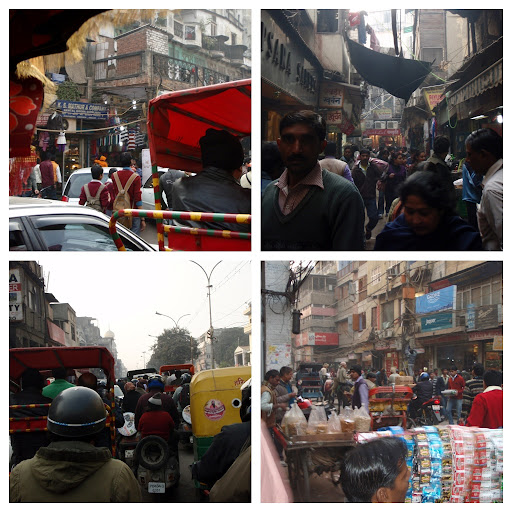
Photos taken while precariously balanced on a cycle rickshaw travelling through Old Delhi.

I see dead people


It is a strange fact that the best people to visit in Delhi are dead. Since Hindu death rituals involve cremation, rather than burial, only the tombs of India's Islamic rulers survive as monuments to its history. Oddly, there are very few examples of palaces for these ancient rulers with even the Taj Mahal --India's most famous landmark-- being a mausoleum built for the third wife of the Mughal emperor, Shah Jahan. One is forced to conclude that each ruler dedicated his time to building the most magnificent resting place possible, while camped at the construction site in a degradable mud hut.

The fee to entre the main tourist sites around India is two tiered, with the fee for foreigners typically over a factor of ten higher than that for Indians. Still, even with this discrepancy, the cost was not unreasonable being typically 250 rupees or about $5. (The Taj Mahal was the high exception at 750 rupees for foreigners but then... it was the Taj Mahal). I didn't feel this difference was unfair, since maintenance of these buildings must be fairly phenomenal yet a single price would mean most locals couldn't enjoy their own city. My friend pointed out the only possible problem would be for visitors from countries such as Sri Lanka, whose economy was weaker than India's own. Possibly, the solution would be for them to claim to be local. With 1,652 mother tongues recorded in the Indian 1961 census, it would be hard to prove otherwise.

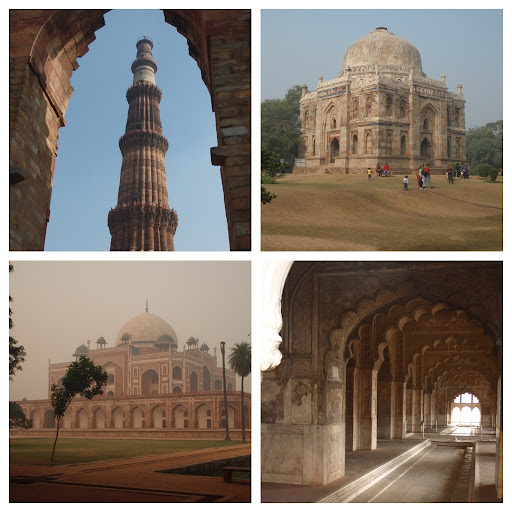
We started our exploration of India's great dead at the Qutub Minar: a tower 72.5 meters high made of red sandstone with decorative elements reflecting both Islamic and Hindu styles. Its construction was begun by the first Sultan of Delhi, Qutb-ud-din Aibak in 1192 and completed by his slave-turned-son-in-law and third Sultan, Iltutmish (and you thought America was the land of opportunity). The latter's tomb is in the same complex along with a few other Sultan's.

From there, we moved onto Lodi Gardens where multiple tombs from the 15th century lie in extensive gardens where families were picnicking and other... uh, soon-to-be-families... were doing slightly more than picnicking. Like in Chile, children in India typically live with their families until marriage, making the possibility of 'getting a room' rather slim. Also like Chile, there are stray, but friendly, dogs everywhere. Woof.

Next we visited Emperor Humayun's tomb, commissioned in 1562 by the Emperor's wife. Not only does this vast building contain the impressive resting place of the above mentioned deceased, but its plinth houses a further fifty-six cells in which rest over 100 other gravestones. Slightly strangely, these hangers-on are not all neatly stashed away inside the rooms but a select few seem randomly dropped outside the door as if left there by mistake. I suggested this was laziness on behalf of the people charged to do the burying while my friend opted for a building error like in 'Sim City' where you mistakenly place objects with an accidental click of a mouse button.

Some tombs, like the one above, were built by the grieving loved ones of the deceased as either a loving memorial or out of desire to maintain their own status. More tombs, however, were built by their owner during his lifetime. This seems a somewhat morbid occupation for a king, and doubly odd since no sign of where he might have lived in life survives.

The one exception to this is the Red Fort in Delhi. Outside, it appears to be a stronghold in red sandstone but, rather like a cream filled chocolate, once through its forbidding walls you reach an area of extravagant pleasure in white marble. Built in the 17th century, it was the residence of the royal family, with open walled buildings through which waterways ran. Clearly, one was suppose to laze by the pool side and.... think about the tomb you wanted to construct.

--
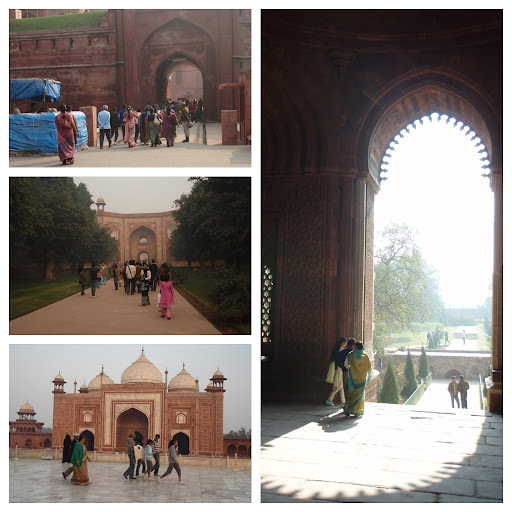
[Top image, clockwise from top left: the Qutub Minar, Lodi gardens, the Red Fort in Delhi and Humayun's tomb]

Hello!


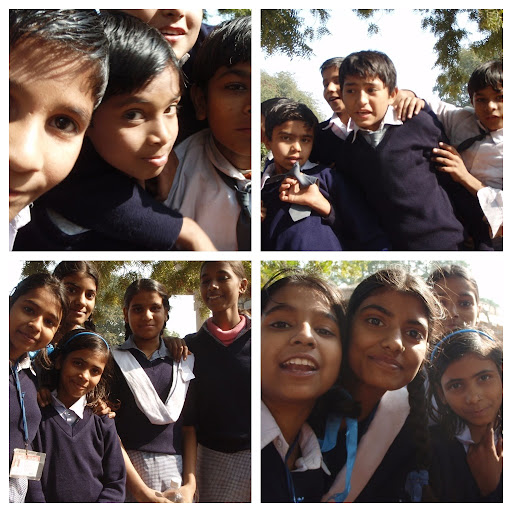
We were at one of the main tourist sites of Delhi and I was being mauled by children.

"Hello!"

"Take my photo!"

"And me!"

"Us! Us!"

It was good that my friend had warned me this might happen or I might have suspected such enthusiasm was a distraction to lift my purse; not an uncommon occurrence in parts of southern Europe. However, these children genuinely wanted to say hello to the foreigner, shake hands and have their photo taken. Some of them approached shyly in ones and twos and held out their hand with a polite 'hello', but others decided numbers were the key and surrounded me in an excited bubble.

"These are not private schools," my friend explained. "Their families are not so well off so they might not have seen a camera many times before."

I was surprised by this since the children were all dressed in immaculate uniforms that looked better than most of the private schools at home. There were several different schools visiting this site today, with the group currently accosting me wearing western-style white shirts and dark blue sweaters. Another group that were due to jump me in about 3 minutes wore white shalwar kameez --traditional dress consisting of loose trousers covered with a thigh-length tunic-- and a burgundy school sweater over the top.

Presentation, my friend explained, is important in Indian schools and there are monitors appointed to check the children arrive dressed neatly.

It was still impressive. To me, white trousers and a day trip did not equal long standing aesthetic bliss but apparently India manages it.

Things never to be experienced

"I finally got confirmation of your room reservation this morning." The friend I was visiting in India told me once we has piled into an airport taxi. "If I hadn't, I would have had to put you in my friend's room but... then you would have had to deal with the toilets."

"I'm sure I could have managed." I told her with cheerful bravado.

"No." She shook her head adamantly. "Some things should not be experienced."

Probably best not to over think that one.

India welcomes clean people

"We will now begin a disinfectant spray. This is government regulations."

I straightened from the slumped position in my seat that I had gradually sunk into during the flight connection from Hong Kong to Delhi. Sprayed?! What was the implication here? I had showered that morning! Admittedly, given the length of the flight from Sapporo and the different time zones, 'that morning' was a slightly vague concept but I was clean! Probably.

(I was to learn later that no one would think this was true, since there was a belief in India that people from cold countries didn't bother washing nearly as much as they should.)

Flight attendants started to walk down the aisles holding three smoking canisters that resembled the cockroach bomb I had used in my apartment in New York. This unfortunate analogy didn't help my feeling of affrontation. The smell from the smoke was sickly sweet and those with contact lenses were advised to close their eyes. I coughed.

It amused me that such precautions were necessary for India; a country whose big cities battled against congested traffic and pollution. In fact, it seemed more the sort of precaution that Japan might introduce. I hoped no one suggested it to them.

Oddly, the same de-roaching process was repeated on the way out. Seemingly, not only was it forbidden to remove the currency from the country but also any top secret germs you might have stolen while in residence.

However, for now it was over and with a bump, we had landed in India. One plane of squeaky clean passengers safe for admission.

Slippery grips


I have discovered the all-time greatest invention in the world.

... if you live in a snow filled city with an ethos that suggests snowploughs are for the weak.

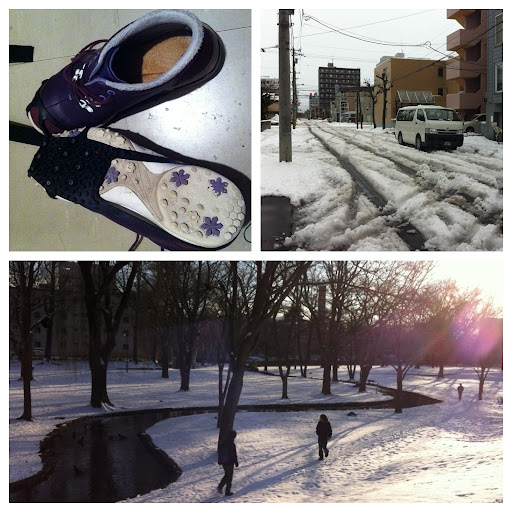
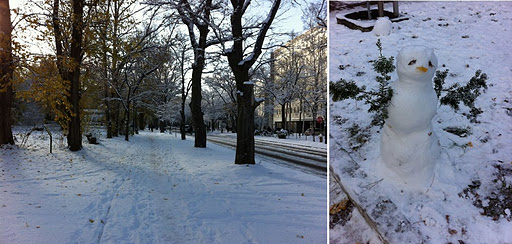
It is true that the heaps of powdery white flakes in Sapporo interspersed with trees covered in Christmas lights have a story book beauty. But no Disney princess ever stepped outside to slide across the street on her backside and break every bone in her skinny body. After a month of snow, I concluded that this was the most unrealistic part of fairy tales; Cinderella should have attended the ball on crutches and the Sleeping Beauty laid in traction on her bed.

The main roads through Sapporo are scrapped by snowploughs yet, compared to Canada, still seem buried for a large part of the day. I'm unsure whether this is a reflection of the relative quantities of snow in Sapporo versus Toronto or a nature-produced traffic calming measure encouraged by the Hokkaido government.

Pavements, by contrast, are not cleared at all. There is no obligation by home owners to clear the walkway in front of their house and --with the exception of the fronts of some businesses or apartment complexes-- the snow mounts up to form a bumpy slick causeway.

There isn't an easy solution to this. While I lived in Canada, I was legally obliged to clear the pavement around my apartment. This was a good (if tedious) idea in principal, but I often found that the thin layer of ice that would appear a minute after clearing was more deadly to traverse than the snow. Indeed, the hardest area on which to walk in Sapporo are the clearer roads which often are covered in black ice. Typically, within this category, the most treacherous surface are the white lines of the pedestrian crossing; a fact that makes me convinced all the city officials go to the southern island of Kyushu over the winter.

Work has become a dangerous expedition. Lunch, doubly so.

Then I saw the solution. Hanging up in the University's bookstore were a pair of crampon-esque attachments. Consisting of studs affixed to a rubber strap, these snap over the soles of your shoes to provide a better grip on snow covered surfaces. Amazingly, not only do they fit my shoes easily, they also make a significant difference, halving the time it now takes me to get anywhere in the city.

Admittedly, there is not much that can help you with ice on roadways, but for the slippery snow piles on the pavements they are unbeatable.

I was so much in love with this clothing addition, I've brought them to India. You can NEVER TELL when you might need such items. Armageddon? Bring it on.

Covering options

In preparation for my trip next week, I needed to buy travel insurance. Since I would be away from Japan for almost three months in total, health coverage was my primary concern along with an extra boost in case one of my 101 connecting flights left me checking airport vending machines for a turkey Christmas dinner.
Hokkaido University sold such insurance packages and so on Thursday afternoon, I skidded across to the appropriate building. With me, I towed one of my friends to act as a translator, all the while assuring her that buying travel insurance was first class practice for writing her thesis, the draft of which was due the following week.

At the appropriate desk, we examined the brochure of options. My type of trip had a choice of three different packages for coverage. Each of these included a set amount for health costs, lost luggage, missed flight and --on a cheerful note-- compensation for death by illness and death by wounding.

The first three of these categories had different maximum amounts, depending on the option you selected. This was all good and understandable; depending on the number of flight
connections you would make, the value of your luggage and your
propensity for tightrope walking without a safety harness, you might
want more or less coverage in these areas. What was rather more perplexing was that while 'death by illness' had the same fixed amount in all cases, you could select different sums for 'death by wounding'.

Now, let us think about the thought process that must go into such a decision. Presumably, it starts as follows:

"Hmm. Yes, it is rather likely I will be stabbed to death in a dark alleyway on this visit."

OK, there are probably circumstances in which such a conclusion is inevitable. However, SURELY most people would CANCEL THEIR TRIP as opposed to thinking:

"I better take out the extended coverage for death by knifing in dark alleyways."

But no! Apparently, there are a whole class of people who, faced with probable death by violent homicide, consider the prudent course of action to take out more insurance.

GUYS! YOU DON'T GET TO SPEND IT!

I kept to the basic level of insurance for this nicety and pocketed the extra cash. Then I spent it. That's how to live, people.

Cutting it fine

One morning I looked in the mirror and realised something profound:
I looked like a hedgehog.

For me, the state of my hair is a step function; everything is just fine until EXPLODING SPINY HEDGEPIGS! It's really not. This is probably more a reflection of my tolerance level than the actual process of hairstyle degradation but then, I only got furniture a couple of weeks ago so I think I can be forgiven for having my mind on other matters.

There was also the fact that I could see a trip to the salon going horribly and awfully wrong. For a start, I wasn't yet at the stage where I could have a remotely useful conversation about such a topic in Japanese. I knew the word for 'cut' and for 'hair' but that much was probably deducible from my presence in the shop. I suspected that, even with a photo, any hairdresser would feel anxious about wielding items with (quickly) irreversible effects without more than optimistic finger snipping motions from their client. 

Then there was the fact that my hair wasn't typical of the local population. Quite how different Asian and Western hair was for a stylist was a mystery. I wouldn't have thought my hair was particularly tricky; it has a slight wave and a cowslick but it's not a pile of tight ringlets. Still, since I had yet to meet the Japanese pop star of my dreams, I hadn't had the opportunity to run my fingers through other locks to find out.

Being as it was the beginning of December, I could have gritted my teeth for another few weeks and just had it cut in the UK. However, this did not really seem like a long-term solution. Instead, I sent a message to a fellow Sapporo blogger who was originally from South Africa. She had an inviting button on her website labelled 'Ask' which was probably designed to instigate insightful questions such as 'What are your views on the Japanese economy?' or 'Is teaching abroad challenging?' or maybe 'Do you miss zebras?'. What she got from me was 'Do you know of an English speaking hairdresser in Sapporo?' Mundane but oh, what an amazingly affirmative answer! I made an appointment the following weekend and a mental note to ask about zebras later.

Rie from 'Earth' salon trained in London and had lived there for ten years. She was therefore fluent in English, used to Western hair and knew some aspects of the Japanese hairdressing experience would take me by surprise. Like the fact they cover your face with a towel while they wash your hair. Had she not warned me, I might have taken that rather personally.

After the shampoo came a massage. This wasn't just a scalp rub during the wash, but a head, neck and shoulder kneading that lasted about ten minutes. To be honest, I wasn't wearing the best sweater for this; it was a thick white fleece that the girl performing the massage declared was 'fuwa-fuwa', a Japanese onomatopoeia (read: peculiar sound) used for all things furry.

"Have you heard of Reiki?" Rie asked me when she returned. "People say it's Japanese, but we've never heard of it! Reiki?" she asked the girl massaging my shoulders. She got a completely blank look in return. "See?"

Rie took over and began to cut my hair. "When I first moved to London," she told me. "I was too scared to go to a salon because I didn't speak English at the time. Did you feel the same?"

... was there something about my current hair style that suggested the answer to this might be yes?

Rie told me that not only is Asian hair a very different texture from my own Caucasian strands but also the head shape is distinct, being typically flatter at the back. This makes the cut a significantly tailored process. She took a brief note of my photo but then went her own direction, sweeping my hair towards the front. I went slightly cross-eyed as a lock fell between by eyes. She gave it a trim.

"Your hair doesn't want to fall in a parting, it wants to go in a swirl."

I hoped this wasn't a new bodily commentary about the state of my life.

At the end of the cut, I was offered another rinse, but since everything had been beautifully styled I declined. Peaking in the mirror on the way out, I thought the result was slightly Asian.... you know, in a blond haired, blue eyed, pointy nosed sort of way. Maybe it will help with my language skills. Beats talking to a hedgehog in any case.

Silver & Rupees

Banks in Japan have not yet taken to the notion of convenient opening hours. This includes CitiBank which, despite being a branch of an American business, has hours only between 9am and 3pm, Monday to Friday.

It was therefore Friday lunchtime when I slipped my way along the snow-packed street to see if I could acquire some Indian rupees for my trip in two weeks.

The answer was no.

But the woman at the branch did give me a map, directing me to the location of a currency exchange two blocks further south. Sliding along the ice and thinking this was almost thick enough for skates, I arrived at the "Travelex" kiosk, which was hidden inside a different bank, tucked out of sight of the entrance between the ATM and toilets, as if it were rather an embarrassing act to want to change Japanese Yen for any other currency.

Given the current state of the Euro, I could see where they were coming from.

"I'd like to exchange Yen for Indian rupees," I told the lady at the counter.

She checked her computer system, but then shook her head. "I'm sorry, we do not offer Indian rupees."

"... Can you not order them?" I could understand not having all currencies in stock, but surely they could be acquired.

Again she shook her head. "We do not offer them," she repeated. "I have Indonesian rupiah."

I appreciated the effort at a compromise, but unfortunately this was going to be an area where I stubbornly stuck to my original request quite beyond all reason.

"I really need Indian rupees," I persisted. "Since I'm going to India."

"Ah," the woman nodded as if agreeing this would be a problem. "You cannot get them in Japan."

No where in Japan?! I didn't quite know what to say to such blanket authority so I thanked her and left. It was only when I was half way back to campus (this taking a considerable period of time due to the weather) that I remembered reading on the website for 'The Rough Guide' that rupees were not supposed to be taken out of India. The guide had focussed on visitors with spare change and had said that, while this rule was not strictly enforced, there were currency exchanges at the airport for this reason. It had not occurred to me before now that such a rule would prevent me taking out cash in advance.

This wasn't a particular problem; since I was travelling to Delhi, any major bank in the city would likely accept either cash or credit card.

Clearly, this was just simply a case where it doesn't pay to be too organised. Literally.

Hello home!

I sat on the corner of my bed and debated whether I was pleased that I had understood the last twenty minutes of the moving men's Japanese conversation or disturbed that it had consisted solely of the phrases:

"This is difficult, isn't it?"

and

"Dangerous, dangerous!"

How the movers had got my office desk into the elevator was to be a mystery for all time. Later, when the movers went back to the truck to collect more boxes, I sneaked out of my apartment and took a look down the hallway. As far as I could see, the lift was unaltered. Maybe, like the Harry Potter Room of Requirement, such feats could only be achieved in times of dire need. Such as when the alternative was nine flights of outdoor concrete steps in a snow storm.

Now though, the desk was wedged between my doorway and the bathroom as it was inched painstakingly around the two right angle bends into my main room. The walls, floors and fitted cupboards had all been covered with thick protective paper. My online dictionary had informed me that string had just been called for, possibly to reattach the fingers of the mover who had just shouted 'dangerous!'.

I was promptly seized by a strong desire to use the toilet.

Instead, I decided to live blog the entire proceeding on Facebook.

Then, two amazing events occurred. The first was that the desk was in my apartment and no one had died. The second was that it was a perfect fit for the alcove by my window. It could have been made for it... by a different architect to the one who had designed the entrance way. The fit was so snug that it wasn't possible for the person lifting the back of the desk to escape once it was in place. Personally, I would have got the desk near enough and pushed, but this was evidently not the slap-dash solution that was acceptable in Japan. Instead, one of the movers backed into the corner and then climbed out through the window onto the balcony, returning through the patio doors.

... then they realised they hadn't put the metal feet back on the desk.

Back the man climbed, the feet fitted and the desk lifted back into position. I could really only gape in admiration. After this came the bookcases, the desk chair, the dresser and boxes and boxes of books.

"I like books," I told the men cheerfully in Japanese.

If I were honest, I'd say the resulting laughter was rather dry.

I sat on my bed with the list of boxes I had been given in Canada. As each new box came in, one of the movers shouted the number out in English. I repeated it in Japanese and we both ticked it off our lists.

There was something slightly odd about that, but I didn't have time to dwell on it.

Finally, everything was in my apartment apart from the sofabed which seemed to be taking 5 in the hallway. Then the men started opening the boxes.

They were going to unpack. Seriously?!

THIS WAS THE GREATEST THING EVER!

I suppose since the company in Canada had packed, unpacking was part of the service but I was still taken by surprise. Not that I was about to complain; possibly the greatest part of this would be that the movers would take away all the empty boxes. In a place where my trash was already sorted into seven different containers, I did not relish the prospect of dealing with all the cardboard.

One of the men lifted up a collection of small books and studied the covers for a moment. "Japanese," he said in surprise. "Tenisu no Oujisama."

"Echizen Ryoma." Another of the other movers volunteered the progenitor's name in the series.

Oh guys, you have only just touched on my obsession here. Wait until you find the other comics, the CD singles and the fan-made, explicitly drawn, doujinshi manga...

... actually, I should probably find that first. Grabbing a likely looking box, I ripped off the tape.

In another box, my astrophysics texts had been found. One of the men lifted up the copy of "An Introduction to Modern Astrophysics" with two hands and an expression that said he'd found the reason he wasn't going to be able to walk tomorrow morning.

"Tenmongaku," I said cheerfully. "Astronomy."

"Hn," came the disgruntled answer.

My queen-sized duvet had become the flattened size of a pillow during its three months of captivity. I fluffed it about and then left it in a corner to think about air.

Finally (now there was some floor space) the sofabed was guided into position and --just for that final mind blowing effort-- one of the movers polished the floor with a cloth in case he had left a mark. It was doubtful he had; before they started the agonising process of getting the desk into the apartment, all the movers had politely taken off their shoes. Only in Japan.

Japan is a totally non-tipping culture. You don't leave extra money in restaurants, taxis or bars. Nevertheless, these movers had done an extraordinary job and I would have liked to give them something. I dug out my computer from under the inflating duvet and sent out a quick message to a Japanese friend:

"Can I tip?"

She wrote back, "You don't have to, but you can if you think they were really good."

I glanced over at the desk. Hell yes.

As the men prepared to leave, I handed one of the movers a small pile of notes. He stepped back in refusal but took them when I tried to explain that I thought their work had been amazing. Hopefully this means that tipping was OK and not that I have condemned him to a life of HARDSHIP, PAIN and MISERY while he tries to explain the extra income to his boss, his wife and his particularly accusatory pet dog.

Then they were gone. I moved from the cushion on the floor to the sofa and examined the contents of the room. Ooh, hello snowboots, how I've missed you!

The times they are a-changin'


There is a saying among the Japanese that Japan is the only country to have four seasons.

Obviously, this is complete crap

... and yet ...

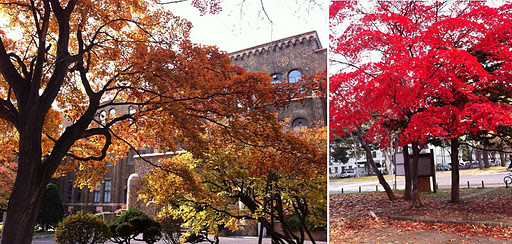
There is no denying that Japan pays some serious dues to the turning of the year. The most famous seasonal change is the fleeting appearance of the cherry blossoms heralding the arrival of spring. These pink and white delicate delights deck the trees for no more than a few weeks, but are probably more photographed during their brief lifetime than Britain’s newly wed royal couple.

Prior to this year, Autumn for me had been that drawn-out wet interval between summer and winter in which I stopped considering myself dressed without a sweater. At some point during that period, the tree leaves would change colour and and fall, leaving their hosts standing around like forgotten clothes racks for months on end.

In Sapporo, it turned out to be quite impossible not to fully appreciate the spectacular foliage.

This was because every man and his dog was on campus, taking photographs with giant zoom lenses. It was stop or be penetrated in a place that would give both you and the would-be viewers of the picture collection a nasty surprise.

To be fair, the colours were amazing. I am unsure whether it was to do with the number of trees, the fact they were all deciduous or if the range of hue was just particularly large. Trees with bark that appeared almost black were donned with leaves in a uniform deep red. Along one of the main roads, more trees in orange, yellows and pale greens tangled their branches in a mix that gave me an unnatural urge[*] to decorate my entire apartment like a pumpkin. There were areas away from the road where the leaves had been allowed to collect in a carpet of rust and gold; the ultimate honey trap for the visiting photographers.

On my less amenable days when my focus was lunch, not leaves, I did think it was a pity that said leafy ball pens couldn’t be booby-trapped to superglue all the visitors in one place and out of my way. However, their cameras did look passingly like rifles and, given the convenience of Japanese technology, it was probably best not to risk anything.

"Snow next week." I was told grimly when I finally escaped the heaving Nikon mass to reach the department.

Feh, snow! The start of winter is never exciting. Rain that you have to squint sideways at to see that it's actually slush, not even a dusting of white on the pavement. The only disappointment is the likelihood of it knocking the leaves prematurely from the trees.

I woke up on the morning of the expected snowfall and looked out of my window.


Bam. Goodbye Autumn. Hello Winter.

Is this unusual?” I asked my friends once I had bundled on all the clothes I had brought with me from Canada and skidded into work. “Shouldn’t there be.... well... a gap between the height of Autumn and that of Winter?

Actually, the snow is kind of late this year,” came the reply.

"But...." I protested. "They'll be a mix of days? Some snow, then warm then..."

I received blank looks in return.

No, it is now winter. Get with the program.

--
[*] No one would has seen me wield a paintbrush would consider such an endevour a good idea.

The beauty of tea

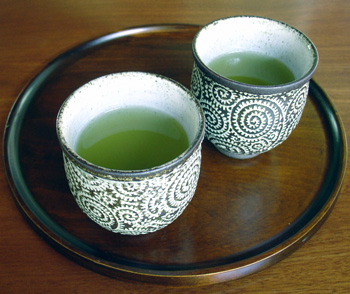
teaThere were two handle-less cups in front of me. One was an emerald green on the outside but white within. It was empty apart from a few dregs of damp green leaves stuck to its bottom. The second, wider cup, was made of porcelain in a light brown with leaves etched onto its surface. It held a freshly brewed black tea. Transferring my attention to this more promising item, I lifted the cup by pressing both sets of fingers to its rim and sipped.
"Did we need to change cups?" the woman sitting beside me inquired to our host, a Japanese lady who was the librarian in the Physics department. She had kindly invited me and the other female foreign professor in the department to her house for dinner. We had eaten nabe; a dish in which multiple foods are cooked in boiling water on a portable stove placed at the centre of the table. Our nabe had contained chicken, scallops, tofu and noodles. Removing chicken from the bone with chopsticks while trying to maintain the very greatest of manners was not easy. I wasn't totally sure I had succeeded. Still, no one had reacted in horror and thrown me off the balcony and some days, you have to consider that a success.

We had now moved onto tea, an area where I felt far more confident. I was British after all. The British understand tea.

I had presumed that we had been offered clean cups because the tea blend had changed. I personally would have been happy using the same container, but there was a delicateness to the way our host had added boiling water to a jug before dividing it perfectly between the three cups that suggested such reuse would be a crime against nature.

Our host however, shook her head. "There is no rule," she told us. "But green tea looks best when it is in a cup with a white interior." She indicated the pale ceramic of the empty vessels on the table. This elicited a nod of deep understanding from the other professor.

If I was strictly honest, I couldn't see much of a difference in shade between the inside of my first cup and the one I was holding now. This probably suggested I was barbarically uncultured. I examined my tea. This in itself was a strange act.

Rising from the table, our host opened a cabinet that seemed to contain a wide variety of different crockery. She held out a red cup. "This would be bad for red tea," she told us. "But good for coffee."

I sadly concluded I did not in fact understand tea. There was a whole school of aesthetics that our brown teapot at home had never fully epitomized.

In defense of tomorrow

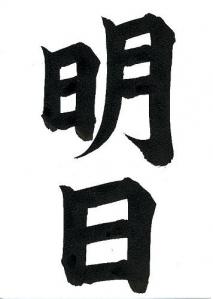
"What is the meaning of this Kanji?" Our teacher highlighted two Chinese characters on the sheet being projected to the screen in front of us. One looked a bit like a flower. The other, like a child's climbing frame.
"らいねん," we volunteered as a class. "Next year."
来年 rai-nen.

"And this one?"

The flower was still there but the climbing frame had been replaced by a broken ladder with the bottom-most rung twisted free.

"らいげつ," we replied. "Next month."
来月 rai-getsu.

"How about this one?"

Again, the same flower but now alongside a small chest of drawers.

"らいにち," we started confidently and then paused. "… next day?"
来日 rai-nichi.

"In this case," our teacher explained. "日 (nichi) is understood as if it were 日本 (nihon), Japan. So it means: 'coming to Japan'."

There was a silence as we took this in.

"…. why doesn't it mean 'next day'…?" asked someone at last.
a.k.a. Defend your language, Japanese person!

Our teacher paused. "Well, what is the Japanese for 'next day' or tomorrow?"

"あした," we all chorused.
明日 ashita.

"Yes. That's why."
a.k.a. Silence, you foreigners!

--
(Note: らいねん, らいげつ, らいにち and あした are written in the phonetic Japanese script, hiragana.)

Betrayal

shoeI feel so betrayed.

It all began when I set out on an outrageous quest to buy a new pair of trainers. The ones I was currently wearing looked fine, but the sole was thin and I was getting blisters.

While Sapporo is surrounded by high mountains, the city itself is amazingly flat. This makes it great for walking, causing me to neglect all forms of public transport and hop around the city like a teenager without a driving license. The upshot of this was that I had found the location of 101 backstreet Raman bars and had craters in my feet that looked like there were rodent-sized bed bugs hiding in my futon.

I was reasonably sure it was the shoes.

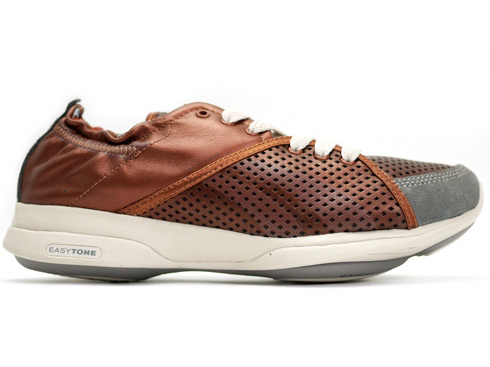
The pair I wanted were in a deep rust-colour and looked more like a fashion shoe than sports equipment. Despite this, they had a proper sole that was used throughout the brand's entire "easytone" range that included designs for serious gym workouts. This --I decided-- should allow me dress as if I were going to check out a few shops, but still provide enough suspension for a 10 mile run around the town. No one would suspect my crazy ways, oh no! At least, not until I hurtle into them.

The first shop I tried was in the indoor mall on the east side of town. They had the shoes in stock, but the largest size was a UK 5.5 (about a US women's 8). I normally take a UK 6, but I gave the 5.5 a try. Two minutes inside that shoe confirmed that I would have to lose at least three toes for a proper fit and somehow I didn't think that would help my walking problems. Peeved, but undefeated, I set off to the centre of town to try another few stores.

... only to find exactly the same problem.

I have never considered my feet large. In fact, I always thought I was a little smaller than average. It turns out this was a mistake.

I clearly have the foot size of an obese yeti.

"Maximum size." One of the shop attendants finally broke it to me, tapping the squiffy 5.5 box with a finger. He held out a different trainer in the 'easytone' men's range. "We have these in a 6."

To be fair, these other shoes were pretty nice. They just weren't the cute, golden brown chestnut delights I had completely set my heart on. The sort of shoes that I had determined it would be impossible to look bad in due to their radiative glow of adorable magnificence.

.... When you're coming from such an angle, it is hard to consider a different design.

A look around the shop did inform me that I was just unlucky with that particular brand. Other shoes for woman went up to at least a UK 6 or 7. Apparently, the 'easytone' shoes were very much focussed on the petit Japanese woman. As I left, I went back and glanced at the box of the shoes I was forbidden to wear.

The brand was Reebox.

A British brand.

Made only for Japanese women.

I feel so betrayed.

Nobody could make this up

"Welcome to Japan."

It was a promising start to an email that was from a relocation company in Tokyo, the people who had just taken over the details of the shipment of my possessions from Canada.

The movers had come at the end of August and squirrelled away my worldly goods, whereupon they were taken first to Toronto and then to Vancouver, before being loaded onto a boat to Hong Kong.

I have no idea why we had to go via China. Maybe it was ex-Commonwealth love for Hong Kong or because all goods come from China, so they feel obliged to drop back in once in a while.

Last Tuesday, I was informed the shipment with my beloved artifacts had left Chinese shores and would arrive in Yokohama in a week. Yokohama is south of Tokyo, so still a good 700 miles from Sapporo but considerably nearer than Vancouver. At this point, everything would need to clear Japanese customs.

The relocation company requested I mail them the following documents in preparation:

(1) A clear copy of my passport showing the photo page

(2) The customs form I had filled in when I entered Japan, stating there would be unaccompanied articles to follow.

(3) A copy of my most recent immigration entry stamp.

(4) And finally, a copy of my work visa page which must be valid for at least one year.

The one I was clearly not expected to have was number (2), the request for which was followed by a slightly panicked note saying "Hoping you have chance to complete this form during your arrival in Japan??". There was no need to worry, I had remembered to fill in the appropriate form in duplicate, keeping one copy back for this purpose.

No. The problem was so much worse than that.

I had a visa, but it had been issued for a single year since the start of my position last July. This meant it was only valid for another 8 months.

Hmm --I hear you say-- perhaps you could renew your visa now and ask for the process to be expedited?

Such a course of action might well be worth investigating, if my passport had any free double pages.

It does not.

I have two single pages devoid of stamps, but a visa requires a clear double page. My plan was to renew my passport when I returned to the UK at Christmas, thereby acquiring a whole book full of deliciously blank sheets for inky fingered border control guards to smudge up like kids on a crayola high.

Could extra space be quickly added to my passport? The UK passport office has the following to say on the subject of additional pages:

27. Can the Passport Office add pages to my current passport if it is full?
No.

Well then, perhaps I could renew my passport in Japan instead? It transpires, however, that the British Embassy in Tokyo no longer issues British passports. Rather, you must send your application to Hong Kong (anyone seeing a sinister pattern emerging here?) who then send everything away to the UK. The processing time --the webpage ironically entitled 'Help for British Nationals' informed me-- would take at least four weeks.

I leave Japan in 5.

And I'm not back until February 25th.

With my cat.

If I was just heading off on a single jaunt for those two months, I could probably postpone my trip, clear everything through customs and then leave the country knowing all is well in hand. As it happens, the exit next month marks the start of a round-the-world trip that sees me spending a week in India, home for Christmas in the UK and then onto Canada to work at my old institution for 7 weeks. Awesomely great. Awesomely awful to cancel.

Fortunately, the relocation company I was now dealing with seemed to have a practical mindset. Their suggestion was we send in the documents as if there is no problem and see what happens.

And if they send everything back to Canada…. well, I'll see it there.

Musical chairs

Reversible train seats

I had thought the Shinkansen seats were cool. They had the power sockets, the cybonic up-right chair backs and the leg room needed to satisfy a wookie with no knees. By the time I reached downtown Sapporo, I realised they were nothing more than second-rate, yesteryear designs in the same category as tape recorders and ball point pens.

It was true that the train that dragged itself up to the platform at New Chitose Airport did not look like it had the capacity to rock my world. It appeared as the standard rattly locomotive that did the subway rounds. Motion in general did not seem to be a strong priority, either in getting to our final destination of showing up at the airport in the first place.

I stepped on board behind an elderly man who was using his wheeled suitcase as a cane. We entered one of the back carriages to see the seats all facing the rear of the train. I was unfazed by this. My childhood Hornby model railway set had taught me that locomotives can clip equally onto the back and front of trains, so it was inevitable that sometimes the seats would be reversed. It was perhaps a little unfortunate, since I found that travelling with my back to the engine occasionally made me travel sick. However, since all the seats in this carriage faced the same way, I could probably vomit over the person in front of me and be off the train before they could truly kick up a fuss.

The old man was having none of it.

He released one hand from his suitcase and grabbed the handle on the side of one of the seats. With a squeaking of hinges, the back of the chair slid over the seat cushion to clunk down on the opposite side. The man then sat and looked expectantly out of the window towards the direction we were headed.

Well, that was surprising.

I took a quick look around the carriage and then gingerly stood up and pulled on my own seat handle. With an identical thump, the seat direction also reversed, accidentally crushing my carry-on as it did. I sat down hastily.

Shortly after this discovery, a group of school kids climbed on board. They proceeded to redesign the rest of the carriage, making some seats face each other and others stand in rows. It was possibly a complex reflection of their social network or more probably the result of each boy feeling the urge to move a least one chair before sitting down.

Rather like the desire to use the bathroom as soon as an exam starts, it only now occurred to me that I really wanted to take a photo of a chair half-way through its repositioning. There was the perfect single seat right in front of me but it contained a small girl.

A line of thought suggested that this wasn't really a barrier to me suddenly moving it.

I suppressed the notion.

Fortunately for all, the girl exited the train at the next station and, as we started to move again, I leaned forward and pushed on the seat handle, snapping a photo as the chair back moved. Behind me, the gaggle of boys went briefly quiet. I did not turn around. Travel on a UK train, kids, and you'll be composing Haiku to these by the time you return.

License to drink

I walked boldly through the partitioned walkway to the security gate at Tokyo's Hanada airport. Nestled within my grey carry-on was one 150 ml bottle of moisturiser and a full sized tube of toothpaste (extra minty). Tucked into an outside pocket of my red rucksack was --bold as brass-- a bottle of fizzy orange soda I'd bought at a convenience store in downtown Tokyo.

Basically, I was armed up to the teeth.

Without hesitation, I dropped my pack onto the conveyor belt for the x-ray machine and then lifted out my laptop from the rucksack. That at least I had the good manners to declare, laying it gently in its own tray to be scanned separately.

"Anything in your coat pockets?" the security guard asked me, glancing briefly at my boarding pass for Sapporo.

Hell yes! My phone, wallet, keys and --just for good measure-- a sachet of liquid bubble bath I'd swiped from the hotel bathroom. I don't believe in doing things by half. Without bothering to list these items, I slid my arms out of the sleeves and slung the gortex onto another tray. Then, without even removing my shoes (possibly for the first time ever in a Japanese public building), I marched through the people scanner.

My carry-on, laptop and coat were already waiting for me at the other end. My rucksack was brought through by a security guard. He tapped the bottle of pop. "Check?" he asked.

I indicated he should go right ahead but as soon as he lifted the bottle he lost interest. "It's not open."

"No, still sealed," I agreed.

Contrarily, he slid it back into the pocket on the opposite side of the bag and handed bag plus bottle back to me. I went over to my gate and crack the top. Somehow it tastes so much better when it's brought from the other side of security.

When my flight came to board, I scanned my own boarding pass at the gate. Not once did I show any of the multiple forms of identification I was carrying[*]. My demonic plans for world domination were now irrevocably set.

Sitting next to me on the plane was a passenger with a stinking cold. He proceeded to buy two cans of beer.

.... might have to put a hold on domination plans until after Christmas.

--
[*] Note to self, birth records of all family members dating back to 1742 are not required on Japanese domestic flights.

Innovation of the work called programming

The theoretical astrophysics meeting at the National Observatory of Japan in Tokyo is primarily aimed at graduate students and as such, is one of the few science conferences to be held in Japanese. Despite this sounding like a recipe for unimaginable PAIN, CONFUSION and DISTRESS, I was chilled out for two reasons:

Firstly, I was informed my primary directive was to present myself to the Japan astronomy circuit which I pretty much achieved by walking through the door and eating sushi at the evening dinner.

Secondly, it was a theorist meeting. The talks were BOUND to have pretty movies. Words are so overrated. They are what observers need to justify strange grey blobs.

In fact, attending the talks turned out to be a bizarre walk through the babyland world of language learning. Before we left, I had asked my head of group whether the slides were likely to be in English, an occurrence that seemed common practice in the seminars I had attended in Hokkaido University. "Some might be" was the response that was elicited. By this, I presumed a few speakers might do their slides in English and others in Japanese.

This was not the case.

The reality was a completely random distribution of English and Japanese slides within the same talk. A presentation might be given entirely in Japanese but the list of concluding remarks written in English. Others had a sudden English slide buried in their midst and still more were written in Japanese throughout but would have a short paragraph or single phrase such as "Radial migration of disk stars" appearing unexpectedly half-way down a slide. 

No one else seemed to consider this the slightest bit surprising.

Possibly, I reasoned, presenters had borrowed slides from other talks they had previously given in English. However, this didn't really explain the language switch mid-slide. That more resembled the writer getting up for a cup of coffee, becoming momentarily inspired by a line of Macbeth, and returning to type up his presentation in English.

An additional help to my comprehension was the use of katakana. Katakana is a Japanese phonetic script for writing foreign words, a catagory that includes many scientific terms that have been adopted rather than translated. Reading katakana, however, isn't the most straight forward process since while it's often transcribing an English word.... it's English on crack.

"シミュレーション" for example, reads literally "shimyureeshon". It's only by experimentally dropping 'U's and switching around a few 'R's for 'L's and all the while pretending you are eating a gigantic gob stopper does it become clear that it reads "simulation". Likewise, "ユニバース" ("yunibaasu") can just about be crushed into "universe". Similar feats allowed me to extract "dark halo" (mysterious things around galaxies), "dust" (everywhere), "dead zone" (for planets, not people), "Andromeda" (nearby galaxy) and "model" (unrealistic creation that allows the opportunity to produce a follow-up paper). Oddly, one presenter obviously became tired of katakana and just plonked "thick disk" in the middle of his sentence in English.

In terms of understanding what was actually spoken I found my comprehension was inversely proportional to the usefulness of the phrase. Pretty much all nouns and verbs escaped me but I was right on the ball regarding terms such as "there is...", "yes, that's right" and "and after that we...". Basically, if you could take it out of the sentence without affecting the meaning, I was all over it.

The program for the three day meeting was written in Japanese but my head of group had run it through an online translator. The bot for this had done a surprisingly impressive job although I think my favourite talk title is definitely: "Innovation of work called programming". Appropriately, this presentation concluded the conference.