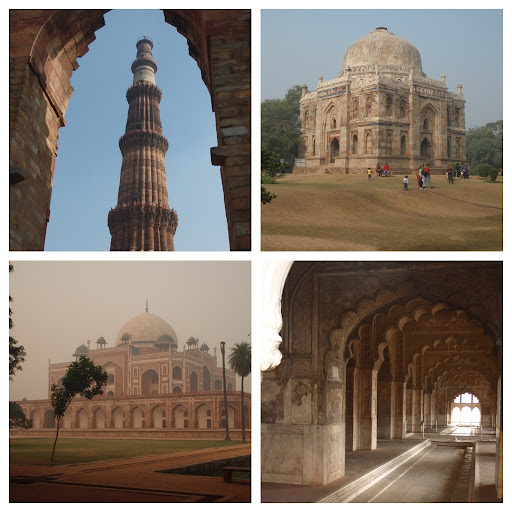
The fee to entre the main tourist sites around India is two tiered, with the fee for foreigners typically over a factor of ten higher than that for Indians. Still, even with this discrepancy, the cost was not unreasonable being typically 250 rupees or about $5. (The Taj Mahal was the high exception at 750 rupees for foreigners but then... it was the Taj Mahal). I didn't feel this difference was unfair, since maintenance of these buildings must be fairly phenomenal yet a single price would mean most locals couldn't enjoy their own city. My friend pointed out the only possible problem would be for visitors from countries such as Sri Lanka, whose economy was weaker than India's own. Possibly, the solution would be for them to claim to be local. With 1,652 mother tongues recorded in the Indian 1961 census, it would be hard to prove otherwise.
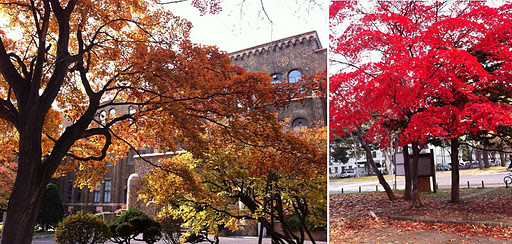
We started our exploration of India's great dead at the Qutub Minar: a tower 72.5 meters high made of red sandstone with decorative elements reflecting both Islamic and Hindu styles. Its construction was begun by the first Sultan of Delhi, Qutb-ud-din Aibak in 1192 and completed by his slave-turned-son-in-law and third Sultan, Iltutmish (and you thought America was the land of opportunity). The latter's tomb is in the same complex along with a few other Sultan's.
From there, we moved onto Lodi Gardens where multiple tombs from the 15th century lie in extensive gardens where families were picnicking and other... uh, soon-to-be-families... were doing slightly more than picnicking. Like in Chile, children in India typically live with their families until marriage, making the possibility of 'getting a room' rather slim. Also like Chile, there are stray, but friendly, dogs everywhere. Woof.
Next we visited Emperor Humayun's tomb, commissioned in 1562 by the Emperor's wife. Not only does this vast building contain the impressive resting place of the above mentioned deceased, but its plinth houses a further fifty-six cells in which rest over 100 other gravestones. Slightly strangely, these hangers-on are not all neatly stashed away inside the rooms but a select few seem randomly dropped outside the door as if left there by mistake. I suggested this was laziness on behalf of the people charged to do the burying while my friend opted for a building error like in 'Sim City' where you mistakenly place objects with an accidental click of a mouse button.
Some tombs, like the one above, were built by the grieving loved ones of the deceased as either a loving memorial or out of desire to maintain their own status. More tombs, however, were built by their owner during his lifetime. This seems a somewhat morbid occupation for a king, and doubly odd since no sign of where he might have lived in life survives.
The one exception to this is the Red Fort in Delhi. Outside, it appears to be a stronghold in red sandstone but, rather like a cream filled chocolate, once through its forbidding walls you reach an area of extravagant pleasure in white marble. Built in the 17th century, it was the residence of the royal family, with open walled buildings through which waterways ran. Clearly, one was suppose to laze by the pool side and.... think about the tomb you wanted to construct.
--
[Top image, clockwise from top left: the Qutub Minar, Lodi gardens, the Red Fort in Delhi and Humayun's tomb]
 In preparation for my trip next week, I needed to buy travel insurance. Since I would be away from Japan for almost three months in total, health coverage was my primary concern along with an extra boost in case one of my 101 connecting flights left me checking airport vending machines for a turkey Christmas dinner.
 One morning I looked in the mirror and realised something profound:
 Banks in Japan have not yet taken to the notion of convenient opening hours. This includes CitiBank which, despite being a branch of an American business, has hours only between 9am and 3pm, Monday to Friday.
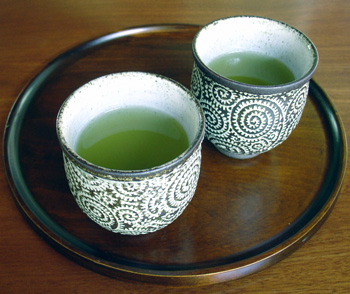 There were two handle-less cups in front of me. One was an emerald green on the outside but white within. It was empty apart from a few dregs of damp green leaves stuck to its bottom. The second, wider cup, was made of porcelain in a light brown with leaves etched onto its surface. It held a freshly brewed black tea. Transferring my attention to this more promising item, I lifted the cup by pressing both sets of fingers to its rim and sipped.
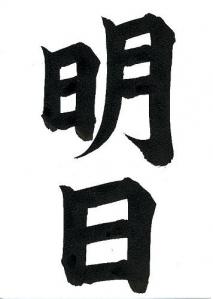 "What is the meaning of this Kanji?" Our teacher highlighted two Chinese characters on the sheet being projected to the screen in front of us. One looked a bit like a flower. The other, like a child's climbing frame.
 I feel so betrayed.
 For my train ride to Tokyo, I was issued with four identically sized tickets; one to take me down to Hakodate in the south of Hokkaido, one to bring me through the tunnel to Shin Aomori in Honshu and two for the Shinkansen bullet train to Tokyo. Standing in Shin Aomori station, I flexed the two card rectangles in my hand and wondered how the duplicate nature of this ride confirmation worked with the automatic ticket barriers. Presumably --I reasoned-- one ticket was a receipt or a seat reservation while the other would allow me to pass through the metal gates in full possession of my limbs. Experimentally, I inserted a likely looking ticket and stepped forward.