Revenge is a dish best served cold

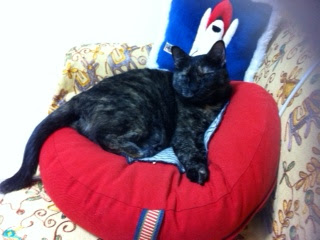
catbed.JPG

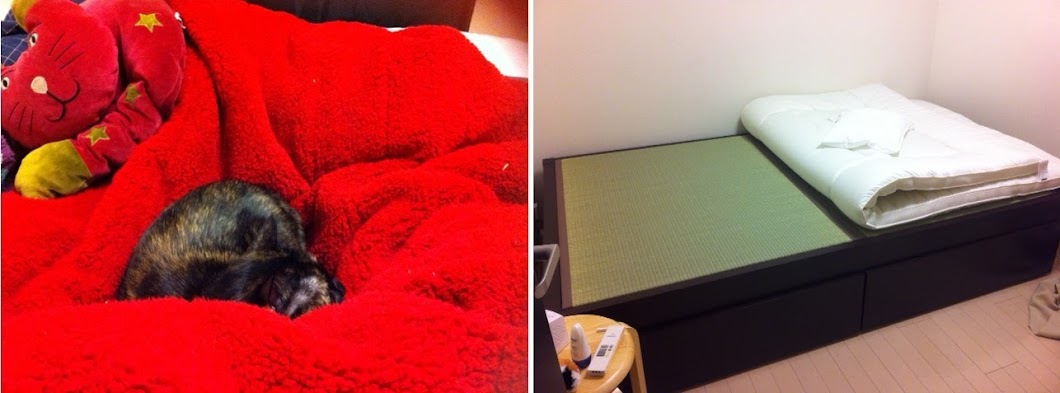
Trouble with getting out of bed in the mornings is hardly an unusual complaint. The difference is that while most people don't want to leave the warmth of their covers, I physically couldn't. Carefully, I attempted to extract the leg that was bunched up by my chest. The knee emerged, but the shin was still trapped under my second leg. This limb was stretched out, but prevented from moving away from the wall by the stone-like object positioned perfectly centrally on the blankets.

My cat had found her revenge.

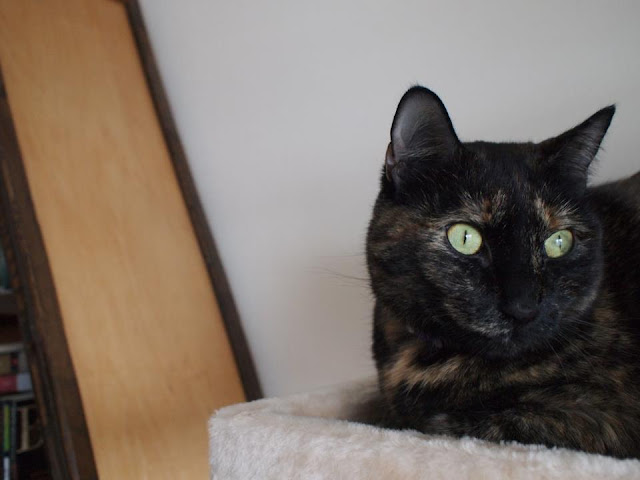
In the end, I tipped forward and fell ungraciously onto the floor. Tallis deigned to open one large yellow-green eye and yawned.

"Do you know how uncomfortable I am?" I demanded. "All my muscles are scrunched up!"

This didn't receive any form of verbal reply but somehow the image of the cat carrier was projected into my brain.

You would think one half-decent kick would shift Tallis along to a more acceptable position but somehow her body mass seems to increase by a factor of 100 when she goes into ball-mode. Remember the Pixar movie, 'The Incredibles' where their youngest son, Jack-Jack turns himself into a canon ball so the villain can't fly away with him? Yeah. Tallis recalls that too.

Perhaps to fully appreciate this problem, I should explain about my bed. When we lived in Canada, I had a Queen sized frame and mattress. To be honest, this was too large (or so I thought at the time) for what was normally just me and a cat. I had opted for that size to match the bedding I had bought while living in a furnished rental in New York. That apartment had a Queen bed, so when I came to buy my own furnishings, I matched the dimensions and reused the sheets. Despite the fact I loved the mattress, I knew a Queen bed was never going to fit in a Japanese apartment. I'm pretty sure that if you put such a mattress in my bedroom, you wouldn't be able to open the door. Actually, you would not be able to have a door at all, since my bedroom door opens inwards. It would have to be unhinged and propped up against the bathroom preventing me from ever using the toilet.

So, it was sell the bed or lose the kidneys. I went with the former.

Since my furniture took three months to ship from Canada, buying a new bed was actually a pretty good move. After some research, I discovered I had three main choices for bed design:

(1) The normal western-style bed with a frame and mattress. This is very common in Japan and almost all of my friends sleep on such a bed.

(2) The traditional Japanese-style futon, which consists of a thick foam pad on a tatami mat floor.

(3) A hybrid option, whereby you have a bed frame with a solid tatami mat top surface on which you then lay down a futon.

My apartment does not have any tatami mats, being pseudo-wood flooring throughout. However, I was reluctant to buy a normal western bed. For a start, I might not find a mattress I liked as much as my old one, which would cause me to SULK each time I went to bed. Secondly, I was IN JAPAN! It was exciting, new and I wanted to integrate by sleeping on a futon!

… Even if no one else was.

I therefore went for option (3) and, after some careful measuring, purchased a 'semi-double' tatami mat bed. A semi-double is in-between a single and double bed in size, with a width of 124 cm (49 inches). It is often the size newly wed Japanese couples buy, before they can afford a double bed. This brings me to one obvious conclusion:

Cats take up more space than husbands.

Or maybe they are just harder to kick.

A Japanese futon is somewhat different from the Western product of the same name. For a start, the term 'futon' refers to both to the foam pad underneath you (the 'shiki futon') and the blanket on top (the 'kakebuton'). The Brits would call a kakebuton a 'duvet' and the Americans… well, I'm going to go with 'comforter' and you'll have to live with the fact it just isn't the same kakebuton fluffy cloud of awesome. The shiki futon is thinner than a Western futon and can be easily folded into three sections for storage. Futons are often sold as a set containing both parts.

An advantage of opting for the tatami mat bed over a straight futon, was that I could have drawers underneath the bed for extra storage. When my bed was delivered, the men assembled the frame but not the drawer set. When I asked why, I received a monologue in Japanese until I decided I would just go and buy a screwdriver. As any Ikea fan will not be surprised to learn, I had to assemble the drawers twice; the first attempt having a key early panel placed backwards.

As a final touch, I purchased a Japanese style pillow which is filled with beans rather than feathers. It's a slightly odd sensation to lie on but it's not uncomfortable. I quite like rolling around on it as a DIY scalp massage. I confess though, that when my feathery pillows arrived from Canada, I did switch them over and leave beany pillow as the optional extra.

So there we had it; one perfectly Japanese bed. Tallis tells me it is exceedingly comfortable. Perhaps I should take the hint and move to the couch.

Jumbos


On the day I was born, my Dad went out to buy me my first toy. He chose a cuddly elephant; a simple design for infants with two big ears, a trunk, two feet and a rattle. The staff at the hospital were dismissive of this gift, informing my parents that babies were not interested in soft toys for many months.

THEY WERE WRONG.

Dad was later to say that this elephant was the most successful gift he had ever bought anyone. It became my constant companion and when I was old enough, I named it:

Jumbo

(Friends party to a recent discussion in which I attempted to name my iPod shuffle 'iPod shuffle' will now realise my inspired christenings began at an early age. Just be glad my cat isn't named 'cat').

As the months went by, concern started to grow that the loss of Jumbo might mean irreversible psychological damage. For my parents, that was, since it seemed likely I would scream for the next 20 years in such an eventuality. Since Jumbo came everywhere with me and had an adventurous spirit with a love of water, insanity was looming on the horizon.

In an effort to protect against the inevitable, Dad went out and purchased a second toy elephant. This one looked exactly the same as Jumbo, but its rattle had a different tone. I named this one:

Jumbo 2

Jumbo 2 was a popular addition but suffered from one very obvious flaw: She wasn't Jumbo 1.

In a desperate second attempt, a third elephant was purchased. This one sounded just like Jumbo 1 but was a different colour, having orange ears and a white coat rather than white ears and a yellow coat. Clearly, he too was also not Jumbo 1.

Oddly, while the second two Jumbos had clearly defined genders, Jumbo 1's gender remained ambiguous. Possibly this is deeply significant. Could these two Jumbos never replace THE Jumbo because of Jumbo 1's unique transsexual life perspective? Did Jumbo 1 feel constrained by the psychological pressures surrounding children's toys? Or perhaps the neutral colour of its original box left it without a feeling of identity that only intensified as I grasped my own. DID JUMBO 1 JUST WANT TO BE FREE?

... that would explain the number of times Jumbo 1 got lost.

Dinner guests at our house would often have to be introduced to the three Jumbos. I would stand by the door to our sitting room and hold up the first elephant.

"This is Jumbo 1."

There'd be the customary murmur of what I deemed was approval, but on later reflection was probably sympathy: This poor mundane child. She would probably grow up to became a physicist. Oblivious to this remorse, I would then proceed to hold up the second elephant.

"This is Jumbo 2."

A polite laugh would eminent from my audience. I would then hold up the third elephant.

"This is..."

"Jumbo 3." They would always chorus.

HOW WRONG THEY WERE.

".... New Jumbo," I would say, astounded at the stupidity of the people before me. What sort of completely ridiculous name would 'Jumbo 3' be? Good grief. These people were supposed to be adults.

Nobody understood my genius. UNTIL NOW.

May I point you all to:

iPad 1, iPad 2 and the NEW IPAD.

When it was launched, Dad sent me an email asking if I'd secretly been appointed Head of Naming at Apple. I replied that my bank account suggested I had not.

How to pack a cat: taking your pet abroad


Oddly enough, the most popular blog post I have ever written is this one; a list of 10 points on micro-braiding your hair. I'm therefore going to draw the bold conclusion (not remotely assisted by the news at present) that there are people out there in search of FACTS. Allow me to present the post I would like to have read before starting this process: 10 tips for moving abroad with your pet. For understandable reasons, this will be highly biased towards a move to Japan!


(1) Check your destination country's website for animal import requirements

Regulations concerning animal import vary widely but I'd found most countries put up fairly comprehensive and user-friendly details on the web. For example, Japan has a super-nice FAQ here. As a rough rule of thumb, if you're moving between countries that share a physical border, the process will be infinitely easier than those separated by sea since importation of new diseases can't really be an issue. When I moved from the USA to Canada, the only essential paperwork for my cat was a rabies vaccination certificate and, if this was missing, the vaccination would simply be performed on the spot.

(2) Start early

I can't emphasise this one enough. Due to its rabies-free status, importation of animals to Japan is a tightly controlled process. The reason my move went smoothly was because I started the paperwork a year in advance of actually moving my cat. The absolute minimum time you will need to import an animal to a rabies-free country is seven months and most likely it will be longer.

(3) Microchip your pet

Regardless of where you are travelling, microchipping your pet for identification will be essential. Each microchip provides a unique ID number that will be scanned when you arrive in the new country to ensure the documents you have correspond to the same animal. Since all your documents must have this number on them, do this step early on. The microchip itself is only the size of a grain of rice and is injected like a normal vaccination into the scruff of the neck. Tallis didn't even blink, unlike when she was subjugated to a gentle tummy examination. Make sure your vet uses an international 15 digit ISO pet microchip which are recognised world-wide. Even if you are travelling domestically, you don't want to have to do this again at a later date.

(4) Vaccination type

Even if your pet is up-to-date with his or her vaccinations, double check the country's requirements carefully. Tallis had several years of rabies vaccinations under her belt (or rather, fur) but Japan required 'inactive' rather than 'live' vaccines to have been administered, so Tallis had to have an extra one. If this happens, check to see if only having one vaccine of the accepted type is sufficient. Japan required at least two rabies vaccinations, but accepted the live vaccine as the first one so long as the second shot was with the required inactive drug.

(5) To quarantine or not to quarantine?

As I mentioned in (1), each country has its own regulations regarding this matter. The cases I am most familiar with are those for the UK and Japan which are both rabies-free countries. Rabies can take up to six months to show symptoms and so, until recently, both countries had a non-negotiable half-year quarantine period for any cat or dog brought in from abroad. However, the use of microchips makes it possible to guarantee correspondence of the pet to the vaccination records so this step can be performed at your home in advance of travel.

For our preparations, Tallis had to have an additional rabies vaccination and then an official blood test taken one month later. The blood works had to be conducted at a recognised laboratory for which there was only one in the whole of North America, situated in Kansas. The test confirmed that the vaccine was present in sufficient quantities in her blood stream to provide protection. Six months after this now-officially-proved vaccine had been given, we were allowed to travel. 

This six month period did not require special quarantine conditions, since Tallis was already resident in the country. We just had to wait, but act as normal.

(6) Paperwork

Japanese bureaucracy being what it is, the paperwork we had to complete was extended but well organised. Two months in advance of our travel, I emailed an application form into the quarantine service division at Tokyo's Narita Airport, where I would be arriving. They confirmed that they now were expecting us on the date and flight I specified and sent a further list of forms to be completed. These had to be filed in by both me and my vet and certified by the government offices of our current country of residence. In the case of Canada, this was all done by the 'Canadian Food Inspection Agency'. I still find that disturbing.

The final touches to these documents can't be completed until a week before your travel, since they require a recent health check of your pet, so make sure you have sufficient time in the crucial last few days. For my part, I downloaded all these forms and then...

... promptly forgot all about them.

Fortunately, Tokyo was more awake and a week before my arrival date, emailed to ask for copies of the completed documents so they could check them over in advance. In a panic, I called my vet to discover they had sorted all this out for me while I was watching hockey games. This brings me to my next point...

(7) Find a great vet

If at all possible, find a veterinary practise who has sent animals abroad before. Strangely enough, the small Blue Cross Animal Hospital that sat in a nondescript concrete hut close to where I used to live had already sent 3 pets to Japan in recent years. I still don't quite know what to make of that. However, if you are even remotely within driving distance of Hamilton, Ontario, I thoroughly recommend going to this Blue Cross clinic on King & Dundurn Street. Their administrative assistant, Trish, has extensive experience with handling the international exporting of pets. Before I arrived, her record for getting through Japanese quarantine was 20 minutes. Now it is 5.

(8) Cabin or hold?

You may not have a choice as to whether your pet can travel in the plane cabin with you or must go in the pet hold. Larger dogs cannot fit under the seat and so must travel separately while all planes to Australia (and possibly the UK) do not allow pets in the cabin. Air Canada won't fly to Hawaii with pets at all, but transports them separately via its cargo service. I have no idea why, since this seems to be an airline, not state, policy.

If your pet can travel in the cabin with you, then you get the peace of mind of keeping your furry friend within view at the cost of space. Crates that go into the hold can be considerably larger than a carrier that must stuff under a seat. That said, Air Canada will not fly with pets in the hold if the outside temperature is too hot or too cold, apparently due to the waiting time before flight. I found this quite off-putting (why should my cat be outside except for loading?) which is one of the reasons I elected to take Tallis in the cabin.

Pets must be booked onto the aircraft in advance and there is a limit on the number of pets a flight will take, so do this early. You will have to pay a fee, but it is likely to be relatively small. For Air Canada, it was $100 to take your cat in the cabin to Tokyo. Carriers (both for the cabin and hold) must confirm to certain size regulations which will be listed on the airline's website. Soft carriers are often labelled 'airline approved' to suggest they are good for in-cabin use, but each airline has different restrictions so check before you buy. The carrier I bought was made by Sherpa and I found it to be good.

(9) Drugs, food, water and toilet

I didn't use any drugs with Tallis. Reading the web suggests that this practice has gone out of favour, perhaps because complications mid-flight are impossible to fix. The vet did give me a natural spray that is supposed to release pheromones to remind a cat of its mother, but I'm unsure if this made any significant difference.

I bought a stack of puppy pads to line Tallis' carrier and then let her drink and eat as normal. In fact, the shock of what a perfectly normal Saturday had become, meant she didn't eat or noticeably drink at all during our journey. I changed the puppy pad a few times in the aeroplane toilet to freshen up the carrier. For water, I tried ice cubes in a cup as a way of providing a less spill-able beverage.

(10) Cost

The total all-in cost of moving Tallis to Japan was not negligible but neither was it prohibitively large. The single most expensive cost was the official blood works which cost over $300 CAD. Then there was the extra rabies vaccination, the health check, a final de-flea spray and the airline's charge. In total, it was maybe $800-1000, spread over a year.

My final advice (which I refuse to put as point (11) for aesthetic reasons) is don't panic. If you start with plenty of time, this isn't a hard process and it's not that tough on your pet. Tallis had no trouble with the long plane journey to Tokyo and was her usual self within minutes of us arriving at home in Sapporo. My fears that this was all a ghastly and cruel act were unfounded... but I was assured this shouldn't stop me producing copious amounts of Tallis' favourite cat food.

Flying pussy cats


The woman behind the desk at the 'Air Canada' check-in counter took my passport, glanced at the photo page and then down at my carry-on bag from which a pair of gleaming yellow-green eyes could be seen.

"Do you have any documentation for your cat?" she inquired.

I lifted a thick black folder and dropped it with a bang on the counter, where it dwarfed the small red booklet in her hands.

"... right." The woman hesitated before saying cautiously, "Is there a form that shows they're expecting you?"

I gathered from the singular choice of the word 'form' she wasn't after one of my three complete document copies. Pity. As it stood, I wasn't going to be able to fit a drink bottle into my bag.

Snapping open the elastic, I withdrew the sheet I had been sent from Tokyo Narita Quarantine Services, stating that my application to import a cat had been received. The Chinese lady working at the counter next to ours leaned over to take a peak.

"I can read some of the characters," she said with interest as she examined the Japanese-half of the bilingual script.

This apparently was enough proof that the document hadn't been forged, or maybe simply sufficient for the airline to declare it not-their-problem.

I understood their concern; like the UK, Japan is a rabies-free country. This means that their regulations concerning the import of animals are extremely strict. Once, this would have meant a non-negotiable six months quarantine (the time required for a rabies infection to show symptoms) but with the use of microchips to guarantee animal identification, this could all be waved with enough preparation... providing you had to right paperwork.

Tallis and I had been on one flight before, when I moved from Florida to Canada. While only a measly three hours compared to the 13 we were about to attempt, it had left me with some assurance that Tallis was likely to deal with it all relatively well. Unlike everyone else I talked to, I was not concerned about her causing a yowling scene on the plane. This was primarily for three reasons:

(1) I have a certain disregard for humanity.
(2) Planes are pretty noisy and Tallis doesn't have a very loud voice.
(3) ONE CRYING BABY and I was home and dry. No one talks about throwing an infant out the plane, though quite why is something of a mystery. See point (1).

Once in Tokyo, we had an overnight stop before going onto Sapporo for which I had booked Tallis into the airport pet kennels. Originally, I had done this because quarantine services threatened to take up to 12 hours even with the finest of leather-bond paperwork. On reflection, however, I realised a stop to stretch gave us both a much needed rest.

By far the most unforgivable event occurred a mere 10 minutes later as we approached security. Seeing what I was carrying, the airport staff waved me into a different line.

"Please take your doggy over there."

.... doggy?! DOGGY? I walked over to the designated line and pulled out a very ruffled and indignant cat.

"Is she vicious?" One of the security staff asked as they saw her struggle.

Well she didn't used to be until you CALLED HER A BITCH.

I plopped the cat over my shoulder and went through the scanner with a curt shake of my head. Humph. We went and sat in the airport lounge where Tallis chose to sit enthroned on my knee and be petted by the surrounding masses.

And after that ... everything went entirely smoothly. The flight was packed but my neighbours were nice, cat-loving types who didn't mind me sitting with the carrier on my lap after take-off. While she didn't use them, I had lined the carrier with a puppy pad against accidents, and changing this a few times during the flight freshened up the container. It also made me appreciate exactly how small a aeroplane toilet is. There truly is not enough room to swing a cat. Trust me.

When we arrived in Tokyo, I headed off to use the bathroom before approaching the quarantine desk, thinking I would be a while. While not a wasted gesture, this proved completely unnecessary since we were cleared for entry in a staggeringly short five minutes. I owe my vet's clinic a suitcase full of lucky waving cats. Or maybe not, since that might send them insane.

Indeed, the worst part of the whole journey (apart from the bit where Tallis was called a dog) came the following day on our short hop up to Sapporo. For this trip, Tallis was not allowed to travel in the cabin but had to go in the hold. When she was returned to me, she was wet all through and smelled terrible, which suggested she had been far more frightened on that short leg than at any point on our round the world jaunt. That notwithstanding, she recovered fast and vocally protested the remainder of our journey to my apartment.

"Meow meow meow!!"

"Look, we're nearly there!"

"MEOW MEOW MEOW"
You've been saying that for DAYS.

Well... yes, but this time it was true. Adorably, there was no doubt Tallis knew she was home. Perhaps she recognised the furniture, maybe the smell of me was enough or she might have reached the stage where she was prepared to adopted any non-crate room as her home. Whatever the reason, she ran around the apartment then fell on her water as if she hadn't drank in days.

This was perfectly true but it was NOT BECAUSE SHE HADN'T HAD THE OPPORTUNITY. She'd just shunned any cup I'd placed in her carrier. My sympathy was limited.

I collapsed on the sofa. In all honesty, before this trip I'd been anxious about the wisdom of my decision to bring Tallis to Japan. Was it truly fair to take a pet on such a long journey? Should I have tried to find Tallis a new home in Canada? Now though, I can honestly say I'd do it again. The secret is an early start, since the paperwork takes the best part of a year to complete (minimum 8 months) but with the right assistance, it was actually a painless process.

"Meow!"

"... You've gone in the bathtub haven't you?"

The perfect carrier


"meow."

"really?"

"Meow!"

"Really?!"

"MEOW!"

"REALLY?!"

So went our conversation as we headed back to the apartment after our final vet's visit before the flight at the weekend.

Tallis was in her spanking new red pet carrier. Since her old one was disintegrating and smelling strongly of cat pee, I had decided to upgrade her before we attempted the 13 hour flight to Tokyo. Extensive googling had revealed two highly recommended possibilities: a bag made by the manufacturer 'Sherpa' and one by 'Sleepypod'. The second of these two was about twice the price of the first but a few inches longer, with fold-up ends that enabled it to slide properly under the plane seat during take-off and landing. Both had good reviews, so it really came down to exactly how guilty I was feeling about taking my cat on this trip.

I'd put in an order for the 'Sleepypod' the week before.

However, it transpired that the whole of Canada was having some giant guilt complex concerning their feline friends and every shop and their supplier was on backorder. Deciding this was secretly a message from my bank manager, I asked a friend to drive me to the out-of-town Petsmart and purchased the Sherpa carrier.

This was the second journey we had tried with the carrier. On the plus side, the bag was sturdy, well ventilated and and a cheerful colour. On the downside, my considerable care and attention to this matter was being utterly unappreciated.

The sparkly clean interior of the carrier was already coated in cat pee. So was I since, as I mentioned above, the carrier was beautifully ventilated.

On our first visit to the vet's that week, I had purchased a pheromone spray designed to calm cats down by reminding them of their mother. Judging by its success this trip, I wondered whether we might be reaching the heart of Tallis' problem with other cats.

I let her out once we reached the apartment and set about scrubbing the carrier down. I was about to apply the same treatment to myself when my phone rang to let me know that my friend and that day's department speaker had arrived. I sniffed at my shirt. Well, I've never been one for suffering alone. I headed out down the stairs.

The Canadian Food Inspection Agency


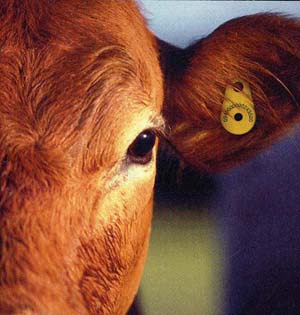
The tags for cows are changing. No more will our Canadian bovine friends accessorize with a triangular green ear ornament detailing their identification number, but instead will model a yellow round disc. However, cows already adorned with last year's fashion piece must not have it removed --since that is illegal-- but rather must have the latest earring added to their attire.

These cows are clearly going to be punk cows.

How did I know this detail about livestock imports? Because I was in the office of the Canadian Food Inspection Agency ...

... waiting for them to approve the export papers for my cat.

May I just say that going to this particular organization for my little furry non-consumable pet kitty was highly disturbing? I distracted myself by reading a leaflet on compensation for Government destroyed animals. Wonderful.

Mercifully, the not-for-consumption cat was not present; all that was required was me and the paperwork for her import into Japan. This was particularly good since I wasn't sure I could carry both. The folder containing the relevant documents was bulging at the seams. I glanced down at the top-most sheet of paper. In English and Japanese, the heading read:

"Application for import: dogs, cat, foxes, raccoons and skunks."

Now, it might be just me, but it seems a little surprising that the import of foxes, raccoons and skunks is sufficiently common to warrant inclusion on a standard form. I made a mental note to keep this sheet handy when I was on the plane. If my neighbor objected to being seated beside a cat, I could point out that should he complain and move, he might be located by a skunk.

At length, I was called through to the main office to meet with the Government vet. He stamped my paperwork and told me that he had wanted to be an astronomer when he was small. I told him I had wanted to be a vet for years of my childhood. We both eyed each other, trying to access who had made the right choice.

Then the stamping was done, the papers returned to me with three additional copies. I tied an elastic band around my folder and stuffed it in my backpack. One shiny bright kitty, ready for consumption. I mean, export.

Indecent questioning


"Why didn't you get married?"

You know, it wasn't so much the question that bothered me, but the tense. Namely, the fact it was in the past. Quite clearly the message was:

"Why didn't you get married when you had the chance, since now you're waaaaaay over the hill so there's no point in even CONSIDERING it at your age."

Frankly, I'm somewhat indifferent to the prospect of marriage. It's expensive, divorce doubly so and I just downright hate the idea of having to move any of my books to make room for someone else's lesser tomes.

BUT. That wasn't the point.

I looked down at the five year old as she sucked on her special curly straw the waiter at the Italian restaurant had brought with her drink. I should mention, this was the SAME 5 YEAR OLD who insisted on looking at a leaflet on complications with wisdom teeth extractions while I was in the dental waiting room waiting to have mine taken out. Basically, I deeply regret this child learning to talk. She was also going to get a way cooler dessert than me.

I debated what my reply should be. I contemplated telling her that marriage was hardly a requirement in today's society. That men were inferior beings with bad taste in books. Or pointing out that her mum was divorced and contemplating turning the coal bunker into a burial chamber for her dad, so really it led to nothing but hard work in crime concealment. I thought about saying I preferred women, furries, anime characters or her dessert, that a piece of paper wasn't necessary to prove you loved someone, that I was too young for marriage and no one under 85 knew enough to consider it, that marriage often led to children and she was currently THE LIVING EXAMPLE OF WHY I DIDN'T WANT TO GO DOWN THAT ROUTE.

Fortunately at that moment my dinner arrived. It was fettuccine with sausage. I speared a small sausage, smiled and bit down.

"I just haven't met the right person yet."

Learning to be different


The officially bilingual status of Canada results in a rather more entertaining education system than that in countries with more decisiveness. Outside Quebec, schools operate in English but offer a "French immersion" stream which apparently involves classes been taught in French, rather than the pupils being dipped in red wine and cheese. This is taken up by franco- and anglophone parents alike to allow their children the chance of being bilingual.

In Quebec, the situation is a little more complex, due to the mixed backgrounds of the population. The province has two publicly funded school boards that offer education in English and French. Originally, these were divided according to religion, with the English-speaking side being Protestant and the French, Catholic. However, this system was later renamed to better reflect the true nature of the split.

By default, a child in Quebec must attend a French-language public school but exceptions are made if you can prove your family has already defected to the dark side. For instance, you may go an English school board institute if you have previously attended an English-speaking school elsewhere in Canada, if you have a sibling being educated in English anywhere in Canada or if one parent did their elementary schooling in English.

When growing up in Montreal, my friend had a choice of school systems, since she had one officially francophone parent and one anglophone. Her school was selected based on academic merit and she joined the English school board stream.... and then promptly enrolled in French immersion.

"You decided not to go to a French-speaking school, but to go to an English school and be taught in French?" I asked, just to completely clarify the situation.

"Yes... but I had more classes in English than if I had gone to a French school," she attempted to justify this completely preposterous statement.

Apparently, the French immersion stream results in half the day being taught in French and half in English, giving a truly bilingual education. I admit, I was quite envious. Not that I think I would have enjoyed it at all at the time, but that is what adulthood is about: reaping the benefits of a tortured childhood.

While this system sounded highly beneficial to all and sundry, my friend warned of its pitfalls. The richer population of Quebec tend to be English speakers who have moved into the province. Because of this, the English school board is better supported by the parents which has resulted in the schools being generally of a higher standard than their French counterparts. Such a division increases the rift already present which is what caused this whole divide in the first place.

Catch 22: created by adults, maintained by 5 year olds.

World of ice


May I just say that snow villages are cold?

Well, d'uh! --you might reply, if you were feeling rather mean-- water does have to freeze for this venture to be successful. Did you expect to saunter around huts made of ice in your bikini?

Like you wouldn't enjoy it too if that were possible.

Montreal's snow village is on the island of Sainte-Hélène, just off the edge of the Old Town harbour and easily reachable by metro. The winter had been so mild this year that initially we were concerned the snow village might not be still standing. Indeed, there were signs of deterioration with several of the rooms showing evidence of small roof renovations and a single large collapsed pile of snow at the edge of the village that stood as a prediction of the doom to come. That said, most of the buildings were in excellent shape and the breeze that peeled off their icy walls helped keep both constructions and visitors nicely chilled.

The main buildings in the village were a hotel, bar and church. Surrounding them were a number of little one-bedroom huts that were likely part of the hotel. It was possible to spend the night in one of these quarters but, with prices starting at $250 per person, we did not consider it. To be honest, I'm not totally sure I would have enjoyed the experience. An ice bed is all very well, but what about the bathrooms?!

As a visitor to the village, you could walk into the hotel and wander through the rooms. The standard set-up was a double bed --consisting of a normal mattress on a bed frame made of ice-- and an ice chair. Many of the rooms though, had a theme. There was one with a giant ice hockey player sculpture (naturally a team member of the 'Canadiens', Montreal's home team) with a replica of the Stanley cup at the foot of the bed. Another room had a solid ice racing car and a third, musical instruments frozen into panes of ice embedded in the walls. One room with two double beds had a trough of ice cubes between the mattresses and roses at the head. It was either a chaste way of spending the night together or the scene from a vampire horror movie. Either way, there was clearly no point in lingering.

The most beautiful building was the church. Ornately carved on the outside, the inside was full of transparent icy glass pews and a wide semi-circular alter with high backed ice chairs. The only non-ice features in any of these buildings were the mattresses in the hotel and the odd fur rug thrown across a chair. Without those, sitting was usually regretted and not easily reversed.

Naturally, as a group of four highly educated adults, we admired the skill and artistry of the craftsmanship.... and at the first opportunity, stole a wooden sled from a careless child.

The sleds, which were scattered around the village for visitors' use, resembled that of a dog sled. They had a single seat up front and a high back with long runners the person pushing could stand on once you got moving. Steering proved to be slightly challenging, but Canada has socialised health care so there was a limit to what (permanent) damage we could achieve.

When we returned to our Bed & Breakfast, I had a hot bath. The ice hotel might be impressive, but you can't do that....

Lights, camera.... history


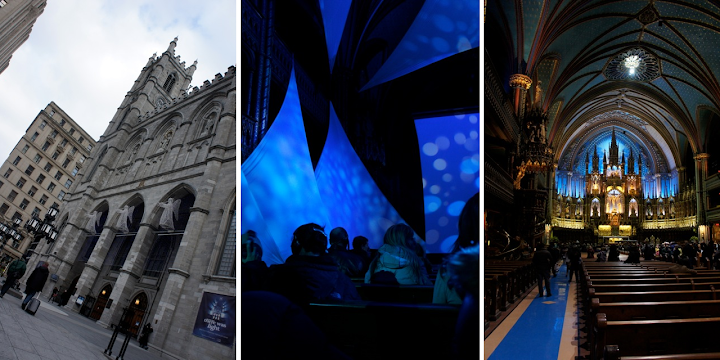
Notre Dame Basilica is set in the heart of Montreal's old town. With its twin bell towers, you could be forgiven for thinking that the name comes from its famous Parisian counter-part. You may even be right, but no one will admit to it; not wikipedia and not the Sound & Light show we attended on Saturday evening.

The flier for this event shows the church nave decked with triangular sails upon which artfully coloured blobs were projected. In a second image, the sails were gone and red and blue lights illuminated different parts of the ornately carved facades. I was therefore expecting the acoustical and elaborately designed interior of the church to be taken advantage of in an abstract interpretation of thundering music.

What I got was a history lesson. Which was somewhat of a surprise.

In 1657, the French settlement of 'Ville Marie' was founded in the new land and with it, a small chapel. The small colony faced difficult times along with their European compatriots up and down the coast but eventually it expanded enough to build a hospital and the chapel was re-housed inside it.

The colony continued to grow and finally in 1672, it got its own parish church which was given the name 'Notre Dame'. The population did not stop there and it reached the stage where thousands of the village worshippers were forced to gather outside the church's doors each Sunday. A new building was needed and an Irish architect by the name of James O'Donnell was brought in for the job. O'Donnell was residing in New York and was originally a Protestant, but converted to Catholicism on his deathbed, quite possibly so he could be buried in his own church. He lies in the crypt alone, so possibly no one else believed in his change of allegiance either. The show mentions that O'Donnell's remains lie beneath your feet, but does not mention his abrupt conversation; wikipedia being a far more reliable source for such juicy details.

O'Donnell lived to see his church open in 1829, but his death in 1830 came eleven years before the construction of its first bell tower. Until that time, the bell was rung from the old church building that was still situated in front of its replacement. While undoubtedly impressive, O'Donnell's design was flawed by his choice for lighting. Behind the alter, there was a large window whose light blinded the faithful who sat in the middle pews. The --undoubtedly more guilt ridden-- parishioners who had slunk to the side were shrouded in darkness. Feasibly no one in the congregation had a problem with this but nevertheless, the interior was redesigned between 1872-79 by Victor Bourgeau, who also designed the intricate pulpit which winds like spiral treehouse to the left of the alter. The front of the church is now covered by an elaborate wooden façade and light enters the church from stained glass side windows. From the outside, you can see an extension now backs onto that part of the church, so presumably the old window is completely bricked up. The interior is undoubtedly very impressive, even if one of my friends proclaimed the pillars to look like Christmas wrapping paper.

All of this was told to us through narration interspersed by --it must be said-- somewhat dubious and sycophantic actors. That aside, the content, which highlighted Notre Dame's history intertwined with that of Montreal's, was extremely interesting. Images of the early settlement were also shown on the sail screens and, when points about the church's architecture were discussed, lights lit the relevant part of the décor.

In 1982, Pope Jean Paul II visited Montreal and raised the status of Notre Dame to a basilica. It also was the location of Celine Dion's wedding in 1994. The show mentioned the former, but not the latter. No prizes for guessing where I got the second fact from.

Parlez-vous Japonais?


It transpires my brain only has a single language button. When 'off', I speak English and when 'on' I speak ... Foreign. For the majority of my life, 'Foreign' has corresponded to what French I managed to recall from school. Now --I discovered-- it produces Japanese. Given that I'm currently visiting Montreal, the largest city in the French-speaking Canadian province of Quebec, this is a trace unfortunate.

It is also rather surprising to the shop keepers who have been addressed in broken Japanese by a blond haired, blue eyed girl with a British accent.

Since the official languages of Canada are both English and French, it is the law that all government services must be conducted in both languages. In Ontario, this equates to everything being in English with the occasional nod to this rule in the form of a French stream in schools (largely taken up by English-speaking kids wishing to become bilingual), bilingual tourist information sheets and the odd sign post. In Montreal, it is totally different.

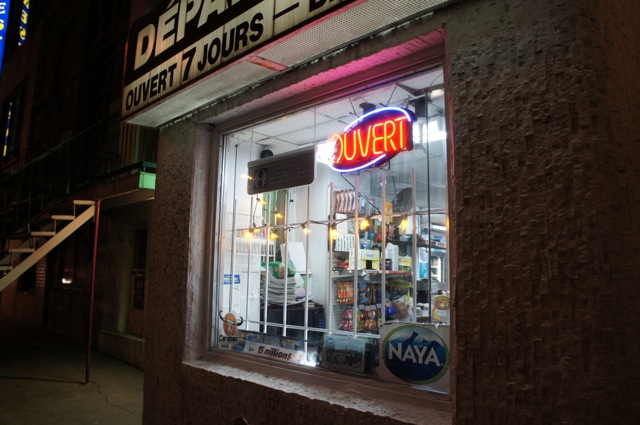
Shop fronts and road signs are in French, while the chatter on the streets is a mix of both languages, with French dominating over the English. Two of the city's major universities are split; the Université de Montreal operates predominantly in French while McGill University lectures in English. Wherever we travelled in the city, waiters and shop assistants greeted us first in French, before switching seamlessly into accented English.

Interestingly, Canadian French is substantially different from European French, although the latter is easily understood. The differences have been said to be greater than that between UK and USA English, but less than German and Swiss German. Somewhat ironically, Canadian French is closer to the early French language of the 15th - 17th century than European French, which has evolved away from the original pronunciations.

The reason for the francophone pocket of Canada is historical: In 1760, the French colony in Quebec was taken over by the British. This was about as popular as any visitor to Europe might expect and, in the resulting resistance, a compromise was reached with the 'Act of Quebec'. This recognised French Canadian distinctiveness and allowed them to keep their religion (Catholic), local laws and language.

This movement had an on/off success with the pressure for autonomy still present today in the form of the Quebec sovereignty movement. Supporters of Quebec's independence claim that the province's best interests cannot be recognised in the predominantly anglophone Canada. Associated with this is the concern that the French language will become overwhelmed, taking a major part of Quebec's identity and heritage with it. This has led to claims of discrimination against Anglo-Quebecers with the terms 'pure laine' (pure wool) used to denote Quebec residents of French descent.

After the initial excitement of "Wow! That sounds just like Harry Potter!" had worn off, I was a little concerned about our reception in Montreal. Would we have to manage with our limited French for fear of mortally offending the entire province every time we ordered a cup of tea? Would English be understood, but only with a particularly bad grace? Or would we be declared 'mudbloods' and banned from Hogwarts forever?!

It turned out we need not have worried. Montreal is a very friendly city and everyone I have met has been happy to converse in either French or English. Of course... this might have been born out of relief that I was no longer attempting to ask the location of the toilet in Japanese.

Chocolate and phones

So the Sunday before last I visited a sex shop. It was either that or church and --when you think about it-- they're near enough the same.
... you all thought about it, didn't you? You sick sick people.

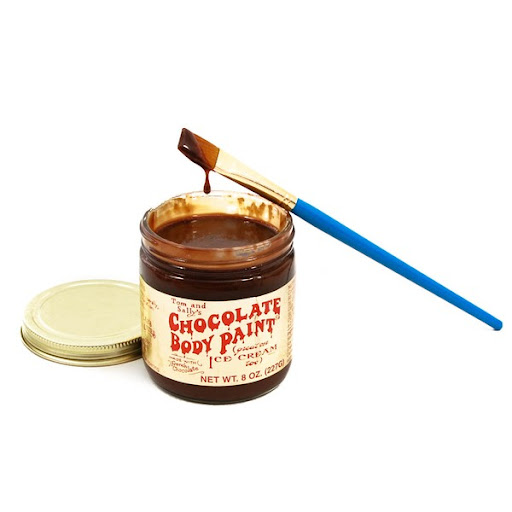
I was after chocolate body paint. I'd explain, but frankly, you'd be disappointed. I only used it on my face during a brief iPhone photo shoot with another girl. Hockey jerseys were involved. Then we sent the photos to a minister.

See? The church connection again. He now has plans to leave the country. I'm denying any connection.

As it happened, the sex shop was unnecessary. I could have picked up the goods at a local Shoppers Drug Mart (equivalents to CVS, Walgreens or Boots depending on your aspirin buying location). Still, I think I could have been forgiven for not thinking of that location first.

Our body paints were in the tame section of the shop, along with more interesting versions of board games I played as a child. Other parts of the shop sold items that I'd never consider buying (or at least not blogging about buying) and harness swings which I totally would. I wondered if anyone other than me would believe I just wanted to hang out in one like a seven year old at a playground. I concluded no.

After the make-shift photo shoot, my friend and I went to the mall. We were watching the superbowl later than day and so figured face paints would not look out of place. Besides, it was surprisingly difficult to clean off. I wanted a prepaid sim card for my iPhone and headed for the appropriate store. As I did so, I passed a mirrored pillar and concluded an unfortunate fact:

There was really no mistaking that I was wearing chocolate body paint.

In the apartment, the paint hadn't looked any different from normal, non-consumable, face paints but in the bright mall lights the chocolatey goodness was revealed in all its edible glory. In five minutes time, I was to become pretty certain that the sales representative at Telus Mobility had noticed this as well.

I, however, needed a sim card and I wasn't going to be distracted. This guy would look me in the eye, keep a straight face and explain to me exactly how many picture messages I could get for their plan.

He managed. Just.

Any apprehension I might have had regarding returning to the store vanished while I watched the superbowl. A 31 year old with two streaks of body paint on her face can't really compete with Madonna and a host of centurion guards.

Japanese efficiency


It doesn't matter how much often you fly, to see a passenger near you repeatedly cross himself during the safety video is never reassuring. That said, I felt I already owed God one for making this flight at all.

For my trip back to Canada, I was connecting through Tokyo with a one hour change-over time. That was slightly on the tight side, but it was Japan so I had faith I would make it.

As we reached the northern half of the main island, our plane met a strong head wind. Towns below us had suffered a dramatic snowfall only a day before, with 3m of the white stuff dumped overnight. The resulting air currents made our plane bounce like a coffee bean in a grinder. It also made us 20 minutes late.

Our chosen landing spot appeared to be only vaguely connected to the airport. I mean, it was probably in the same prefecture. Just. We piled onto a bus for a ten minute ride across to the terminal. From there, I had to pass back through security and through the official country border to the international departures area. Then I had to get to the other side of the terminal, passing 30 gates to get to my own.

Any other country and I would have been asking about vacancies in the airport hotels and buying a toothbrush from the nearest shop. But... it was Japan... this might yet be possible.

I did all of the above in 15 minutes. The flight attendant didn't even look phased as she scanned my boarding pass and waved me through for an on-time departure.

The passenger crossing himself was also reading the safety leaflet, as per the instructions on the video. If anything, that was even more bizarre than the apparent desire for divine intervention. Upon take off, he ordered two (admittedly small, but still a containing a couple of glasses) bottles of wine. After that, negotiating the arm rest on his seat proved to be a more pressing problem than the need to pray.

Once in Toronto, I dubiously walked over to the baggage reclaim... to see my suitcase happily travelling round (at least, I would have enjoyed riding that belt). I'm not sure if there is any other airport in the world I could have connected through where that would have been possible.

This only left one final hurdle.

Canadian border guard: Wait, you were here two weeks ago?!

Here is my pay stub... will you marry me?


"My supervisor thought it was too early for me to marry."

I was having dinner with a new friend; a PhD student at Hokkaido University who not only was from the UK, but had also grown up in my own home town of Oxford. Out here in Japan's snow laden northern island, it was a bit like finding a long lost twin. We had compared schools, discussed local shops and now had finally pushed the time line up to our current affairs.

While working at a summer camp for kids in Sapporo, my British twin had met her husband-to-be; a Japanese web designer who was starting his own company. Since it was still the early years for his business, his salary was not very large and it was this that was the source of concern for my friend's supervisor.

His advice to her was that she shouldn't consider marriage until her partner was making at least 5 million yen a year (about $65.5K or £41.5K, although it should be born in mind that the yen is a strong currency, so the equivalent spending power is probably less).

Growing up in a country where money was not seen as an object to marriage, I found this very surprising. Yet, apparently this view was fairly universal.

"Even my mother-in-law asked if I wouldn't rather wait until his income was higher," explained my friend.

Curious, I asked one of my Japanese friends at work whether money was always consideration in matrimony.

"It is probably one of the main concerns," she told me.

However, I was assured that women were not expected to give up their jobs when they married and when children came along, it seemed to be a matter of choice.

My British friend had obviously not stopped working after her wedding and once she graduates, she plans to join her husband in his business and provide English translations.

"What is your visa status now?" I asked curiously. "Do you have permanent residency through your husband?"

"Actually, a spouse visa is only for one year."

... Well, that was a whole new level of cynicism for you right there!

It turns out that it is very easy to get divorced in Japan. If both parties are in agreement, the whole procedure can be done in a day or less. This, combined with possible concerns over immigration, is probably one of the reasons for initially short-term spouse visas. After renewing your documents a few times you are deemed serious enough to get a longer term visa and after five years, permanent residency. Until then, you're considered about as married as Britney Spears.

[Note to self: Find smoking hot Japanese pop star fast. This visa business is going to take a while.]
[Note to self II: Make sure he earns over 5 million.]

Writing English for south paws


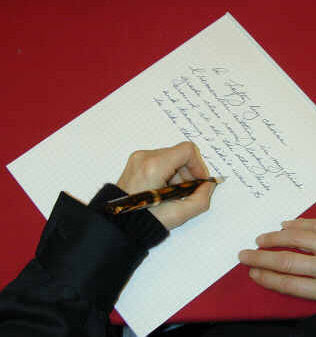
On a scale of 1 to 10, it seems to me the formality of a document stating your resignation from a job --even if a near identical position is taken up with immediate effect-- should rate at least a 9. Maybe even an 11. To be handed a plain sheet of paper and a ballpoint pen to do the deed was therefore something of a surprise.

The instructions I received were quite specific: my resignation letter must be written by hand and copied word-for-word from a sample template. The latter was presumably so that it could be easily followed regardless of whether the author chose to express themselves in English or Japanese. I took both the blank sheet of paper and the template letter and arranged them on a nearby desk, lifting up my pen.

This staggering act resulted in a swift flurry of movement in which all the tools I had laid down on the table were rearranged. My paper was straightened and the template moved to the other side of the desk. I stared at this reorganisation, nonplussed.

"Ah, she is left-handed!" I heard one of the administrative assistants tell her colleague in Japanese.

"Ah!" The other man stepped forward and moved the template letter from the left side of the desk to the right.

I paused.

"Please write the letter exactly as it is here," the female assistant explained to me in English. "The same page orientation."

Light dawned.

"I will do!" I promised. "But because I am left-handed, I must tilt the paper." I rotated the writing paper 45 degrees clockwise and wrote the title. Behind me, there was a panicked intake of breath, followed by a sigh of relaxation as everyone moved away.

Since Japanese writing traditionally starts in the top right corner and moves down, I realised it was possible they had never seen a left-hander tilt the page to write neatly. Yet, if I didn't make such a move, my hand would press over the freshly inked letters and smudge. Before you ask, you would be quite amazed how much a dry ballpoint pen can smear. This sad sad fact confined me to pencil for years. Possibly, I wrote the world's greatest novel at the age of 8, but the non-permanency of my writing implement means no one will ever know.

As I finished, I dug in my pocket and produced my hanko; a personalised seal used in Japan instead of signatures. "Should I use my stamp?" I asked.

This produced a pleased babble of excitement around those seated nearest me in the office, possibly steaming from relief that they wouldn't have to deal with some freakish western signature. Carefully, I pressed down by my name on the paper. The woman next to me clapped.

I tried not to think exactly how low the general opinion of me must be to denote such an act an applause-worthy achievement.

"Can you come in again on February 2nd?" I was asked as I stood to leave. "To finish the paper work."

"Actually, I leave for Canada on the 2nd," I explained.

"Oh. How about the 3rd?"

...... OK, my travel schedule is crazy, but it's not THAT crazy.

"I.....," I began, hoping they would realise their error. They didn't. Or they thought it a completely reasonable turnaround.

"I'm sorry but I'll be in Canada," I said the last word carefully. "until March."

This achieved the desired communication and we agreed to complete all the paperwork on the 1st. I tried not to look too relieved.

Welcome to Japanese bureaucracy


After one week in Canada I returned to Japan. For two weeks. Then on Thursday, I go back to Canada.

Confused? Let me explain:

This brief interlude from my collaborative work trip in North America was to allow me to interview for a job identical to the one I already had, be offered the position, formally start and then order a computer before this was prevented by floods in Thailand.

There. Isn't that clearer? No? Well, I will elaborate but I warn you now, it's not going to help.

Our story (although I defy Disney to create something more fantastical) opens with our young heroine (totally me. It is my blog, after all) assuming the role of "specially appointed assistant professor". The "special" part here means that my salary came from the Japanese Government, not Hokkaido University, who have a scheme to support women in senior roles for three years. After that time, it was understood that I would be moved onto the university's normal tenure track (leading to a permanent position) for faculty members.

This transition was not contracted, but I was told it was a question of honour for the university to uphold the verbal agreement. Since the breaking of Japanese honour traditionally results in disembowelment, I felt there was some incentive for the people who mattered to follow this through.

A few months ago, however, in response to increased pressure from the government to increase the fraction of female employees, Hokkaido University opened a call for two tenure track positions for female scientists. It was suggested that I apply for one of these positions, since it would end any uncertainty regarding my job status in three years time and everyone could retain their digestive tracks.

[As a side note, I don't really approve of any form of sex discrimination in jobs. My concern in this case is it could devalue female researchers' achievements if it is felt they only gained their current position through having a decreased pool of applicants. Despite this, I discovered when put to the test, my morals were surprisingly easy to sweep under the nearest carpet. No one put me in a court of law.]

Even though I had been hired for my current position just months before, I still had to complete the full application procedure, including the in-person interview.

I pointed out that I would be in Canada at that time.

Everyone agreed that it was incredibly daft just to come back so that I could be re-interviewed for a near identical position.

..... but that was just the way it was.

Since a foreigner was preferred for the job and since the Japanese have an innate suspicion of foreigners they have never met, my chances at getting this position were high. This led to a problem concerning money.

New faculty members are typically awarded a large one-off sum known as a 'start-up grant'. This is for single large expenses that are needed to equip a new researcher with the tools they need to do their work, for example outfitting a new laboratory. As a theorist, my wish-list was simple: I wanted computer power. Lots of it. Think 'the ultimate question' solving stuff. The problem was that all this money needed to be spent by the end of the fiscal year which was ... March.

Everyone agreed that it was incredibly daft to spend such a large sum in a month and it would only lead to wasting funds.

..... but that was just the way it was.

Now it transpires that machines more awesome than Steve Jobs builds are manufactured in Thailand. The way it was explained to me is that the ENTIRE COUNTRY disappears under water due to floods each year around this time. Since constructing electronic equipment in such a condition presents some difficulties, an ordered machine will take more than a month to arrive. Since the earliest I could begin the new position was February 1st and the money most be spent by March 31st this left less breathing space than for a snorkelling computer engineer.

The upshot was that I had to still be in Japan on February 1st, so I could officially begin this position as soon as humanely possible and order a computer from waterworld. I booked my flights back to Canada on the 2nd.

I think maybe I should have asked for two passports while in the UK.

Dubious documents

"This passport was issued a few days ago. Why was that?"
Um. Because I needed a new one? Seriously, what sort of question was that? And how did I answer it without sounding like I was talking to a two year old and not a burly Canadian border guard?

I shrugged and tried to arrange my features into something that less implicative of 'WTF you moron?!'

"It needed to be renewed over Christmas."

There look, I spanned that out to a seven word sentence none of which were hamsters or elderberries.

"Are you gainfully employed in the UK?"

"No, I work in Japan."

I instantly regretted my words. The passport the border control guard held was a pristine virgin document, unsullied by any hands except those of the country from which is was forged and ....

... look, the point is it didn't contain a Japanese visa.

This wasn't a problem was far as Japan were concerned. In my backpack was my dog-eared cancelled passport which contained the still in-date visa for my job overseas. Unlike for American visas which have to be paid like a high-profile ransom to be transferred between passports, Japanese visas could chill in the old document until their own expiry date rolled around. The problem was, how much talking would I have to do to convince this border guard of that? Especially given his experience outside of Canadian bureaucracy would probably be with the neighbouring country of .... yeah. You see the problem.

I braced myself for a long hard wait. I was pretty sure that, had this been America, I probably wouldn't be making my flight out in a week's time. I'd be held in the country indefinitely JUST TO BE SURE I didn't stay there forever.

The border guard blinked at me. "Japan?"

I managed a tight smile. "Yeah."

A Brit coming from the UK into Canada with a empty passport, claiming she worked in Japan.

The guy burst out laughing and tossed my passport back at me. "Through you go!"

Maybe no one would ever make up a story that crazy. Maybe he decided he never wanted to know. I love you, Canada.

Stranger in a strange land

"That will be 25p," the man behind the counter of Jessops camera and print shop in my parent's city of Leicester told me.

Bargain! I had gone in to print out a set of photographs that my Dad had taken that morning, ready for an express renewal of my passport while I was in the UK.

"Yes, it's cheap if you do all the work yourself!" the shop assistant joked as I rummaged in my wallet.

I tipped a collection of coins in my palm and examined them. "Is this a ten pence?" I held up a silver coin that seemed about the right size, although the design was different to how I remembered it.

The shop assistant looked at me oddly. "Where are you from originally?" he asked.

"I.... um .... here," I muttered. "It's just... been a while."

Major fail!

Waiting on the world to change


The British understand class. There is an innate comprehension that cockney flower girls are at the bottom of the heap while you can get away with anything if you wear a crown. So when little English girls play at being princesses, it's not cute; it's a desire for world domination.

British class, however, comes down almost solely to money. In India, the situation is far more complex.

Naturally, discussion of social situations is an ethical mine field. So I want everyone to feel reassured that I have a full and complete grasp of this topic from spending AN ENTIRE WEEK in India and attending a play exploring class that was performed in entirely in Hindi. I knew you'd all feel better.

Two major ways of categorising people in India are caste and religion. In theory, the two are interconnected, since caste is a Hindu concept. However, this social stratification is seen in other religions which in theory should be outside the system. A Christian church, for instance, will often have a congregation predominately from the same caste.

Which caste you belong to is decided by birth. There are four major divisions (and about a gazillion subsets) whose origins stem from professions: the Brahmins are the priests and intellectuals, the Kshatriyas are the warriors and rulers, Vaishyas are merchants and Shudras are farmers. Below these are the Dalits, once known as the Untouchables, whose jobs involved the most menial and dirty of tasks, such as toilet cleaning and... midwifery... because small children are similar to toilets.

Discrimination against the lower castes has been banned by the Indian constitution for 50 years. Perhaps predictably for a social system thousands of years old, this has met with mixed success. On the one hand, the current chief minister of Uttar Pradesh, an Indian province that includes the Taj Mahal, is from the lowest Dalit caste. Her career has been colourful, although this is less likely to do with her born status and more with her actions which include commisioning a statue of herself and suggestions that fellow Dalits should beat upper castes with their shoe. On the other hand, despite the ability for low classes to reach high posts, it is still uncommon to marry outside your caste. This, perhaps more than jobs, emphasises the underlying separation is still very much felt.

Aside from the caste system, there is the question of religion. Upon gaining independence from the UK in 1947, it was decided to make two separate countries from the former British Indian Empire; India and Pakistan. The division was founded on the basis of religion, with Pakistan being an Islamic state.

A major problem was the division of land was that is was done by a British lawyer who had never visited India. He drew the boundaries based on population density, creating two areas with a Muslim majority to be East and West Pakistan. These two provinces of the same country were separated by thousands of miles of Indian territory.

... This worked every bit as well as you might suspect, and in 1971, East Pakistan gained independence as Bangladesh.

The whole division was bloody and left millions of Hindus and Muslims with an unappetising choice; give up their livelihood and relocate to the appropriate side of the border or become the minority in their own homeland. Whether this division should ever have been carried out is still a much speculated subject, but the fact of the matter is that it did occur with at least 10 million people changing countries and another half a million dead.

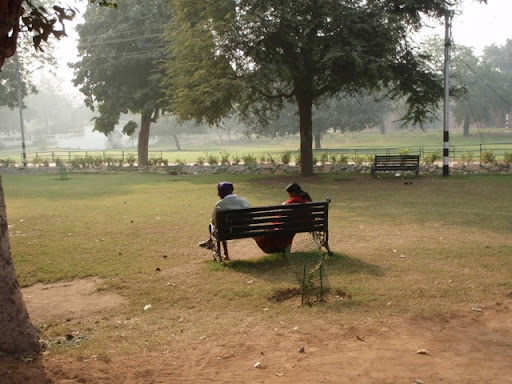
For the Muslims that did remain in India, they found themselves subjected to a significant feeling of bad will from those who believed they gained their own country in the partition and should have moved. This was one of the main topics discussed in the play I attended at the Indian International Cultural Centre on my last night in Delhi. The play was entitled "Ghandi Park", written by Manav Kaul, and focusses around who has the most right to sit on a bench in a city park (no, they can't share; don't complicate the issue).

The play opens with a small boy dancing to John Mayer's "Waiting on the World to Change". His father is concerned that his bad grades at school are because he is being discriminated against for being Muslim. The father in question appears as the boy runs away and is the first 'bench stealer' in the performance. His method has a charming simplicity about it; he threatens to vomit on a young man, Uday, who is currently sitting there.

Moving hastily to another bench, Uday is told to move again after the arrival of the school teacher. The teacher makes his case in terms of caste, profession and age, none of which impresses Uday in the slightest. The teacher's case was not exactly strengthened by his confession that he wanted the bench for the view it offered of the balcony of a girl he admired. The father then wakes up and ... well, things don't run smoothly.

While social issues aren't always the most enjoyable to discuss, I found this amazingly interesting perhaps because it IS discussed in India. It left me with a feeling that even the oldest traditions can change.

So, who is up for skipping Charles in the succession for the throne?

The greatest dead


I confess, I find it slightly disturbing that India's trademark monument is a tomb. For one, the whole concept of a dead body being your most recognized landmark is unappetizing and for another, it looks like an opulent palace which is bound to be under-appreciated by those no longer inclined to tea parties.

It is the city of Agra that boasts the Taj Mahal, a day trip from Delhi by train. In theory, it should have taken us just three hours to reach our destination, but this timetable was designed without allowances for the Delhi fog. I was all for blaming this unexpected twilighting of the city on pollution (the auto rickshaws may run on natural gas but those road-walking goats just looked guilty) but it turns out it is a genuine weather phenomenon that attacks Delhi's winter. The net result was we departed Delhi at 7 am but did not arrive in Agra until 1 pm.

While rather long, the train ride itself was captivating. We travelled by slum dwellings that looked like whole villages with winding streets, monkeys sitting on walls by wheat fields drenched in mist and once a large pig on a station platform.

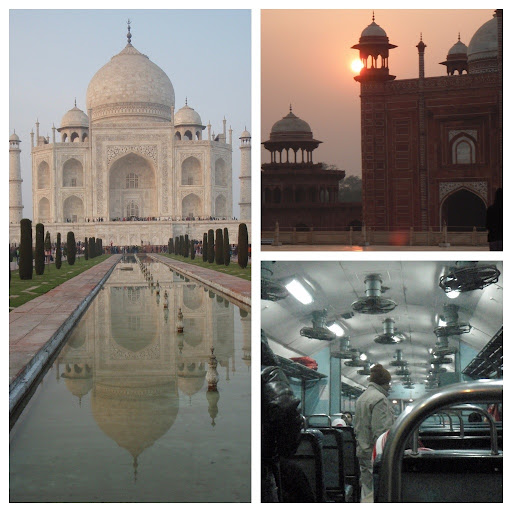
We rode in a second class carriage, seated in what was called a 'sleeper coach' with three people sitting on each long bench seat. There was no air conditioning, but about a gazzilion fans hung from the ceiling to ease the hot air in the warmer months. Up and down the carriages, venders walked with tea, cold drinks and crisps. Oddly, a woman also came by and demanded money. I ignored her since THIS DID NOT MAKE SENSE but she shook my friend awake who gave her some change.

"I don't understand," I said. "Why did you have to give her money?"

"It's what she does," was my reply.

I have to say this was a rather unsatisfactory answer.

The train network in India was first laid down by the British but has been maintained and extended by the Indian government to become the forth largest rail network in the world. Longer distance trains are designed for more comfort than the carriages for our relatively short journey, and are one of the best ways to get around the country.

When we arrived in Agra, we hired a taxi for the day at a flat rate; a good move since the major sites are surprisingly far from the station. Despite its size, the Taj Mahal is amazingly well hidden from the surrounding streets so that the first glimpse I caught of its large marble macaroon domes was after I'd passed through the site's main gates.

We took a camel up the long driveway because.... well, because we could.

The Taj Mahal was build by the 5th Mughal Emperor, Shah Jahan, to be the mausoleum for this beloved third wife, Mumtaz Mahal, who died during the birth of their 14th child. Its construction began in 1632 and was completed around 1653. Shah Jahan dictated that a huge brick scaffold would be used for the building work, whose design mirrored that of the tomb itself. This led to concerns regarding the time it would take to dissemble, but legend has it that the Emperor decreed that anyone who took a brick could keep it and the structure disappeared over night.

Rumors also persist that Shah Jahan intended to build a second mausoleum for himself, a mirror of the Taj Mahal built out of black marble. Regardless of whether this was truly his intent, he was overthrown by his son and spent his last years in the Red Fort in Agra, gazing out over his wife's tomb where he himself would also be buried.

Despite the fact it is a tomb, the Taj Mahal lives up to its name as India's most impressive landmark. Entering through the main gate, you are confronted with the classic view of the Taj in front of you, reflected in the long stretch of water that runs to its plinth. Closer up, it does not disappoint as it is an experience to walk on a structure made of nothing but spotless white marble.

To stand on the plinth and enter the tomb itself, you must either remove your shoes or cover them in elasticated cloth wraps. Notably, Indians visiting the site seemed to opt for the former while tourists the latter, although this might just have been a product of the shoe coverings being included in the more expensive tourist ticket. I was also given a bottle of water which possibly reflects the number of foreigners who collapse with dehydration in the grounds during the summer season.

Due to our late arrival, we were not able to see Agra's Red Fort before it closed for the evening but instead went for dinner and then took the train home. More delays meant that our train did not depart Agra until after 10 pm but then mercifully, took the predicted three hours to reach Delhi.

This was merciful because I was about to freeze.

In India.

Having lived in Northern Japan and Canada, that would have been plain embarrassing.

The problem was that the carriages weren't sealed, so the cold night air rattled through ill fitting windows in an icy draft. This direction, the train was much quieter so we were able to use the 'sleeper carriage' as had been the intention for quieter routes; with each person taking one long seat to lie on. The temperature was such, however, that long before we reached Delhi I wished we were more packed. Perhaps it was nights like this that caused people to design tombs.

This feeling of peril was intensified by a guard with a rifle asking my friend how she knew me. Apparently, he was just curious.

Finally we were at Delhi. My friend was bobbed on the head with a rifle to wake her and I tumbled onto the platform before the same fate awaited me. Slightly nerve wrecking, but ultimately worth it to see the most scenic of India's dead.

--
[Photo: left is... do I really need to specify? Right top is the view of the Taj Mahal's mosque while standing on the plinth of the Taj and bottom is the inside of our train.]