
Stretching 12 blocks through the centre of the city, Odori Park in Sapporo is home to a wide variety of festivals that take place in the city throughout the year. None, however, is as famous as the 'Yuki Matsuri' or 'Snow Festival'.
Read More
I am pro-choice
Pro-lifers, I have a problem with you. You're not pro-life.
Read More
Two by two
Asahiyama Zoo in Hokkaido is one of the most popular zoos in Japan, with a visitor count of over 3 million a year. This number is surpassed only by Ueno Zoo in central Tokyo and the race is close, with a difference of a scant half-million in 2006, compared to a population ratio of 320,000 : 13 million.
Read More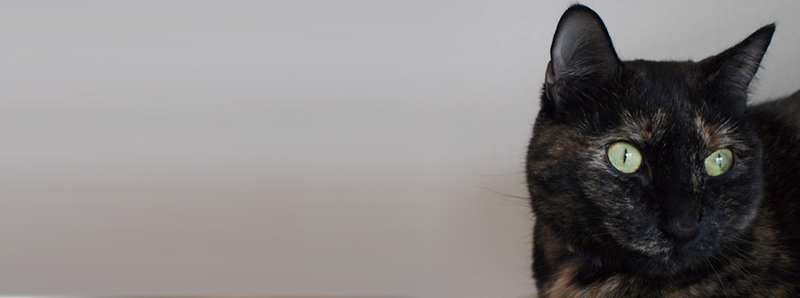
My cat pees blood
I realised this particular Saturday afternoon was not going to go as planned when my cat leaped on my bed and peed blood all over the duvet.
Read More
Katakana: the ultimate 'Lost in Translation'
You know that feeling where you begin a test filled with certainty that the 100%, A-grade, best-student-ever, candidate for lord-and-master was in the bag? Only to be faced with soul crushing defeat of only one correct answer out of five, thereby proving every local 2 year old your superior?
No? Then let this be a lesson in humility whereby you never admit this to my poor broken soul.
Read MoreHafu
Today I caught a bus to a university I didn’t know existed and watched a film about a group of people who would not be considered a specific minority in my own country.
Read MoreI get paid to go to a hotel
This week, I walked into a hotel and was handed an envelope of cash and an empty tube.
Read MoreI refuse money and my bank decides not to pay my rent
The series of events that found me dripping wet on the doorstep of my bank were decidedly Japanese.
Read MoreThe boyfriend's car I couldn't resist stealing
Some years ago, I had a boyfriend whose car I kept repeatedly tried to steal.
Read MoreAmerica decides I have run out of visits
"American border guards," I explained to my student as we boarded the aeroplane for New York City. "have a reputation for being … " I searched for a word that would describe the situation sufficiently to avoid surprise, but not so descriptively that leaping from the plane as it rolled down the runway would be appealing.
Read More
Because Westminster Abbey is in the heart of London, it's actually quite hard to get a good angle for a photo.
House of departed souls
Set in the heart of London opposite the Houses of Parliament, Westminster Abbey has a dead person to suit everyone's tastes.
Read More
Pemberley
"Will you tell me how long you have loved him?"
"It has been coming on so gradually, that I hardly know when it began. But I believe I must date it from my first seeing his beautiful grounds at Pemberley."
The ancestral home of the Dukes of Devonshire, Chatsworth House inspires many questions. Chief among them probably concerns the name of its owners since the house is situated in Derbyshire, although this may be followed in short order by demands to know where Devonshire is even located, if Mr Darcy ever lived in the house and whether he has a great great great great grandson.
The short answer to the first query is that the residing family became the Dukes of Devonshire because they had previously been the Earls of Devonshire. The longer answer stems from the fact there was already an Earl of Derbyshire when the first Earl, one William Cavendish, was awarded the title in 1618. Despite the name sounding promisingly likely, Devonshire as a UK county does not exist, with the nearest match in the south west of the country known simply as 'Devon'.

The sculpture room inside Chatsworth is recognisable from the movie, although without the bust of Mr Darcy.
The Cavendish family first reached notoriety in the history books when Sir William Cavendish (grandfather to the first Earl of Devonshire) married the social mountaineer and close associate of Queen Elizabeth I, Bess of Hardwick as his third wife and her second husband. It was here that Chatsworth House began its roller coaster existence on the whims of the monarchy, since Bess built the first house (later to be greatly restructured multiple times) on money made in the service of Henry VIII in the 1550s and 60s.
The 3rd Earl of Devonshire --perhaps remembering his abode's royal connections-- nearly lost Chatsworth by supporting the wrong side in the English Civil War. However, the family gained its dukedom only one generation later when the 4th Earl, another William, supported ousting the Catholic King James II from the throne in favour of William and Mary of Orange. He promptly rebuilt Chatsworth in celebration.
Since 2009, the peerage has been held by the 12th Duke of Devonshire, who somehow resisted being called William in favour of Peregrine Andrew Morny Cavendish; make of that what you will. The family continue to reside in Chatsworth House, although a large section is open to the public. Additional notable family members (and indeed, the reason I had first heard of the family name) are Henry Cavendish and another William, the 7th Duke of Devonshire, for these are for whom the Cavendish Physics Laboratory in Cambridge is named due to their financial contributions (in the latter's case) and scientific contributions (in the former).

The Painted Hall in Chatsworth is also recognisable from the movie as Lizzy hesitates here during the tour of the house.
Despite these notable achievements, the real question now is whether any of the Dukes of Devonshire bore a resemblance to Mr Darcy.
Situated in the correct area of the country for Austen's tale, Chatsworth House was chosen to represent Pemberley in the 2005 film adaption of Jane Austen's Pride and Prejudice. In truth, Chatsworth is an ambitious property for Darcy who, with his £10,000 annual income, is short by a factor of 10 compared to the residing 6th Duke of the day, astoundingly named William. It is this fact that prevented the Duke marrying his own Lizzy Bennet while Darcy succeeded.
In an exhibition inside the house, a rather charming comparison is drawn between the standoffish Fitzwilliam Darcy and the 6th Duke of Devonshire. Both men were rich, orphaned at a young age and (slightly creepily) had a sister named Georgiana with a fortune of £30,000. They were also both raised alongside random boys taken in by their father and mentioned explicitly in said father's will. In Darcy's case, it was the irrepressible Wickham, his father's godson, while the 6th Duke was brought up with his half-brother, Augustus Clifford.

The room in Chatsworth where Mary, Queen of Scots was held prisoner in the 1570s.
While the Duke won in the financial stakes department, his higher status meant that he was unable to marry his mistress, Elizabeth Warwick. Like her namesake, Elizabeth Bennet, Warwick's family connections were poor, leaving her to be the Duke's mistress for 10 years until he converted to Evangelicalism and left her to save his soul.
The most recognisable room inside Chatsworth from the movie is the hall of marble sculptures although the ceiling in the Painted Hall is also seen as Lizzy dawdles near the entrance.
The later Dukes of Devonshire were great collectors and their home is a mishmash of objects, including large amethyst geodes and an Egyptian figure of the goddess, Sekhmet. If I were honest, I'd say the clashing styles combined with the heavy Baroque artistry is slightly suffocating.

Both the interior door and the violin that hangs on it are painted and actually flat.
OK, I found it kind of hideous.
… and oddly facinating.
But mainly hideous.
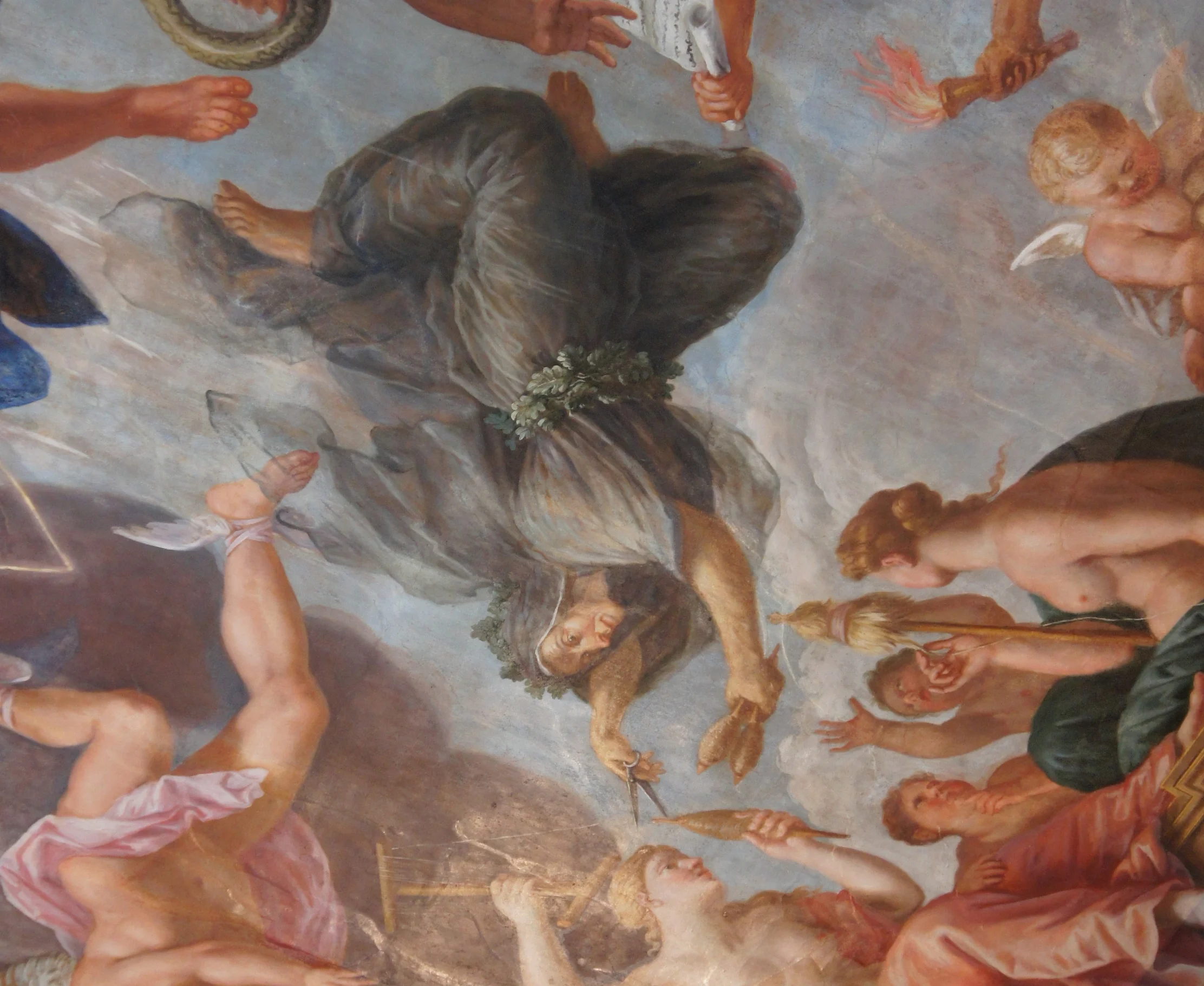
The housekeeper was painted as one of the Fates after irritating the artist.
That said, there are gems in the house including the room where Mary, Queen of Scots was held prisoner during Bess of Hardwick's time. There is also a door leading to what appears to be a second door, with a violin hanging from it by a hook. This is a painted illusion, however, and both the door and violin are flat. In another room, the ceiling painting depicts Atropos, the least favourite of the Three Fates in Greek mythology, who cuts the cord to end the life of a mortal. The story goes that the Fate resembles the housekeeper of the day, Mrs Hackett, who annoyed the artist, Antonio Verrio by not providing his demanded Italian food.
At the end of the visit, the only thing left to do is to standing in front of Chatsworth's newly gold gilded windows and announce:

"You are mistaken, Mr Darcy, if you suppose that the mode of your declaration affected me in any other way, that as it spared me the concern which I might have felt in refusing you, had you behaved in a more gentleman-like manner."
Or decorated slightly differently.

A taste of Scotland in Japan
One of the few times I have ever felt truly homesick in Japan was when visiting the Yoichi Distillery, the first home of Nikka Whisky. Situated about an hour's train ride from Sapporo in Hokkaido, Yoichi encompasses both the hoppy scents and the mountainous landscape of the Scottish Highland distilleries.
This combination is not coincidental; upon searching Japan for a location to practice the arts he had studied in Scotland, Masataka Taketsuru claimed no other place had the right climate and clear waters needed for serious whisky production. Since in the first half of the 1900s Hokkaido was considered a barren wasteland, this crazy talk almost cost Taketsuru his financial backers.

Whisky acquires its golden colour in the barrel. Initially, it is clear.
Nevertheless, Taketsuru was persuasive and in 1934, the production of one of Japan's finest whiskies began. Yet Taketsuru's own story does not begin here, but rather 16 years earlier when he left Japan for Scotland.
The third son of a sake brewer, Taketsuru's original ambition was to continue the family business. However, in sympathy with all those who have ever changed their major, Taketsuru's studies at (what is now) Osaka University, diverted him into the area of western drinks. This interest was shared by Settsu Shuzu, a liquor company who had plans to produce a Japanese whisky. To this end, they hired Taketsuru and --since the secrets of great Scotch were not something casually dispatched in a letter-- sent him to study at the University of Glasgow.
While Taketsuru evidently learned much about whisky production in Scotland, the museum at Yoichi Distillery dwells less on this and more on his relationship with his future wife, Jessie (Rita) Roberta Cowen.
Legend has it that love bloomed between the couple due to the great British tradition of burying chockable items in celebratory food. Taketsuru was sharing Christmas dinner with the Cowen family when he extracted a 6 pence from the Christmas pudding, traditionally foretelling a prosperous future to those who can avoid swallowing said item. Rita, meanwhile, found a silver thimble, declaring her a bride-to-be. Despite such omnipotence arising from their cooking, the Cowen family strongly opposed the match which caused Rita and Taketsuru to forfeit a church wedding in favour of a plainer registry signing. The newly wed couple then left Scotland to return to Japan.
Unfortunately, the intervening two years since Taketsuru's departure had not treated the Japanese economy kindly and he returned to find his country in recession. The resulting financial hardships crushed Settsu Shuzu's ambitious plans for branching out into a new liquor, causing Taketsuru to leave their employment and join the Kotobukiya company which would later become Suntory, Japan's first malt whisky producer.

Distillation at Yoichi
Situated in the Osaka Prefecture in 1923, Kotobukiya built the Yamazaki Distillery to produce its malt whisky. Its owner, Shinjiro Torii, wished to produce a Scottish style of whisky that had a unique Japanese flavour. This didn't sit well with Taketsuru, who wanted to remain faithful to the Scottish techniques. Despite the success of the Yamazaki Distillery, the rift between Torii and Taketsuru caused Taketsuru to leave and begin his own whisky production in Yoichi.
During this time, Rita had taken up Japan's most popular job for foreigners in teaching English. It was her contacts through this work that made it possible for Taketsuru to gain the financial support needed to begin his own distillery. Even allowing for the importance of this act, Rita's prominence in the Yoichi Distillery museum and exhibits is surprising. Several information boards in the museum are devoted to her life and their married home (also on the same site) contains many pictures of her both with and without her husband. Perhaps this interest stems from the fact that while foreigners living in Japan are something of a novelty today, the appearance of a Scottish woman in Hokkaido in the first half of the 20th century is nothing short of astonishing.
That said, Rita's presence in Japan was not always warmly received. When war broke out, Rita became a target of suspicion and dislike, both from her neighbours and Japan's security departments. While her marriage and subsequent nationalisation allowed to remain in Japan, Rita was nevertheless frequently shadowed by Japan's special police even on such mundane errands as delivering her husband's lunch.
Despite this difficult period, Rita appears to have thrived in Hokkaido with photos showing her tumbling through the snow on skis, relaxing with her husband and meeting friends. There is little doubt that Rita was a woman of quite some spirit.

Free samples
The success of any whisky is of course not in its history but in its tasting. Nestled among the buildings devoted to the various stages of whisky production on the Yoichi site, are several spots where the famous drink can be sampled. The most frequented of these would doubtless be the free taster bar, situated above the restaurant. This large sunny room offers a view over the surrounding landscape while providing visitors with a choice of whiskies, apple wine and juice.
However, to really sample Nikka's finest, it is worth stopping at the museum bar. It is here that shots can be purchased of the more specialised blends and malts. Nikka whisky has a strong peaty scent and a flavour that resembles the Islay malts of Scotland such as Lagavulin or Laphroaig. For those who appreciate the smokey taste, the first stop at this bar should be the 'Peaty and Salty' single malt. There are also the rarer 'single cask' malts available which consist not only of a single year, but are also drawn from a single barrel. Since every barrel lends a slightly different flavour to the drink, each single cask malt has its own unique flavour. As such, single cask malts are not easily found outside the distillery, since a more uniform taste is required for the Nikka label. Bottles of these whiskies are also available to purchase, with the distillery seeming to take a particular delight in packaging their most prized products in the plainest of bottles. Perhaps this is protection for the buyer who will not feel forced to share such an unassuming container with guests or maybe Nikka simply feels such drinks speak for their own quality.
Designated drivers are not forgotten at Yoichi. Juice and water is available at the taster bar and drivers are requested to adorn themselves with one of the 'designated driver' yellow stickers. This act is slightly amusing, not because drinking and driving should not be taken seriously, but because if a person is old enough to do the latter, a sticker probably isn't going to prevent him/her making an irresponsible decision.
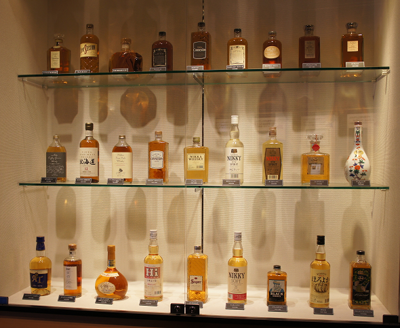
The different faces of Nikka
For visitors thinking of Yoichi, it is worth considering the summer is a slightly better time to go. More of the buildings involved in the whisky production are open during the warmer months, although the museum, bar, restaurant and several other locations are open year round. The museum contains information both in Japanese and English and the restaurant serves good food which is reasonably priced.
I was about half-way through my large plate of rice and sea urchin when I did pause to note that in the food at least, Yoichi was not Scotland.

Your lecturer is not in control of this situation
There are two events that send my delicately balanced work schedule into the realms of chaos.
The first is a deadline. The end of the semester is an excellent choice but an upcoming conference also makes a great substitute if the date isn't working with you.
The second is a brand new seminar. Preparing slides to lecture on a new topic (that is, one for which it's not possible to cannibalise previous talks) is immensely time consuming. An unkind person might suggest here that I tend towards perfectionism, but I rebuke this by pointing out pictures take on a whole new level of importance when your audience is pretending really hard not to speak English.
Also, I have an artistic vision and you're not allowed to mess with that, yo!
It is also a sad fact that people take pleasure, nay DELIGHT, in combining these events into one large chaos bomb.
[Note to self: must remind my students that their extended essay is due three days before their final exam.]
Such it was that the world found me awake at 2 am on the last day of my 33rd lap around the sun, putting together the last of my slides for that morning's seminar. The semester end loomed large at the end of the month which meant it was a golden moment for someone to suggest a guest lecture would be perfection in a 90 minute time slot.
But, not to worry! The slides were now drawn and all that was left to do was sort their order and animation flow. I went to bed.
For some entirely unexpected reason, getting up the next morning was a struggle. I was supposed to be in my Japanese class by 8:45 am, but with the homework undone, the test unrevised and my slides still requiring final touches, I took a management decision to cut my losses. And the class.
Even with this guilty concession, I found myself running late for the seminar. I sprinted across campus, tumbled into the lecture room and wished I'd had the foresight to tuck a bottle of water in my bag.
Two minutes later, I would have switched the bottle of water for remembering my laptop's power supply.
I had a spare plug in my office, but that was on the 9th floor of the building, whereas the seminar room was on the 4th. With a single elevator servicing all 11 floors, such excursions had to be carefully timetabled events.
But, not to worry! My battery was fully charged and would probably last through a presentation. Probably.
My first slide flashed up on the screen and I attempted to look like someone who had their life in order. I began to describe the use of computer simulations in astrophysics, relieved that my slides at least looked the part, even if the speaker looked as if she had a hedge as a close cousin.
I was on slide 3 when the next thought struck me:
My period had started.
But … not … to … worry… I focussed on the talk while I tried to plot a course of action.
"There are three main groups of astrophysicists: observers, instrument builders and theorists."
Could I apologise and run to the bathroom? No… I've not got any sanitary pads in my bag…
"One of the problems observers face is they can only see the Universe from one position; the Earth."
Maybe I could run upstairs to my office? No, it would take too long and I don't remember if I have anything there either….
"In reality, we cannot turn-off different physics. But in simulations, physics is like a giant toy box."
Definitely no time to go to the campus store… I'm wearing black trousers... that'll have to do.
This was the scientific equivalent of the thespian phrase: 'The show must go on'. And on it did go while I silently admitted the irony of such a pubescent mistake occurring the day before my 33rd birthday. To anyone who has had 'Young at Heart ' on replay around their birthdays, remember an eternally youthful mind comes at a price.
The seminar ended. Everyone applauded. I answered questions, calmly took my leave and … sprinted back to my apartment to throw myself, work bag and the cat who had appeared under my feet, into the bathroom.
"Why don't YOU get periods?" I demanded to the yellow-green eyes staring up at me.
"Meow."
You've gone mad. Will this affect my food supply?
Freshly clothed (the damage had been mercifully minimal but the day required a new front), I returned to campus and met with my graduate student. Cool, calm and collected; that's me.
"So, what mass are you finding for the star forming clouds?"
Adulthood: Same mistakes. More practised cover-up.

How a science institute got a castle: a short history of Ringberg
When Luitpold Emanuel Ludwig Maria, Duke in Bavaria, was orphaned the the age of 4, he was left a large amount of money and a desire to build a castle.
This doesn't strike me as remotely surprising since --had I been given a choice of abode at the age of 4-- I would also most certainly have picked a castle.
On the other hand, building a mediaeval castle in the early 20th century might be considered a little eccentric.
When building work began in 1914, the Duke was 24 and had plans to create the new family seat for his decedents. The personal importance of this project likely stemmed from the Duke's branch of the family being relatively young, beginning only at the start of the 1800s. Its creation was caused by a split in the Wittelsbach extended family with the purposeful desire to create a second, subsidiary family line. The main family were henceforth referred to as the 'Dukes OF Bavaria' while the new splinter group became the 'Dukes IN Bavaria'.
The resulting inferiority complex could have been the inspiration for the ancient castle theme, with the concept being that if the family seat looked mediaeval, people would be led to think that the family themselves had a similar depth of history.
However, the Duke forgot one key ingredient when creating a family heirloom; he never married nor sired any off-spring. Indeed, his family line failed entirely when his only other living relative, his cousin, Duke Ludwig Wilhelm, also failed to produce a child. Ludwig Wilhelm made a last ditch attempt to remedy this by adopting a boy from the other side of the family, Max of Bavaria. Duke Max is currently 76 years old and has 5 daughters. This sounds almost excessively prolific until the traditional primogeniture stance in the family is added into the calculation, which only allows boys to inherit, thereby discounting all of Duke Max's bedroom exertions.
Such a complete failing of the family line was rather spookily prophesied by a monk, who told the Duke's aunt, Queen Kaiserin (Empress) Elisabeth, that her line would die within 100 years; a forecast that is now most certainly to come true.
Ringberg castle, though, is not the story of one man, but two. While studying philosophy and the history of art at the Ludwig-Maximilian University in Munich, the Duke met Friedrich Attenhuber; an artist and interior designer. The pair travelled around Europe together, after which the Duke offered Attenhuber the job of personally designing every detail of the home he planned to build. For a man from a poor background, it was the chance of a lifetime. It was also the one that would ultimately lead to his death.
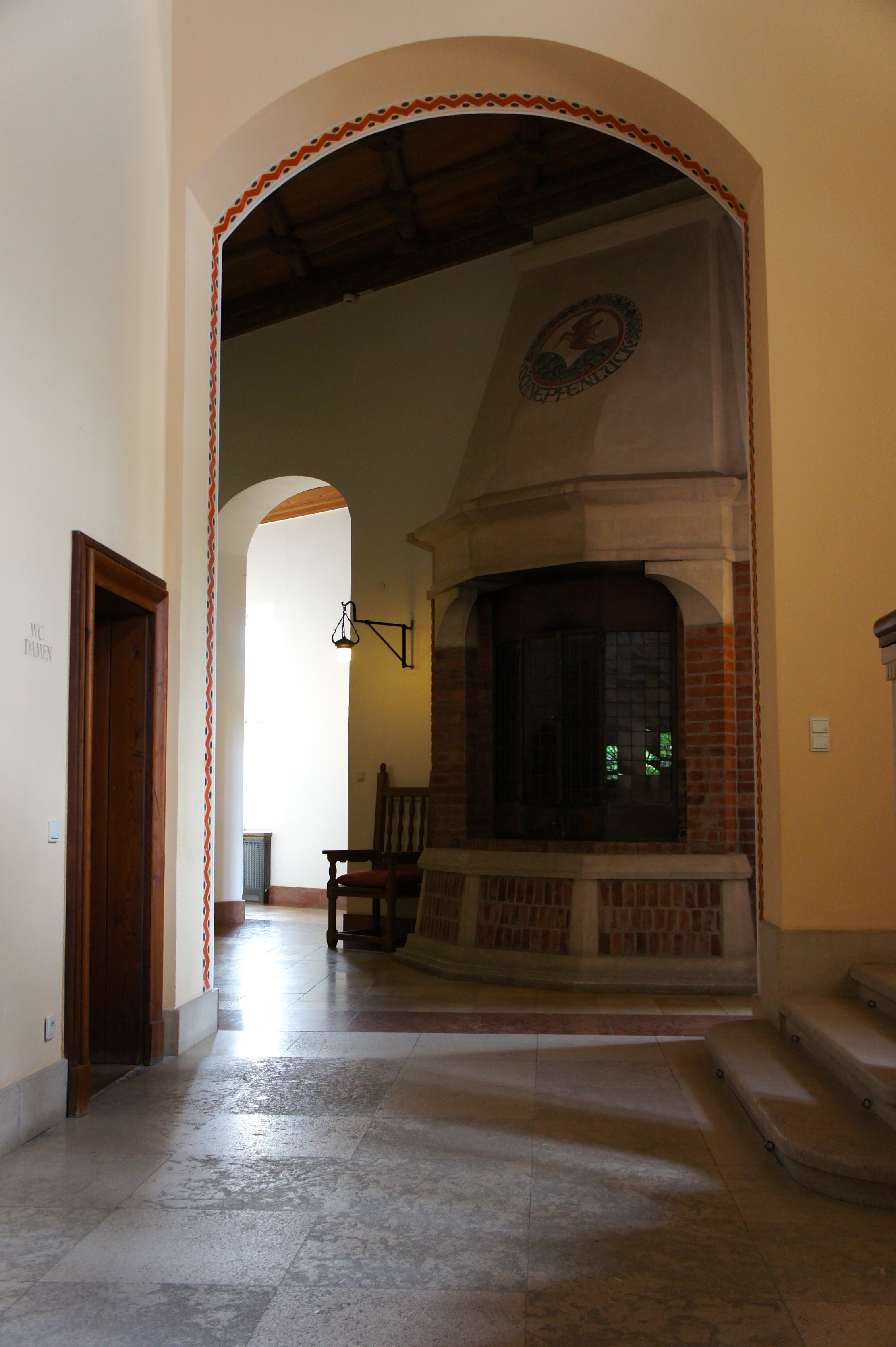
The main entrance and staircase, complete with the original wood burning furnace.
The construction of the castle continued for almost 60 years and was not even completed by the Duke's death in 1973. One of the reasons for such a prolonged building process was the indecision regarding the style of architecture. The Duke originally opted for a villa as the main house and the large painting in the castle hallway shows the Duke standing with his cousin in front of a single story version of the ultimate building. This then changed to a castle design, followed finally by the mediaeval bent. Even now, the castle is not one pure style throughout, but reflects the varied tastes of the Duke. Such alternations required as much deconstruction as construction and slowed the process down considerably.
Attenhuber's work as the designer stretched far beyond the formulation of room plans. His designs dictated every minute detail, from the custom made furniture, the lampshades and continued right down to the ash trays. What was more, every single painting in the castle was done by Attenhuber himself.
It is perhaps in the art work that Attenhuber's story begins to be revealed. Walking through the hallways, it would be easy to believe there were two independent artists employed, with markedly different styles. In fact, Attenhuber's work had two distinct periods; his impressionist time from 1904 - 1926 and his folk-style canvases from 1926 - 1947. The earlier impressionistic work is significantly superior and demonstrates Attenhuber's true gifts as a painter. Quite why he abandons this style is not certain, but it is likely to be to conform to the Duke's tastes.

An example of Attenhuber's second style of painting.
His later style of art has the unfortunate association of being favoured by the Nazis, where it was known as 'Blut und Boden' (Blood and Soil). The landscapes are based on real scenes and frequently depict peasants working the land with their own hands. Due to lack of money, Attenhuber's models were normally people from the local village, some of whom are still alive today. This political association was however coincidental, since the Duke had no Nazi affiliation; he simply liked the style.
As time continued, Attenhuber's relationship with the Duke deteriorated. At first, the Duke was the student and Attenhuber the teacher, but as the Duke became older, he began to instruct his old friend as to how he wanted the work done. His high handedness stretched to all the castle workers, who were forced to address him as 'Sir Highness' or risk losing their jobs. When the recession struck in the 1920s, the Duke stopped paying Attenhuber for his work altogether. His argument was that the currency was worthless, but Attenhuber would get his bed and board in the castle and his art supplies. If the castle was then later sold, Attenhuber would also get 10%. All in all, it was not the most promising deal, but Attenhuber accepted. The reason he accepted was that he had become a prisoner to his own work.
With every inch of the castle so intimately designed, Attenhuber's life project was tied up inside the stone walls. What was more, the isolated nature of the castle had meant that he had cut himself off from almost all outside contact. He had invested too much and now he was a prisoner.
In the winter of 1947, Friedrich Attenhuber climbed the castle tower and jumped to his death.
The Duke never stopped building even after his friend had gone and he died with grand extension plans sitting in his desk drawer.
As his time drew near and it was apparent there would have no family to inherit his work, the Duke looked for options for what to do with the castle. His first choice was to donate it to the closest village that sat at the bottom of the hill. They however refused, since a small settlement did not have the funds to maintain such a huge property. The Duke next offered the castle to the City of Munich who also rejected it, perhaps because they already had too many castles.
(I told them we already got one)
Next, the Duke tried to sell the castle. He acquired one buyer: the German Trade Union, but rejected them. Lastly, the Duke looked for a scientific organisation to whom he could donate his property and he offered it to the Max Planck Society. The institute heads at that time told the Duke they would be prepared to take the castle ... so long as he also bequeathed them all his cash.
Really, that must be up there as one of the best bargaining strategies of all time.
The Duke accepted and upon his death 1973, Germany's most prestigious science institute came to own a castle.
Yet, the story does not end there since the castle was not finished. The main building had no second floor, the tower was just a facade and there was no central heating. The castle was heated via ceramic wood stoves that still sit in each room. Visiting groups of scientists staying in the castle had to shovel the wood themselves to provide heat.
When you consider this, it was a small miracle the castle survived such an experience.
In 1980, the Max Planck met with a second piece of luck in the form of a large donation from a Munich insurance company to mark their jubilee. They donated 6 million deutsche mark (3 million euros) which was able to modernise the castle. 14 new guest rooms were built on the second floor, the tower was completed, central heating was installed and lecture rooms were added. The new work was completed in 1983, producing a conference centre that is now booked up for two years in advance.

The Duke (right) and his cousin, standing in front of the split dead tree that represents the end of their family line.
There was only one request the Munich insurance company placed on their donation; the painting of the Duke and his cousin in the hallway was too ugly and had to be covered. They paid for a tapestry to be hung over the image. While millions of deutsche marks tend to call the shots, the Max Planck was never happy with this situation. The Duke had been their principal benefactor and it seemed wrong that his portrait should be hidden. During an open day at the castle, the tapestry was removed for cleaning...
… and no one will confess to remembering where it was sent.
The painting now stands uncovered as a central piece. It is indeed quite ugly, but since there is a room down the hallway with a theme of witch paintings, it does not seem particularly inappropriate.
The popularity of the castle is essential for its continuing upkeep. Situated at an altitude of 1000m in the Alps, the castle burns 100,000 litres of oil per year. In addition, it is a modern historical monument, meaning the Max Planck are legally obliged to keep it in its current condition. This means that the wooden shingles on the roofs must be replaced every 15 - 20 years, at a cost of 150,000 - 200,000 euros each time. Energy saving is also a challenge, with the older first floor windows being made of thin glass.

The castle cat
That all said, the castle is an incredible heritage and I for one, was staggered to be able to attend a conference there and sleep in an ornate wooden bed.
THIS IS WHY I WENT INTO ASTROPHYSICS! TO BE A PRINCESS LIVING IN A CASTLE.
Although I admit, the route to that goal was a little unconventional but I never really fancied marrying into Royalty.
(Many thanks to Jochen Essl and Max Planck Society for the tour of the castle that provided the information for this post)
A comedy of (minor) errors
"Taxis don't go to Ringberg castle. And there are no taxis."
It was proving to be an extremely long day, and it was only just after lunch. Admittedly the day had started at 5 am, when I had risen with the rather modest aim of traveling from Amsterdam to the Bavarian town of Tegernsee, which is nestled around the shore of a lake with the same name. Overlooking the lake is Ringberg Castle, the conference facility belonging to Germany's world class research institute, the Max Planck Society.
I really feel people should sell science as a career more in terms of the possibility you might get given a castle.
The journey to Ringberg should have been straightforward enough:
Step 1: Go to Amsterdam airport.
Step 2: Fly to Munich.
Step 3: Take a train to Tegernsee.
Step 4: Take a taxi up to the castle.
Step 5: Rescue the princess.
It was perhaps an indication of the events to pass when the bus to the train station from which I'd connect to the airport did not show up. Standing in the pouring rain, my friend and I studied the empty road in the grey dawn. It was empty. And grey. And wet. And still empty.
We called a taxi.
Fortunately, since the bus times had not been frequent even had they corresponded to buses, we had made a generously early start. It was sufficient for me to still reach Amsterdam Centraal station, buy a chai tea latte from an open Starbucks and appreciate that this historic European city was full of drunken pot heads at 6 am.
"Hey man, I'm in Amsterdam! What happens now? … what do you mean you're not up?" This particular mobile phone conversation had a similar tone to my morning, except I rather suspected I would be the only one of us able to reminisce about it later.
Once at airport, I checked in, printed my boarding pass and headed through security.
"Please remove your laptop, camera and all chargers."
Camera? Chargers? Normally, airport security only requires your laptop to be removed from your case to sail through the x-ray scanner in its own personal tray. Anything smaller, including tablets, e-readers and game consoles can remain in your bag. Amsterdam, however, had decided there was nothing more suspicious on Earth than an electric plug. This was particularly unfortunate since I had been far more liberal with the quantity of electronics I had packed than I had with my clothing. I had also put each adapter into one of the mini zipped pockets that decorated the outside of my backpack.
A great deal of zipping and one large spidery tangle of bomb-free wires later, and I was scuttling towards my gate, stopping only briefly to buy a bottle of water from a convenience store:
"Is that to drink on the plane?" The cashier confirmed as I approached the till. "They won't let you take it onboard."
Even though it was bought it after I'd come through security? Amsterdam were having a highly suspicious 2013. I thanked the shop keeper for the warning as I abandoned my ideas of rehydration and slumped off to the aeroplane feeling peeved.
Munich airport was full of promise. I bought a train ticket to take me through to Tegernsee and was even sold a bottle of water without any dire warnings about its imminent confiscation. It was a time of light and hope and not even the fact that I needed to board the train at 'platform 2' when the choice was 'platform A' or 'platform B' could dampen my mood.
Then I disembarked at the wrong station and missed my connection.
Sadly, this was really all my fault but in my defence, the conference website had said I would change trains at Munich Central Station (a logical central hub) instead of where my ticket specified, "Munich Donnersbergerbrucke" (an illogical backwater of a platform). When I reached Donnersbergerbrucke, I discovered not only was the next train not for another 50 minutes, but the entire surrounding area was completely devoid of public restrooms and packed with glossy windowed office buildings that made squatting behind a tree too risky a venture for non-exhibitionists.
Ignoring all calls of nature, I finally got on the right train … to be told it was the wrong train.
The ticket inspector's hand gestures suggested I was on a train heading the wrong direction; a surprising statement since I thought I'd checked the destination before boarding. However, I dutifully rose to exit at the next stop, whereupon train announcements came through both in German and English. This was lucky, since I would never have deduced the true problem:
It wasn't that the train wasn't going to Tegernsee, it was that my carriage wasn't going to Tegernsee.
The train was about to split into three parts, all of which headed down different forks in the train lines. What I actually had to do was to hop out of my carriage and head to the back of the train to the section that was indeed heading to my desired destination.

Tegernsee --presuming you find the right carriage to reach it-- is beautiful. It is a small lake-side tourist town surrounding by alpine mountains. The buildings are in a similar style to Swiss Chalets and hang heavy with window boxed flowers while many of the shop assistants dress in the traditional Bavarian dirndl.
The weather was warm and sunny, so rather than waiting for a taxi at the station, I drifted down through the town and stopped to eat the sandwiches I'd packed by the lake front. Little did I know that this lackadaisical approach to conference attending would see me fighting to reach the castle at all.
Approaching the far edge of the town, I called in at the tourist information office and told the woman behind the desk of my desire to go up to Ringberg Castle by taxi.
"Ringberg Castle is up there," she told me, pointing as a beige smudge on the hillside. "But taxis do not go to Ringberg Castle and you cannot go on a tour."
"I'm not touring," I explained. "I have a meeting there. I was told I could get a taxi?"
"It's not old." The woman's tone clearly implied that she thought my meeting story a barefaced lie. Clearly, I had to be dissuaded from my trespassing schemes before she was labelled as an accomplice.
"Nevertheless….," I replied with cheerful persistence. "I do need to go there."
"Today?"
"Today."
A map was produced that showed the town and the road out to the castle. "You can take a taxi or bus to here." The woman pointed to where the main road forked to become a winding path up the hillside. "Then you will have to walk. It is at least 20 minutes."
This time I was the one looking doubtful. If we'd have to walk up the hill, the conference website surely would have mentioned it and suggested suitcases were for pansies. Still, I had only hand luggage and this wasn't really an area in which I could back down.
"Do you want me to call a taxi?"
"Yes please," I replied.
The woman picked up the phone and dialled. After a moment or two, she replaced the handset. "There are no taxis."
"I'll head back to the station," I suggested.
"Taxis are not always at the station. They only sometimes come when there are trains."
The message from this lady was persistently clear: ONE DOES NOT SIMPLY WALK INTO RINGBERG.
"I can wait at the station," I persevered. "There will be many people coming to this meeting, so I'll probably be able to meet up with them."
At this, the information centre lady looked positively alarmed. There would be MORE people wanting to take taxies to the forbidden castle? But it was forbidden!
"You are alone now?"
I nodded. The woman then made a fast decision; send this midget up first and Ringberg can prepare. They were a castle, they probably had cannons if necessary. She tried the phone again and then looked up a different number. This time she met with more success.
"The taxi will meet you outside in 10 minutes."
I thanked her and left, feeling more anxious than victorious. Had I misunderstood the instructions? Was there a town with a similar name to Tegernsee with an equally similar sounding castle that more readily took in astrophysicists?
MARIO, WAS THE PRINCESS IN ANOTHER CASTLE?
Possibly, I was about to spend a very cold night outside a castle that no one was allowed to enter.
It was somewhat apprehensively that I got into the taxi that showed up and asked him to take me to Ringberg. My driver however, was completely unphased and, in apparent flagrant disregard for all the warnings the tourist office lady had issued, drove me right up to the castle's heavy front door.
Whereupon I recognised another conference guest attempting to break in. This wasn't a trivial undertaking since castles were generally designed to withstand such attempts, especially by rogue scientists clutching suitcases. Fortunately, by the time I'd paid my bold driver, a second route involving a doorbell had been attempted and we were let inside, given keys and promised sandwiches at six.

You have gained entry to the stronghold and completed level 1. Press any key to advance to level 2.
My bedroom has a Narnia-style wardrobe, an old wood burning ceramic heater and four poster bed with a roof.
Mario, the princess is now totally in this castle.
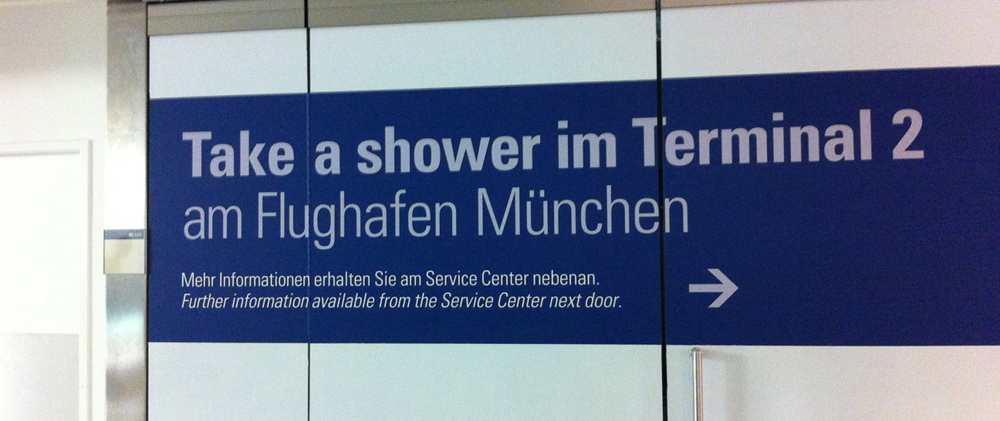
Oddly, the first sentence on this poster seems to be in a crazy mix of German and English. The prospect was just too clean for one language.
I strip off in the airport
I was sitting by the departures gate at Munich airport where 20 minutes earlier, I had been butt naked.
OK, perhaps I hadn't quite been sitting on the linoleum covered chairs in my birthday suit, but I had only been around the corner.
My flight over to Germany from Japan had been uneventful, with the singular exception of the quantity of dry Asahi beer cans the elderly Japanese lady seated next to me managed to consume. She also appeared to have zero ill effects from this venture, talking non-stop to her friend for the entire 12 hours and only rising to use the bathroom twice. I'm pretty sure than in an anime show, this would have been warm-up act to introducing the lead villain. I left the aeroplane directly.
… And ran into three signs all telling me to take a shower.
Supposedly aimed at business men attending meetings directly after long-haul flights, Terminal 2 in Munich Airport has installed showers. For 15 euros and a 20 euro deposit, you get access to one of 6 bathrooms with shower, towels and soap as well as the usual toilet and washbasin.
Was this a premium rate for a fairly basic service? Yes.
Did I go there largely for the novelty value? Absolutely.
Although to be fair, I probably stank too; if not of travel sweat, then of second hand beer fumes.
The transaction of money for bathroom key was conducted with the austere German efficiency that makes you think you've agreed a contract for life insurance as opposed to a quick freshen up. I signed the appropriate form, handed over the pool of Euros I'd discovered in my desk drawer than morning and followed the signs around the corner. En-route, two more posters assured me I'd made the right choice. I avoided eye contact with my fellow passengers incase they did the same.
The bathroom itself was a basic but functional affair. There was a neat pile of white towels and a single soap dispenser that produced an all-in-one mix for body and hair. I briefly thought longingly of the Japanese hotels and onsen with their bathrobes and large containers of body wash, shampoo and conditioner. But on the other hand, I did have privacy; the equivalent in Japan would undoubtedly have been a communal pool of hot water in the centre of the departures lounge.
Scrubbed clean, I stepped clear of the shower and eyed the clothes I'd dropped artistically in the corner. Since I had my luggage with me, it would be quite easy to don fresh garments, but I'd counted everything out carefully with the assumption that I'd simply degrade into 'hobo-fresh' on Thursday. Admittedly, I'd also almost forgotten to pack trousers but I see that not so much as poor planning, but an admirable desire for my upcoming conference talk to be memorable.
Somewhat ironically, this wouldn't have been a problem had I been 7. Throughout my childhood, I painstakingly packed undergarments for every day I was to be away followed by a 'spare pair in case of accidents'. As I got older, my parents found this more and more amusing, possibly due to my encouragement that they show the same care when preparing a suitcase. Clearly, however, I was planning for the day when I'd wish to spontaneously take a shower at the airport. Sadly this helpful tendency had been squashed out of me, so I shook out my clothes and put them back on.
While admittedly I used these showers largely to tick ' stripping off in an airport ' off my bucket list, I do now see the attraction for business men. Aside from the basic hygiene improvement after a long flight, I felt awake, refreshed and free from the headache that typically develops after sitting in dry air for so long.
So my advice after a long haul flight? Get your kit off.
Should you throw a million kittens into a river to save one baby?
"My husband saw your article on Japan Today."
This rather surprising remark came from my pet sitter, who had written to confirm the dates she was looking after Tallis while I was away. It was a surprising because, to the best of my knowledge, I had not written for that particular online publication. My first assumption was that there had been a mistake; either the article in question had been authored by someone of similar name or had actually been published elsewhere. I was half-way composing my fervent denial when I thought...

… I'll just google that.
Whereupon, I struck upon an article written by myself in Japan Today from which stemmed 51 exciting comments of abuse.
The article in question had been originally published on GaijinPot, a website for foreigners living in Japan with a blog section for which I am (knowingly) a regularly contributor. Japan Today had republished my post, admittedly with full credit to myself, on their own site. My feeling about this move were divided:
On the one hand, I wasn't sure that publishing an article without the author's express permission (or indeed, knowledge) was legal. At the very least, it wasn't good form. Yet conversely, my work now appeared on a much bigger website and I wouldn't really want to stop this happening again.
I suddenly understood why my cat sometimes only half-inflates her fur: it's the cross-roads of indecision. Is this a scene of indignant anger or one of fun timez?
Unsure how to react, I emailed the editor of Japan Today and expressed my surprise that I had not been contacted. I received a reply almost instantly, apologising for any inconvenience and explaining that Japan Today and GaijinPot were part of the same company and regularly share content. GaijinPot also replied to my tweet of distress and offered to remove the article from Japan Today if I was unhappy.
I had a cup of tea.
After which I concluded that overall, it was a net win and simply asked to be notified in future. Then I read the comments to my post.
Kids, don't try this at home.
If you're tempted to read comments to an article, I recommend first signing up to AvoidComments on twitter which will periodically send you helpful reminders such as 'If someone told you the internet had hemorrhoids, would you want to look at those, too?'
I should say up front that had I chosen an article for Japan Today, it wouldn't have been this one. Originally from my personal blog, it was the story of my flight from Toronto to Tokyo with my cat and contained phrases that I knew could be trigger points in a public forum.
In particular, I express mock outrage that my cat was thought to be a dog when we passed through security and remark that it's highly surprising that people don't discuss throwing screaming babies out of planes.
Obviously, both the above are not designed to be serious; it wouldn't be possible to tell the type of animal I had in my pet carrier and aeroplane windows don't open.
In fact, such concerns had caused me hesitate before submitting the post in its (almost) original form to GaijinPot, but I had decided it was worth the experiment for the sake of humour. I had already written a few articles for the site, read posts containing similar material and hoped regular readers would give me the benefit of the doubt in the region of homicidal tendencies. They unanimously did but the readers of Japan Today were divided: was I a fun-loving cat owner or a neurotic baby-killing narcissist?
To be honest, the answer largely depends on which stage of the research publication process I'm currently dealing with at work.
The Japan Today comment debate came down to a few juicy points fought out between a handful of people. In reverse order of entertainment, I present the questions and my opinion:
- Should pets be allowed in the aeroplane cabin at all?
This debate actually had nothing to do with my article since I had no control over Air Canada's rules regarding pet transportation. I also do not suffer from asthma, so I'm also unable to comment as to whether pets in an aircraft with circulated air is a big problem. I would guess that the restriction on pet number and the offer to sit allergic passengers away from the animals would be sufficient, otherwise more restrictions would exist. If that actually isn't enough, as a pet owner I'd be perfectly happy with a compromise that only allowed pets on one flight per week. Moving with my cat required a huge amount of planning, so restricting the flight I would be able to take would be a minimal inconvenience.
(@AvoidComments: We like to think that we're smarter than dolphins, but no dolphin has ever bothered to read online comments.) - Did I care about my cat at all or was I flying just for the fun of the experience and blog post?
Now I have to admit, the thought of writing a blog post allows me to brave many an experience from which I might have otherwise fled. However, I am sorry to confess my passion for writing has yet to reach the stage where I engage in an 8 month long, $1000 initiative just for entertainment. Seriously people, they have cats in Japan too. If I were indifferent to which furry critter decked my apartment, I would have hot swapped them over.
(@AvoidComments: Tempers flare and break / Winning move is not to play / Don't read the comments) - Should you throw a million kittens into a river to save one baby?
I am proud to say my blog post initiated this serious ethical debate. However, as one commenter revealed, it is just not possible to make this call without more information: "Do the kittens have a fatal disease communicable to humans? They should be put to sleep soon. Is the baby Adolf Hitler? That might give me pause." You see? Kittens and babies are cute but cats are frequently more cute than adults. The situation is complex.
Linked with this was a second question: Are all animal lovers people haters?
Now I have to say the answer before I started reading the comments was a resounding 'no'. However, by the time we were on comment 51, it was decidedly more debatable.
(@AvoidComments: "It was the worst of times." -- Charles Dickens, if he'd read internet comments)
Since these comments were largely poorly reasoned and nonsensical (being a physicist is awesome both for your ego and Vulcan roleplay) , I was more amused than perturbed. However, they did raise the warning flag of the pitfalls of being a public writer.
To date, my experience with negative reactions to my writing has been limited. This is largely because my main blog audience are my friends (who have no qualms about handing me their off-spring and so therefore presumably trust me or regret parenthood) or regular readers who understand my humour. Moving onto a more public site has the dual effect of positive comments being like prozac and negative comments tearing me between desires of laughing and wanting to bite someone. While I would have chosen to write a different post for Japan Today, it's unlikely I will always avoid every trigger point. It's a roller coaster of excitement. I may need to order in more tea.
Also, if anyone approaches me and tells me their name is 'Maria' or 'Cleo' and they read Japan Today, I'm buying them lunch.
The loneliest students
This morning I was late for my Japanese class.
Admittedly, it was not by much: My class started at 8:45 am and I arrived in the foyer of the International Student Centre a few minutes later. However, it was enough to find the tables and comfy chairs that decked the lobby area completely devoid of student loafers. Since the day had already become warm, I paused briefly at a drinks machine to buy a bottle of water.

Drinks machines are everywhere. Everywhere.
One great thing about Japan: there are always drinks machines. Everywhere.
I then turned about and zipped up the stairs to the third floor. I had only walked a few steps towards my classroom when another student intercepted me in the hallway.
"You're in 'Kanji II'?" he confirmed. "There's no one there."
No one? I glanced in the nearest classroom. It was packed full of students staring somewhat desultory at the papers being handed to them by their teacher. It reminded me that we too, were due to get our mid-term results back that day. It also told me that today was not intentionally a holiday. Walking down to our classroom door I stuck my head inside and confirmed what I had just been informed; it was as barren as an open invite party entitled '101 photos of my gangrenous toe nails'.
"Was our lesson cancelled?" I asked uncertainly. I didn't remember this being previously mentioned but that didn't necessary preclude the possibility; our classes are conducted purely in Japanese and my verbal skills can be politely referred to as 'rudimentary'. By now, the class should have started about 10 minutes ago so someone ought to have turned up.
"Maybe our mid-terms were so bad..." I began. "That everyone knew it would be better to never come here again."
Denial. This class never existed. No one was ever taught any Kanji characters. If you're in doubt of that fact, there is proof somewhere in the staffroom.
Just as I was about to suggest we went back down to the lobby and checked the notice board, our teacher appeared striding down the hall way towards us. She looked at her two lonely waifs and then in at the empty classroom.
"Eh?"
Then the doors of the elevator slid open, revealing our entire class.
Everyone had arrived late.
Everyone.
At the same time.
The chances of that happening are disturbingly low. I'm declaring it a conspiracy aimed at creeping me out. It won't work. My mid-term result was fine and I'm staying with all you people no matter how long you choose to hide in elevators.

Vegetarian without bacon: Surprise! A restaurant review
"Does this pasta contain meat?"
"It doesn't contain meat," the cheerful the restaurant waitress assured us. "Only bacon."
Visitors to Japan who are vegetarian face two problems: that of language and that of culture. The former consists of the usual difficulty in making yourself understood in an unfamiliar tongue. Meanwhile, the latter exacerbates the problem by not guaranteeing your culinary desires will be understood, even if your words are.
At first glance, it may seem counter intuitive that vegetarian eating would be a struggle in Japan, where so many products are soy-based. It is certainly true that items such as tofu and natto are popular, but with no purposeful intention to remove meat, both are frequently cooked with unsuitable stock. Those who cannot overlook these small additions and also remove fish from their diet face a battle to eat with confidence away from home.
I am fortunate enough to eat both meat and fish and suffer from only amusing --rather than health destroying-- allergies. As a result, my 'point n' smile' approach to food ordering stood me in good stead until I became friends with a strict vegetarian. The above conversation is not remotely atypical for a trip out of town and results in me frequently having to choose between companionship ...
… or dinner.
This is not the choice of champions.
Given this rarity of vegetarianism in Japan, it was therefore a surprise to find 'Aoi Sora'; an organic vegan restaurant in Sapporo. Offering lunch plates at around 1000 yen (about $10 or £6.50), Aoi Sora is reasonably priced as well as offering dishes devoid of all animal products.
It is also amazingly tasty. Perhaps I shouldn't have been surprised, but Hokkaido is famous for its seafood in a country obsessed with seafood, so my standards for a tasty meal have sky rocketed since moving here. The brown rice in particular was full of flavour.
Yes. The brown rice. And before you think I'm crazy, I found this other blog where the person also waxes lyrical about them wholesome grains.
The restaurant is small, containing a large communal table, a handful of small tables and a window-side bar. The menu is presented on a chalk board and consists of one daily lunch and three smaller alternatives. It is written only in Japanese, but being organic vegan food, my usual 'point n' smile' ordering system just became a whole lot safer.
For a home-made style Japanese cuisine, I'd genially recommend this place even to the non-vegetarian. It may become a regular spot for me and if myself and my vegetarian friend go elsewhere ... well, I may buy her a bento box to fill in advance.

--
Aoi Sora Organic Cafe
Chuo Ward, Minami 1 Jonishi, 22-1-7
Sapporo 064-0801
011-623-3887